Tag: Seniors Week

Barry: A highlight of my week

For Seniors Week 2026, we asked some of our over-70 volunteers to tell us about their experience with us. There is no age limit to ethics volunteering – we have volunteers in their late 80s. At 73, Barry Richardson is in his eighth year of volunteering with Primary Ethics.

Barry’s experience

Eight years ago, I was transitioning to retirement, moving from a five-day working week to three days. I saw an advert for ethics teachers in our local community Gazette, teaching at our local primary school, Artarmon, which my now very grown-up children had attended many years ago. What a great way to give something back to our wonderful community.

I thoroughly enjoyed the training and meeting an eclectic group of people of varying ages, backgrounds, experience and interests.  The training introduced me to some great new skillsets.

My first ethics lessons were exciting, sometimes challenging, but always fun.  It was like going back to school myself, with all that that brings.

I have been lucky enough to teach all ages and stages, at one time taking three classes a day.  I’ve met some wonderful other volunteer teachers from our local area, as well as the school staff.  It is both enjoyable and rewarding to be involved with young, active minds engaged in critical thinking and to learn about respectful discussion.

Without doubt, my classes have been a highlight of my week.

Barry

I am now retired and have moved to the inner west, where I have transitioned to teaching ethics at the local high school.  More challenges, but always fun and certainly rewarding.

I also relief teach at the local primary school which three of my grandchildren attend or have attended.  Having moved to a new area after 40 years in Artarmon, ethics volunteering has been a great way to meet many people in the community through the local school.

You’re never too old to be an ethics teacher!
Paul: In touch with the rising generation

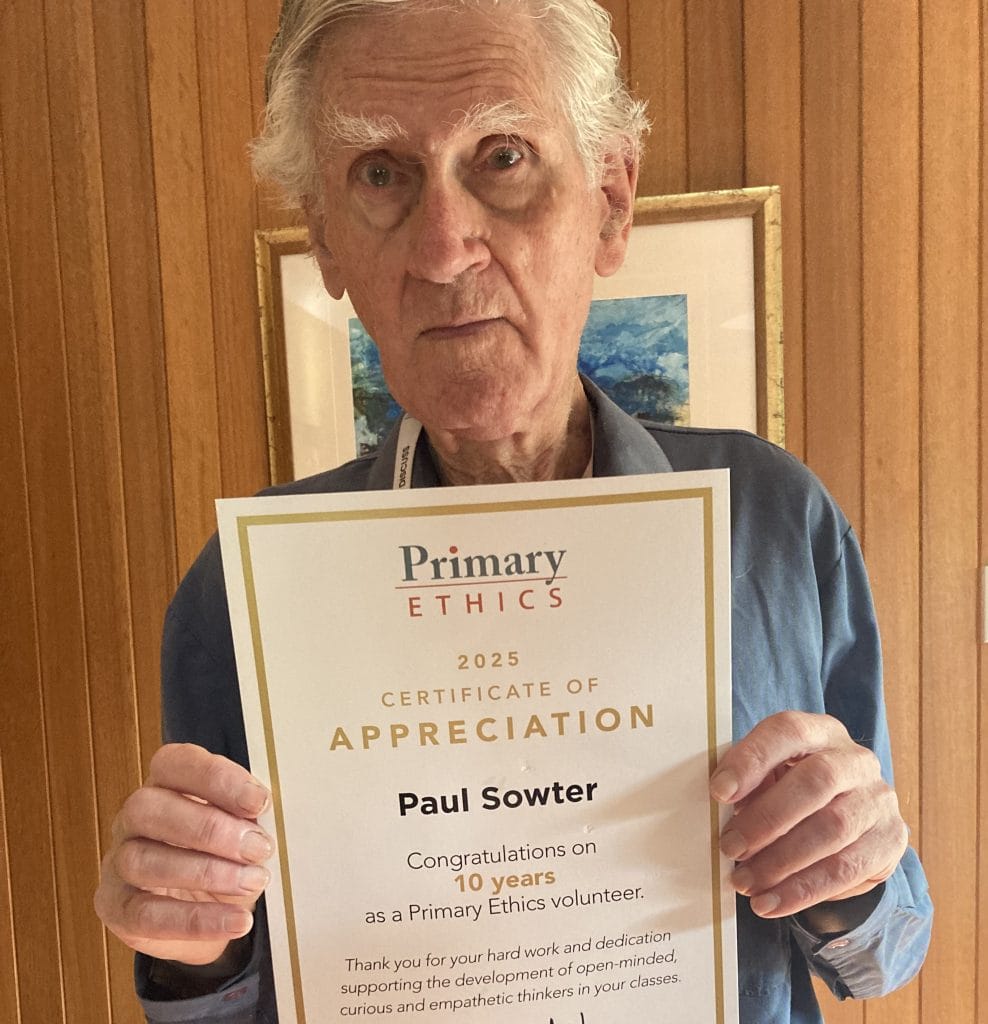
For Seniors Week 2026, we asked some of our over-70 volunteers to tell us about their experience with us. There is no age limit to ethics volunteering. At 88, Paul Sowter is in his eleventh year of volunteering with Primary Ethics.

Paul’s experience

When I retired from casual teaching at age 75, my son alerted me to the existence of Primary Ethics. I enquired, did the training and suddenly I was a teacher of ethics at Normanhurst West Public School, on Sydney’s far north shore.

As a former schoolteacher, I was impressed by the approach: everyone in a circle, kids do the talking but only if they want to. What a safe haven for the shy! The feedback in that most valuable end-of-year lesson revealed the benefits students draw from the experience, particularly in personal growth.

And I found this: whichever stage I taught over the next 10 years in various schools. Primary Ethics keeps me in touch with the rising generation – their innocence and awareness of so many things about the world is a delight to observe. The lesson material, especially for stage 3, can be challenging – you can see it in their faces. And they respond, slowly, feeling their way, listening intently to what their peers are saying, building on the previous contributions.

I have also seen the courses themselves develop over the years. And yes, old as I now am, I too have developed. I only wish I could have applied what I’ve learnt from teaching ethics in my former career.

As my hearing worsens with advancing age, soft voices can be a challenge. I am now employing an app on my iphone to improve my reception through airpods. The kids like being the monitor who delivers the iphone to the chosen speaker!

Over the years I have developed my IT skills with frequent assistance from the wonderful helpdesk. I delight in the material from Kindergarten to stage 3, often taking me off into further study

Whenever I meet someone for the first time I unashamedly steer the conversation towards Primary Ethics. No one has ever disapproved. All express an interest.

At the time of writing, March 2026, the topic my stage 1 class is exploring is pride. The photo of me above shows my pride in my endeavours.

The photo to the right is not my class. It is the instinctive formation of a troop of gorillas when they realise their leader is dead.

William: Ethics volunteering is meaningful, valuable and satisfying

For Seniors Week 2026, we asked some of our over-70 volunteers to tell us about their experience with us. There is no age limit to ethics volunteering – our oldest volunteer is currently 88. At 81, William Rodwell is in his ninth year of volunteering with Primary Ethics.

William’s experience

As an 81-year-old, I think it very worthwhile to let my fellow seniors into a secret. For those of you with an inquiring mind and an interest in our grandchildren’s and hence our society’s future, there is something for you that’s even better than the events of the NSW Seniors Festival. And you can enjoy it every week! That’s being a volunteer ethics teacher in a NSW school.  I am now in my ninth year of volunteering and it is undoubtedly my most rewarding weekly activity.

My proximate motivation for volunteering to teach ethics was to ensure that my grandsons had access to the Primary Ethics programme at their primary school. To me it also felt important to find a way to contribute to society after I was no longer doing that through work. The ethics programme provided a meaningful and valuable way to do so.  My grandsons are now well beyond primary school but teaching ethics is so satisfying that I continue to teach at their former school and now also at other schools.

We volunteer ethics teachers believe that the Primary Ethics curriculum provides a unique opportunity for school students.  It develops their moral sensibilities, including the capacity to empathise with others, consider other peoples’ points of view, be aware of the relevance of intentions and circumstances to ethical decisions, and so on.  The emphasis on the students providing reasoned arguments for their ethical standpoints also develops their capacity for critical thinking.  To me critical thinking is as valuable as the ethics component, as it is especially important in this age of false information – it provides students with the tools to distinguish specious arguments from valid ones.  The structure of our lessons as collaborative enquiry also develops the students’ ability to work together to reach a collective understanding of the ethical issues under discussion.  Importantly this does not mean they have to agree with each other, but they should understand other students’ points of view, which is so important in our contemporary polarised society.

The most consistent advice I see given to seniors to maximise health and wellbeing is to maintain their social engagement and mental stimulation.

Being a volunteer ethics teacher provides both. The kids’ openness to ideas, joie de vie and capacity to think seriously about quite demanding concepts is a joy to behold.  I think this interaction with children and seeing the value of the ethics program for students is very rewarding.  In addition, I find the syllabus we teach stimulating and thought-provoking for me, which adds to my enjoyment of the role and has contributed to my own philosophical development.

Moreover, the social engagement does not end with the students.  A group of people prepared to contribute their time to teaching ethics – ie the other volunteers at my schools – constitutes a lovely, supportive and interesting community.  As an old person it’s a treat to be involved in a group covering an age range from parents of Kindy children to long-retired persons like me.  Who wants to be confined to old peoples’ groups where the conversation inevitably turns to ailments, infirmities and funerals?  Not me!

When I suggest to retired people that they would enjoy becoming a Primary Ethics teacher they often say something like “I could never manage a group of primary school kids; it’s too daunting”.  I was also anxious about this at first.  I had been volunteering in several roles at my grandsons’ school, so I knew I enjoyed interacting with the pupils, but that’s not the same thing as controlling a class.  However, the students are not generally little demons itching to cause trouble – most are delightful. In addition, in most primary schools a regular teacher sits in the class to help with any behaviour management issues.  They don’t contribute to the teaching itself, but their mere presence is enough in most cases to ensure that the class behaves and they are there to help if some students don’t behave.

My only regret about embarking on volunteer ethics teaching is that my personal circumstances prevented me from becoming involved earlier!

William

Diana: Investing in future generations

For Seniors Week 2026, we asked some of our over-70 volunteers to tell us about their experience as ethics volunteers. There is no age limit to ethics volunteering – our oldest volunteer is currently 88. In her mid-70s, Diana Dagg is in her seventh year of volunteering with Primary Ethics.

Diana’s experience

I was drawn to this role because teaching ethics offered the chance to teach my grandchildren. Over the years I’ve taught ethics to two grandchildren at Arncliffe Public School (they’re now at high school) and currently two grandchildren at Marrickville West Public. But I discovered early on that this is much more than simply having an opportunity to spend time with my grandchildren.

Before I list the many benefits, it must be noted that ethics teaching is not just a cushy volunteering job. Without being too dramatic, becoming an ethics teacher is an investment of our time, our expertise and our belief in the importance of contributing to future generations.

To do the job properly, we as volunteers need to commit to preparing well for lessons, taking the time to learn our students’ names and to understand any of their particular needs. We must also be willing to ask for and accept advice from trainers and schoolteachers. There are lots of opportunities for continuous learning within the ethics teaching technique.

We don’t need to have been teachers before becoming ethics teachers. In fact, friends of mine who were schoolteachers before becoming ethics volunteers say they had to ‘unlearn’ the traditional teaching practice of rewarding ‘correct’ answers. This ethics teaching role is about helping our young students develop approaches to thinking for themselves.

Above all, to be authentic, we as volunteer ethics teachers must value and want to understand children.

Spending this teaching time with my grandchildren each week is rich with potential, including:

  • Hearing their opinions about issues that affect them
  • Meeting and hearing the opinions of their classmates as a group
  • Providing an intersection point for conversations with them outside of ethics
  • Meeting their teachers and understanding the school ‘culture’.

My relationship with my grandchildren has been strengthened by my ethics teaching role because:

  • we confidentially discuss (and I get to hear) what questions matter to them in our ethics class
  • their friends like and respect me as an ethics teacher using our humanitarian rules in class – that earns me points as a nanny!

There are many great things about this role apart from the strengthened bond with my grandchildren:

  • I have the opportunity to meet and work with students with disabilities, to help them learn
  • I have greater insight into the challenges teachers face each day
  • I’ve enjoyed some fun lunches and morning teas, sharing war stories with other ethics teachers.
  • I’m proud to be investing in future generations through rigorous teaching practice and a thoroughly researched ethics curriculum which reflects values similar to my own.

Are there rewards/benefits that I wasn’t expecting?

Hmm, probably it’s the opportunity to understand the needs of students with disabilities and to be mightily impressed by the skilled teachers who work with them. Also, the satisfaction of managing challenging situations well.

Any concerns about dealing with technology (EVIE) or coping with things like hearing impairment?

It’s been fine to use the technology but if there are problems, I know I can turn to the very helpful Primary Ethics staff on the Helpdesk or my ethics coordinator and/or school admin or teaching staff. I already have hearing aids (yikes!) so no probs with hearing in my classes.