Archives

Philosopher AC Grayling: Critical thinking for kids

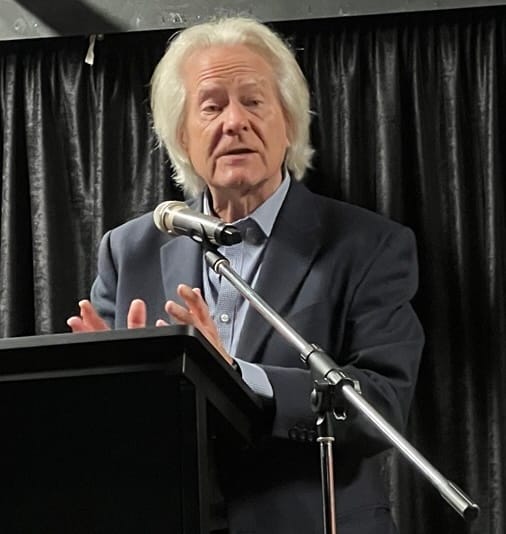
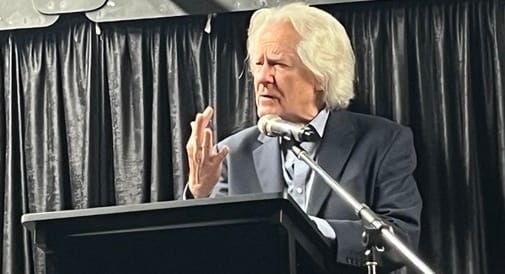
Prominent British philosopher Professor AC Grayling is in Australia to talk about the future of democracy and the future of truth in the upcoming Sydney Writers Festival. Professor Grayling’s niece Catherine is an ethics teacher at her children’s school, Dulwich Hill Public School in inner-west Sydney. We were delighted when Catherine, in collaboration with the school and with Primary Ethics, invited her uncle to address an audience of parents, children and ethics volunteers and supporters at the school one afternoon last week. The subject was children and critical thinking. A huge thunderstorm punctuated the event but the audience was held by an amusing but serious and stimulating talk. But first, Professor Grayling was introduced by some young students who told us what they especially value about ethics.

Thoughts from a Year 5 student

Eli from Year 5 had this to say about ethics: “I think these classes give us some really important skills. Usually, Catherine our ethics teacher gives us a dilemma and draws out our different opinions. She asks us whether our views change with new information. She teaches us to listen to what other people have to say, even if we don’t agree with them – because that helps us make our ideas better or more nuanced. Sometimes it can be hard to listen to someone you don’t agree with or when you think they’re wrong. But when you do listen, sometimes you learn something you didn’t know or hadn’t thought of, or in working out why you don’t agree with them, it strengthens your own reasoning. … Understanding competing interests can be a very powerful tool, as can developing advocacy skills. Both are proving quite handy with my parents.”
Ethics and morality

Then Professor Grayling spoke, first about the origins and meanings of two terms that are often used interchangeably, but benefit from a clear distinction. Ethics derives from the Greek word ethos, meaning character, disposition or way of being. He described it as relating to the philosophical inquiry into how one should live. Not in the sense of prescribing answers, but in examining and reasoning about them. In that sense, ethics is concerned with the process of forming character, of becoming a certain kind of person and thinker, with certain values.

Morality comes from the Latin mores, meaning customs, habits or social norms. Morality, therefore, refers to the rules, expectations or codes of behaviour that a society holds. It could be thought of as guidance [or in some stricter societies or religions, as a mandate] about what to do, how to behave.

Critical thinking

Professor Grayling used this distinction between ethics and morals as a segue into critical thinking. His point, in essence, was that developing one’s ethos, one’s character and way of thinking, is a process. And this process requires rigour in how we form, interrogate and review/revise our beliefs. Critical thinking, arguably, brings that rigour. It is not simply about having thoughts and opinions, but about testing them. He suggested things like asking whether the reasons support the conclusions, or testing assumptions. And he also spoke about the willingness to reconsider.

 

Catherine Grayling

Audience reflections

Catherine Grayling: I did really love hearing from the students and was so proud when my uncle acknowledged them and said that clearly the ethics program is working. Each week I am amazed at how thoughtful and engaged the children are and I agree with my uncle that the Primary Ethics materials are “marvellous”! It was fabulous to bring those things together on stage.

Gary: This was an extremely interesting deep dive into the history of ethical thinking and how it relates to education today. He highlighted the real need for critical thinking in an overly saturated age of information. I love that he asked us to always pose the question “Really?” when consuming ‘information’ online, essentially fact-checking as we sift through the noise.

Allan: Professor Grayling’s engaging and erudite talk had two themes: (1) what is ethics, why it is important and how it is significantly different to morality; and (2) what is critical thinking and how do we apply and cultivate it particularly in primary education practice. His clear and apt explanation of the Latin translation by the Roman orator Cicero (mid first century BC) of “moralis” for the Greek concept of “ethos” started to make a lot of sense to me. Morality concerns ‘proper’ behaviour or customs and is situated in a time and place, with Prof Grayling giving examples of the shifting moral expectations and standards from periods such as tight Victorian England, the roaring 1920s, the illiberal buttoned-down1950s and the swinging 1960s. Ethics is something more fundamental, more universal, more long-lasting. A phrase Prof Grayling used struck me as essential to understanding this. He said something like “ethics is predicated on sympathy for the human condition”. Yes! Whilst we don’t usually explicitly talk about the human condition in ethics, we do have our stories which illuminate and cultivate such sympathy, whether they are ancient fables (Aesop’s the farmer and the apple tree), myths (Daedalus and Icarus) or more modern examples, both fictional and real-world news stories.

It was an inspiring hour, with Zeus arguing with thunder outside to no effect. I am sure the audience understood and felt that the pursuit of ethics education at all ages is necessary and valuable.”

Bruce: AC Grayling was able to speak about some of the deepest ideas in the history of philosophy, and especially ethics, and to make those ideas so accessible for the audience – and that included my 10 year-old son! What the event showed me was how relevant, and even vital, ethical studies is for young people who are growing into themselves.”

Catherine: AC Grayling  was both engaging and deeply insightful. He articulated ideas that many of us intuitively understand but struggle to put into words. His discussion on the importance of teaching ethics to children was especially compelling. He made a persuasive case that these skills are not only valuable, but increasingly essential in a digital age.

Rousseau: This talk was very nourishing for the mind! One of the things that stood out for me was his explanation of what ethics means. Ethics isn’t teaching students specific rules of behaviour (which is morality), but helping them to cultivate character. In our lessons, this is developed through students learning together how to articulate their thoughts about what constitutes ethical behaviour, actively listening and conducting a respectful dialogue. His comments highlight the urgency of ethical education in today’s world where there are many societal problems that can only be tackled on the level of ethics, including AI which was raised in the questions and then discussed at length.
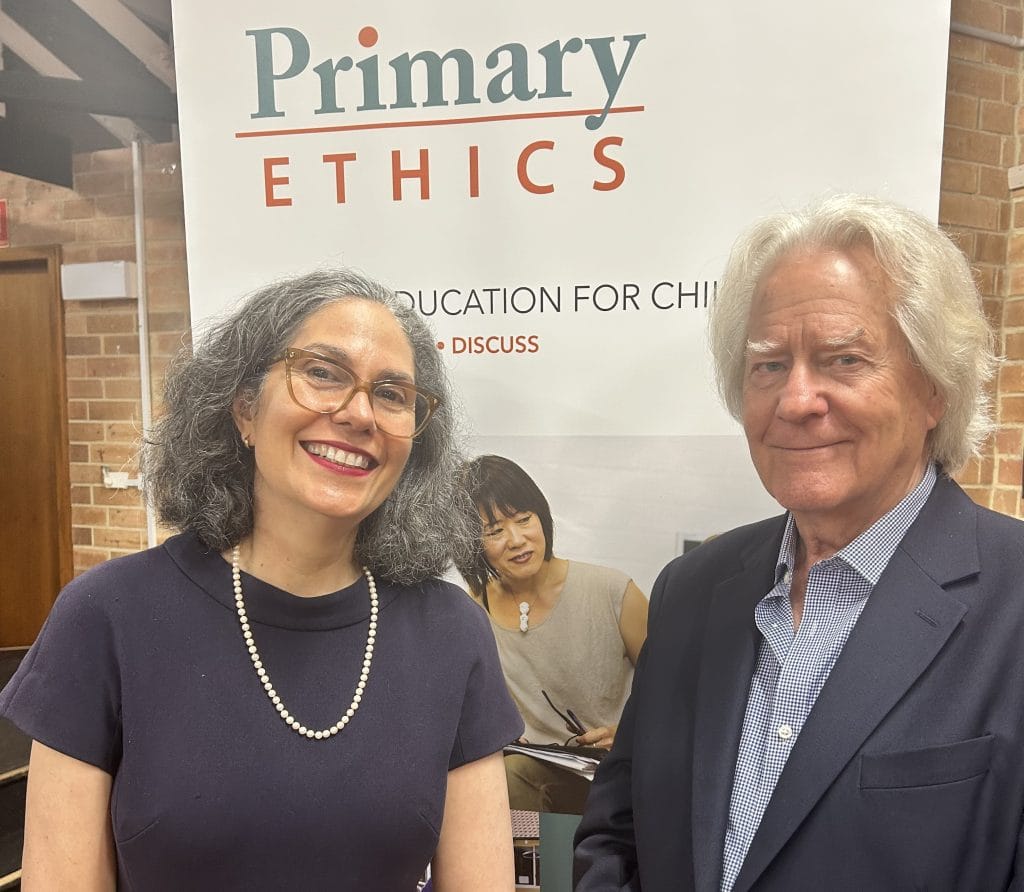
Laura Ramos with AC Grayling

Elizabeth: I was intrigued that Professor Grayling articulated what appears to be happening with global issues, eg. climate change, disease eradication, political self-determination. It came up in response to the question about use of AI and he called it Grayling’s Law: Anything that CAN be done WILL be done if it brings advantage or profit to those who can do it.

And the corollary to Grayling’s Law he mentioned, every bit as negative: What CAN be done will NOT be done if it brings costs, economic or otherwise, to those who could stop it.

Slightly depressing when set out like that, except that he was referencing that what’s needed to counter and break these laws (inter alia) is shared human experience  – which is what we talk about in the scenarios in ethics.

Mike: Such an inspiring event, delivered with such warmth and humility. Well done for arranging the thunder and lightning at key moments to dramatise AC’s key points!

They correctly guessed:

  • Hm (expressing curiosity or interest); and
  • Ah (reflection or understanding)

Acknowledging AC, I have added the element Re (‘Really’! – critical thinking response to a dubious assertion, seeking evidence or counter perspective).

Glynn: This was a delightful and thoughtful evening. AC (as our family calls him) opened with what he’s famous for: ethics, why it’s different to morals and the huge benefits of mastering critical thinking early in life. But this time it was a little different for me. AC reached out to the children, including the four primary students who started the evening telling us all why they liked ethics classes so much. Professor Grayling reminded us that children are nicely positioned to ask themselves “Really?” (when they hear something that needs a little more thought) and to hum “hmm” (when a little thinking time is needed).

And a highlight for me: AC asked “Where does the hole in a donut go when you eat it?”  The answer: ask a group of nine year olds, you’ll be surprised.

I’d also like to mention the pounding rain and thunder which wrapped up AC’s magical time with us!”

And the last word goes to Eli.

I really enjoy ethics classes. I hope they continue. And that AC Grayling might take up one of the volunteer positions here.
Eli

All about ethics lessons: webinars

We run regular one-hour webinars for anyone interested to find out more about what happens in ethics lessons or about volunteering with us.

In the webinar, you’ll be able to participate in a demo lesson to see our teaching style in action, hear first-hand from current ethics volunteers, hear about what impact ethics lessons have on children, plus all about our comprehensive free training and what’s involved in volunteering with us.

Click on an image for any session below to register.

Barry: A highlight of my week

For Seniors Week 2026, we asked some of our over-70 volunteers to tell us about their experience with us. There is no age limit to ethics volunteering – we have volunteers in their late 80s. At 73, Barry Richardson is in his eighth year of volunteering with Primary Ethics.

Barry’s experience

Eight years ago, I was transitioning to retirement, moving from a five-day working week to three days. I saw an advert for ethics teachers in our local community Gazette, teaching at our local primary school, Artarmon, which my now very grown-up children had attended many years ago. What a great way to give something back to our wonderful community.

I thoroughly enjoyed the training and meeting an eclectic group of people of varying ages, backgrounds, experience and interests.  The training introduced me to some great new skillsets.

My first ethics lessons were exciting, sometimes challenging, but always fun.  It was like going back to school myself, with all that that brings.

I have been lucky enough to teach all ages and stages, at one time taking three classes a day.  I’ve met some wonderful other volunteer teachers from our local area, as well as the school staff.  It is both enjoyable and rewarding to be involved with young, active minds engaged in critical thinking and to learn about respectful discussion.

Without doubt, my classes have been a highlight of my week.

Barry

I am now retired and have moved to the inner west, where I have transitioned to teaching ethics at the local high school.  More challenges, but always fun and certainly rewarding.

I also relief teach at the local primary school which three of my grandchildren attend or have attended.  Having moved to a new area after 40 years in Artarmon, ethics volunteering has been a great way to meet many people in the community through the local school.

You’re never too old to be an ethics teacher!

Paul: In touch with the rising generation

For Seniors Week 2026, we asked some of our over-70 volunteers to tell us about their experience with us. There is no age limit to ethics volunteering. At 88, Paul Sowter is in his eleventh year of volunteering with Primary Ethics.

Paul’s experience

When I retired from casual teaching at age 75, my son alerted me to the existence of Primary Ethics. I enquired, did the training and suddenly I was a teacher of ethics at Normanhurst West Public School, on Sydney’s far north shore.

As a former schoolteacher, I was impressed by the approach: everyone in a circle, kids do the talking but only if they want to. What a safe haven for the shy! The feedback in that most valuable end-of-year lesson revealed the benefits students draw from the experience, particularly in personal growth.

And I found this: whichever stage I taught over the next 10 years in various schools. Primary Ethics keeps me in touch with the rising generation – their innocence and awareness of so many things about the world is a delight to observe. The lesson material, especially for stage 3, can be challenging – you can see it in their faces. And they respond, slowly, feeling their way, listening intently to what their peers are saying, building on the previous contributions.

I have also seen the courses themselves develop over the years. And yes, old as I now am, I too have developed. I only wish I could have applied what I’ve learnt from teaching ethics in my former career.

As my hearing worsens with advancing age, soft voices can be a challenge. I am now employing an app on my iphone to improve my reception through airpods. The kids like being the monitor who delivers the iphone to the chosen speaker!

Over the years I have developed my IT skills with frequent assistance from the wonderful helpdesk. I delight in the material from Kindergarten to stage 3, often taking me off into further study

Whenever I meet someone for the first time I unashamedly steer the conversation towards Primary Ethics. No one has ever disapproved. All express an interest.

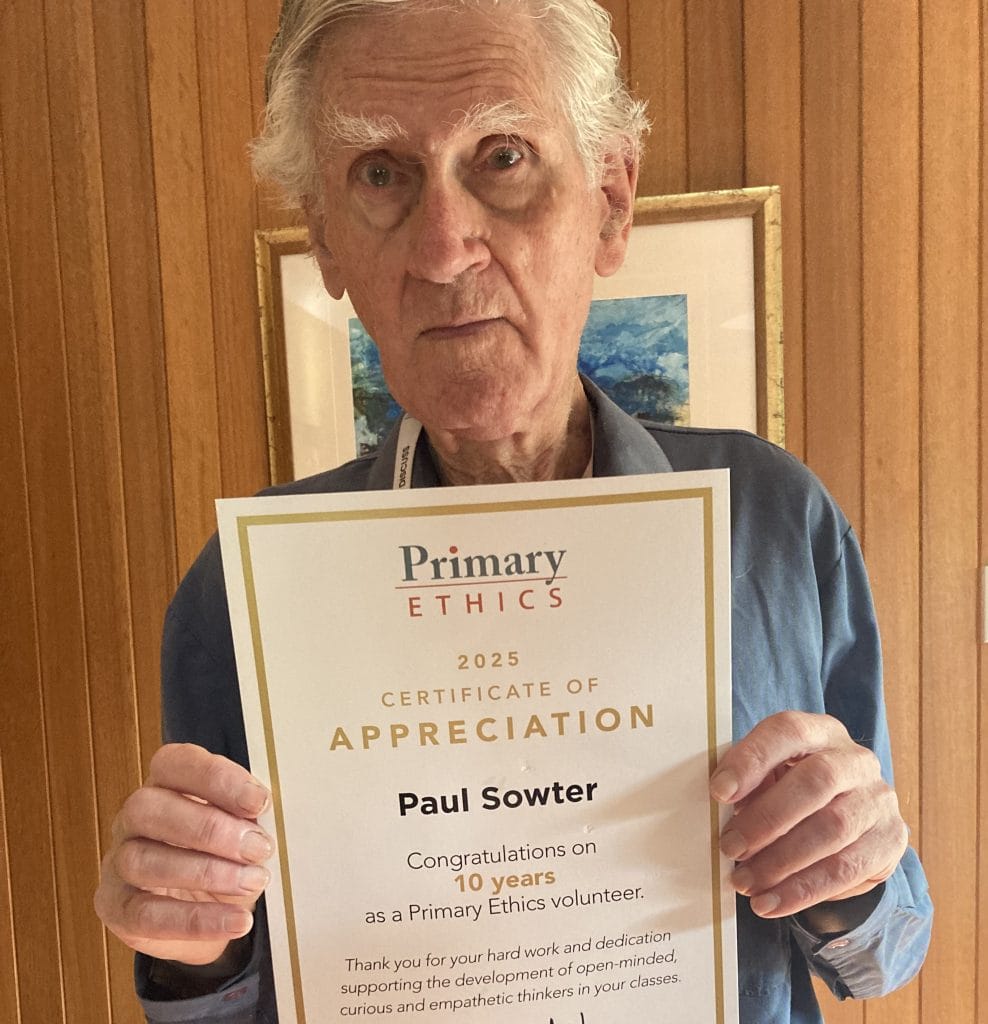
At the time of writing, March 2026, the topic my stage 1 class is exploring is pride. The photo of me above shows my pride in my endeavours.

The photo to the right is not my class. It is the instinctive formation of a troop of gorillas when they realise their leader is dead.

William: Ethics volunteering is meaningful, valuable and satisfying

For Seniors Week 2026, we asked some of our over-70 volunteers to tell us about their experience with us. There is no age limit to ethics volunteering – our oldest volunteer is currently 88. At 81, William Rodwell is in his ninth year of volunteering with Primary Ethics.

William’s experience

As an 81-year-old, I think it very worthwhile to let my fellow seniors into a secret. For those of you with an inquiring mind and an interest in our grandchildren’s and hence our society’s future, there is something for you that’s even better than the events of the NSW Seniors Festival. And you can enjoy it every week! That’s being a volunteer ethics teacher in a NSW school.  I am now in my ninth year of volunteering and it is undoubtedly my most rewarding weekly activity.

My proximate motivation for volunteering to teach ethics was to ensure that my grandsons had access to the Primary Ethics programme at their primary school. To me it also felt important to find a way to contribute to society after I was no longer doing that through work. The ethics programme provided a meaningful and valuable way to do so.  My grandsons are now well beyond primary school but teaching ethics is so satisfying that I continue to teach at their former school and now also at other schools.

We volunteer ethics teachers believe that the Primary Ethics curriculum provides a unique opportunity for school students.  It develops their moral sensibilities, including the capacity to empathise with others, consider other peoples’ points of view, be aware of the relevance of intentions and circumstances to ethical decisions, and so on.  The emphasis on the students providing reasoned arguments for their ethical standpoints also develops their capacity for critical thinking.  To me critical thinking is as valuable as the ethics component, as it is especially important in this age of false information – it provides students with the tools to distinguish specious arguments from valid ones.  The structure of our lessons as collaborative enquiry also develops the students’ ability to work together to reach a collective understanding of the ethical issues under discussion.  Importantly this does not mean they have to agree with each other, but they should understand other students’ points of view, which is so important in our contemporary polarised society.

The most consistent advice I see given to seniors to maximise health and wellbeing is to maintain their social engagement and mental stimulation.

Being a volunteer ethics teacher provides both. The kids’ openness to ideas, joie de vie and capacity to think seriously about quite demanding concepts is a joy to behold.  I think this interaction with children and seeing the value of the ethics program for students is very rewarding.  In addition, I find the syllabus we teach stimulating and thought-provoking for me, which adds to my enjoyment of the role and has contributed to my own philosophical development.

Moreover, the social engagement does not end with the students.  A group of people prepared to contribute their time to teaching ethics – ie the other volunteers at my schools – constitutes a lovely, supportive and interesting community.  As an old person it’s a treat to be involved in a group covering an age range from parents of Kindy children to long-retired persons like me.  Who wants to be confined to old peoples’ groups where the conversation inevitably turns to ailments, infirmities and funerals?  Not me!

When I suggest to retired people that they would enjoy becoming a Primary Ethics teacher they often say something like “I could never manage a group of primary school kids; it’s too daunting”.  I was also anxious about this at first.  I had been volunteering in several roles at my grandsons’ school, so I knew I enjoyed interacting with the pupils, but that’s not the same thing as controlling a class.  However, the students are not generally little demons itching to cause trouble – most are delightful. In addition, in most primary schools a regular teacher sits in the class to help with any behaviour management issues.  They don’t contribute to the teaching itself, but their mere presence is enough in most cases to ensure that the class behaves and they are there to help if some students don’t behave.

My only regret about embarking on volunteer ethics teaching is that my personal circumstances prevented me from becoming involved earlier!

William

Helen: Primary Ethics and ‘senior’ me

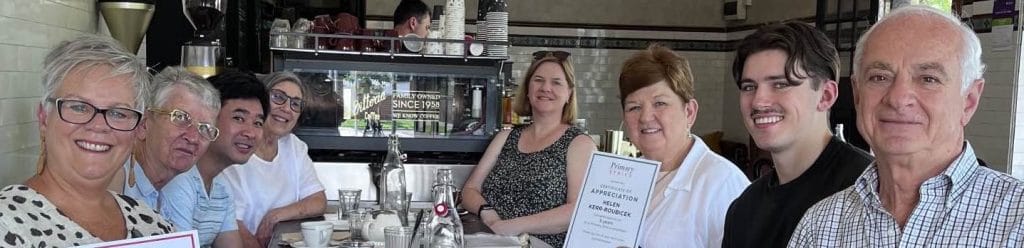
For Seniors Week 2026, we asked some of our over-70 volunteers to tell us about their experience as ethics volunteers. There is no age limit to ethics volunteering – our oldest volunteer is currently 88. In her later-70s, Helen Kerr-Roubicek is in her eighth year of volunteering with Primary Ethics.

Helen’s experience

When I took that Primary Ethics pamphlet at the Drummoyne Primary School fete, I opened the door to a very stimulating volunteering adventure. That was around eight years ago and I was approaching 70. I had three granddaughters at the school. After I began volunteering, while we only shared limited time in ethics classes together, I enjoyed the fact they now saw me in a broader role in their school context. They have all moved on to high school but I’m still here – loving being the coordinator for Primary Ethics of a brilliant team of nine volunteer teachers.

Over those years I have always found my PE journey stimulating, because I am challenged to think deeply about the philosophy and research behind contemporary issues. These form the background to the curriculum that is set out for we teachers to follow and facilitate in lessons.

When people ask me ‘so what do you tell the kids?’, I delight in explaining that it is not about ‘telling’. It is a community of enquiry approach that encourages students to think together about topics such as fairness, disagreeing respectfully, screen time and understanding diversity. They develop their own ideas and become more confident in expressing those to others and giving reasons for why they think what they think. They develop skills in reflecting and listening to what others think and say. PE is open to all faiths and belief systems. Mutual respect is a very important underpinning value for the classroom discussions.

People also ask ‘what’s involved as a volunteer?’ Then I can’t wait to explain that the setup has many amazing strengths:

  • It is very economical timewise and the time commitment is predictable – after training, a teacher typically needs to download and read over a lesson a few times and print copies of any pictures or activities in preparation for the average 35-minute lesson each week. There is a quick online feedback process after each lesson.
  • PE is an organisation that provides professional layers of user-friendly training and support. The technical support for the Internet materials is very effective and makes it easy to be involved with only basic skills (which are bound to improve as well). There is also good classroom support if issues arise and if all else fails there is a helpdesk at the end of the phone to clarify direction. All this is provided free – it is not expensive to become involved.
  • Undoubtedly the most exciting aspect is the opportunity to have regular contact with young people, exploring day to day issues with them, hearing their ideas and having the opportunity to support their personal growth.

After three to four years, I was offered the opportunity to become the PE team coordinator for the school. I was reluctant at first, lacking confidence. This is a liaison role with the school on all relevant matters including the setting up (online) and management of classes. Actually it has turned out to be a perfect extension of my favourite professional roles – resource linking, mentoring, recruiting, team building and with limited administration. There is also plenty of support for this role. And the best thing – it’s time limited too! Setting up at the beginning of each year is the busiest time.

Helen third from right with other Drummoyne volunteers.

Our team is made up of a balance of retired older people who have a range of rich professional and community experiences, and keen parents of current students who keep us in touch with school news. We manage our team organisation through a Whatsapp group and look forward to catching up at our end of term dinners.

Over the past four years I have been through some tough times personally as I journeyed with my husband in his experience of serious illness until his recent death. The care and support from my team and the school-  from offering to take my classes or other tasks, to being available for ‘debrief’ coffees and messages – have made a real difference for me. And the regular classes with bright, lively faces each week ready for another discussion have provided a structure activity in my week that has also been helpful.

The camaraderie with my team and the wider PE community, including my regional manager, has been incredibly rewarding and uplifting. I realise as I look back over the eight years that this community building is at the heart of my PE experience and it is so good to feel that the lessons we provide are assisting students to do that in their own worlds.

Have I just been lucky with my school and team members? Would it be different somewhere else? There is no doubt that I have been fortunate and I know that there are many influences on how PE functions in different schools, including critical issues like when it is timetabled and how supportive the school executive is. But it is my belief now, that the community of enquiry approach as an underpinning of this program is right for this time and resonates with young people, parents, teachers and community members. Why else would we have growing numbers in our classes and more volunteers to teach in such a busy world?

Diana: Investing in future generations

For Seniors Week 2026, we asked some of our over-70 volunteers to tell us about their experience as ethics volunteers. There is no age limit to ethics volunteering – our oldest volunteer is currently 88. In her mid-70s, Diana Dagg is in her seventh year of volunteering with Primary Ethics.

Diana’s experience

I was drawn to this role because teaching ethics offered the chance to teach my grandchildren. Over the years I’ve taught ethics to two grandchildren at Arncliffe Public School (they’re now at high school) and currently two grandchildren at Marrickville West Public. But I discovered early on that this is much more than simply having an opportunity to spend time with my grandchildren.

Before I list the many benefits, it must be noted that ethics teaching is not just a cushy volunteering job. Without being too dramatic, becoming an ethics teacher is an investment of our time, our expertise and our belief in the importance of contributing to future generations.

To do the job properly, we as volunteers need to commit to preparing well for lessons, taking the time to learn our students’ names and to understand any of their particular needs. We must also be willing to ask for and accept advice from trainers and schoolteachers. There are lots of opportunities for continuous learning within the ethics teaching technique.

We don’t need to have been teachers before becoming ethics teachers. In fact, friends of mine who were schoolteachers before becoming ethics volunteers say they had to ‘unlearn’ the traditional teaching practice of rewarding ‘correct’ answers. This ethics teaching role is about helping our young students develop approaches to thinking for themselves.

Above all, to be authentic, we as volunteer ethics teachers must value and want to understand children.

Spending this teaching time with my grandchildren each week is rich with potential, including:

  • Hearing their opinions about issues that affect them
  • Meeting and hearing the opinions of their classmates as a group
  • Providing an intersection point for conversations with them outside of ethics
  • Meeting their teachers and understanding the school ‘culture’.

My relationship with my grandchildren has been strengthened by my ethics teaching role because:

  • we confidentially discuss (and I get to hear) what questions matter to them in our ethics class
  • their friends like and respect me as an ethics teacher using our humanitarian rules in class – that earns me points as a nanny!

There are many great things about this role apart from the strengthened bond with my grandchildren:

  • I have the opportunity to meet and work with students with disabilities, to help them learn
  • I have greater insight into the challenges teachers face each day
  • I’ve enjoyed some fun lunches and morning teas, sharing war stories with other ethics teachers.
  • I’m proud to be investing in future generations through rigorous teaching practice and a thoroughly researched ethics curriculum which reflects values similar to my own.

Are there rewards/benefits that I wasn’t expecting?

Hmm, probably it’s the opportunity to understand the needs of students with disabilities and to be mightily impressed by the skilled teachers who work with them. Also, the satisfaction of managing challenging situations well.

Any concerns about dealing with technology (EVIE) or coping with things like hearing impairment?

It’s been fine to use the technology but if there are problems, I know I can turn to the very helpful Primary Ethics staff on the Helpdesk or my ethics coordinator and/or school admin or teaching staff. I already have hearing aids (yikes!) so no probs with hearing in my classes.

@Home for parents bulletin – Term 1 2026

Welcome to @Home bulletin for Term 1 2026, where we let families know what your children, from kindergarten into secondary school, are exploring in their ethics lessons this term.

Subscribe here to receive our @Home email bulletin once a term.

The topics we show below are based on classes which begin at the beginning of the year – this can vary as schools start their ethics programs at different times. If your child tells you they are discussing a topic you don’t see in this bulletin, you can also look at the Curriculum section of our website.

We hope the students talk about ethics with you at home – ask them questions about it!

Kindergarten: Being curious and asking questions: Young children are curious about countless things and a goal of our curriculum is to nurture this curiosity so that they’re motivated and confident enough to think critically for themselves about issues that matter to them. Our first topic of the year encourages kindy students to start thinking about why we ask questions. Students will also consider why it can sometimes be hard to ask questions out loud when we’re worried about looking silly.
Later in the year, students will consider questions about sharing, fairness and doing harm without meaning to.

Stage 1 (Years 1 & 2) Pride: In our first Stage 1 topic of the year students explore some big questions to do with pride. What does it mean to be proud of something? Is it okay to be proud of our accomplishments? What about being proud of the things we’re given, like gifts and rewards – is that okay? And why are we sometimes proud of other people?
Later in the year, students will reflect on the importance of having good reasons and discuss the ethics of laziness.

Stage 2 (Years 3 & 4) Being selfish: In our first Stage 2 topic of the year, students delve into the ethics of being selfish. Is it okay to act selfishly or is it always wrong? If you’ve put lots of effort into something or you’re worried it could get broken, is it okay not to share it? What does it mean if you help someone but for selfish reasons – is that misleading or deceitful?
Later in the year, students will think about how to disagree respectfully and whether it’s okay to keep animals in captivity.

Stage 3 (Years 5 & 6) A fair society: In our first Stage 3 topic of the year, students ponder what it means to have a fair society. Do we have a responsibility to make sure everyone can go to school and receive medical treatment? What are some of the challenges involved in providing such opportunities? And do governments have a responsibility to address inequalities that are the result of good or bad luck?
Later in the year, students will consider whether it’s ever okay to challenge a rule or piece of advice given by an authority.

Stage 4 (Years 7 & 8) Role models: Our first topic of the year invites students to consider the place of role models in our lives. What makes someone a good role model? Must someone to be a good person to be a good role model? Is it fair to have higher expectations of someone just because others consider them a role model? Can having a role model, even if it’s someone you’ve never met, help you navigate life’s moral challenges?
Later in the year, students will discuss whether the voting age should be lowered and some ethical dilemmas around friendships.

Each term brings new ideas and questions, and we hope these topics spark interesting conversations at home as well!

The secret weapon against polarisation – Osher Günsberg

Osher Günsberg, radio and television presenter and now popular podcaster, has joined the ranks of ethics volunteers at his son’s school. Osher says: “When I open my phone, it explodes in a cascade of fear, fury and furphies… leaving me spinning in a tizz of desperation and powerlessness. … I think I have found something that makes that feeling less intense and instead gives me the feeling that I am actually doing something that will make a difference.”  Thanks Osher for this lovely reflection, we wish you the best in your year of ethics volunteering ahead.