Archives

Q+A: Evan and Laura

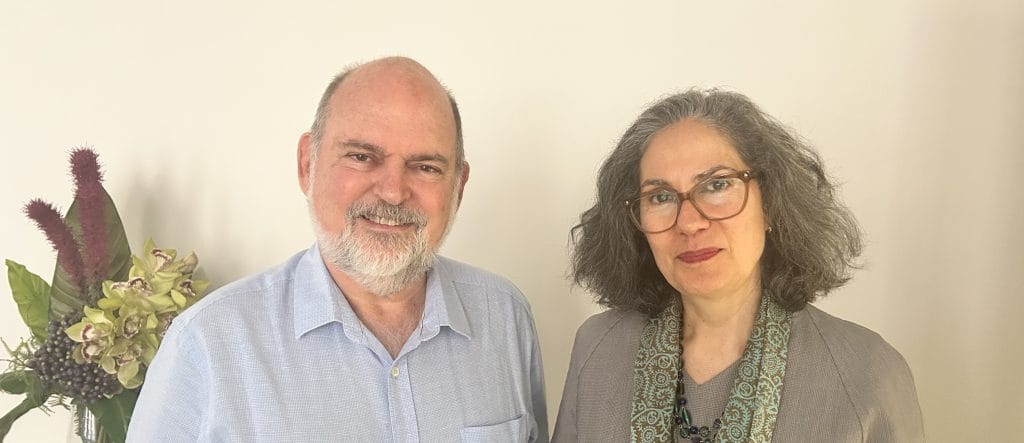
As the handover period between Primary Ethics leaders Evan Hannah and Laura Ramos comes to a close, we gave them both a Q+A. So it’s farewell to Evan after over eight years in the role and welcome to Laura!
Evan Hannah

When did you start working for PE and what drew you to the job?I first ‘worked’ for Primary Ethics as a volunteer coordinator at my son’s school – Five Dock PS – for several years from 2013. I became CEO in July 2017. My motivation came from seeing how powerful the program was and wanting to do what I could to take it to more students in more schools.

How many locations have you worked in since you started? Five – with three of those being in the same multi-storey office block in Potts Point! We love where we are now (co-located in the city with The Ethics Centre), but my favourite was the wonderful purpose-built space at the Paddington offices of our great supporter Rob Keldoulis and his Vivcourt company. We were there for a happy 12 months before Covid pushed us to our home spaces!

How many staff were there when you started and how many now? We had six people (five full-time and one part-time) when I began. As I hand over to Laura we now have 17 staff (seven full-time and 10 part-time.) We’ve increased our staff to meet the growing demands of recruiting and supporting volunteers – and we’re busier than we’ve ever been.

You’ve done numerous media interviews over those years, which was your favourite? My favourite interview was with ABC Radio 702’s Sarah Macdonald in their Ultimo studios. Sarah was well across what Primary Ethics does, which made the interview relaxed, but what made it a favourite was when one of her regular contributors – film academic Bruce Isaacs – called in to talk about his own experience teaching ethics with us. It was such a positive and fun interview, which created some good listener interest in volunteering.

You will have heard many stories about the impact of ethics lessons. What stands out for you? Perhaps the most moving was when a parent told me his son had talked about how thinking things through as they did in ethics classes helped him deal with the grief of losing a grandparent. It’s both fulfilling and deeply sobering to hear how what we do can give students those tools.

What are you most satisfied with as you leave? I’ve had a bit of time to think about this and there are two examples out of many satisfying outcomes.

First was our successful multi-year campaign to allow parents to choose ethics at the same instant they were told about SRE (scripture) – Department procedures originally forced parents literally to opt out of scripture twice before they could be told ethics was available at their school. It was unfair and frankly unethical! The change meant information and choice is now equitable, opening the way to more student enrolments and more volunteers.

Second is how our volunteers responded during the long Covid lockout from schools, when our hard work to keep people engaged kept them keen and eager to return to schools when they re-opened. Our volunteers stayed with us during that difficult time, when many other not-for-profits had trouble keeping their volunteers on board.

I leave knowing we continue to have an amazing committed staff and a fantastic group of volunteers.

What’s in your future? I’m incapable of sitting still for long, so I’m already thinking about a couple of ways to keep busy. Leading such a great organisation as Primary Ethics has shown me the rich satisfaction you gain when you’re able to see effort at one end of our program turn into great outcomes at the other, so I’m certain I will seek to again be involved in an organisation or social enterprise that benefits the community.

And I’ll keep up with my cricket umpiring!

Laura Ramos

What drew you to this job? Knowing about the amazing work of the organisation and the opportunity to be part of the next chapter. I knew of ethics education from when my daughters were in primary school. My daughters (who are now at university) still have positive memories of ethics lessons.

You’re doing the ethics teacher training now, how are you finding it? I’m loving the training – and can confirm that it is thorough! It’s been really humbling to step into student-mode and realise how little I actually knew about what it takes to be a great teacher. There is so much to consider. Our trainer has been phenomenal; she’s got deep knowledge of teaching practice and is super methodical in pointing out where we’re demonstrating the right

teaching skills, when we need to finesse and when we need to try again. From seeing how training happens, I also have a far greater appreciation of the care that goes into every aspect of our program.

Is there anything surprising about it? I love that our training is set up to build teaching skills for adults who come from very different backgrounds. And yet, we’ll all be able to deliver ethics lessons now – and we’ll have access to our excellent Classroom Support resources to help us improve over time.

You’re originally from Puerto Rico and the US, have you come across anything like Primary Ethics over there? I wish! I’m pretty sure my parents would have loved having this for my sisters and me when we were growing up. I haven’t seen any program offer ethics education to students at the scale that we can, with the breadth and depth of topics and the rigorous approach to curriculum and pedagogy. Our program is pretty unique as far as I’m aware.

What have been the highlights of the job so far?

  • Being blown away by the rigour and excellence built into our program.
  • Realising how talented, committed and generally awesome every person in the staff team is.
  • Developing deep respect for every one of our volunteers, because they make the magic happen in schools.
  • Seeing our team work on setting up ethics classes for the 2026 year – exciting and a lot of work!

Tell us about your interest in AI. I’m curious and trying out different products with interest. A big part of my career was in tech-focused roles, so I guess I’ve seen many examples where IT solutions don’t meet the expectations of users and also instances where tech can be deployed to make things demonstrably better for people.

When it comes to AI, it’s fascinating to see new services that can help us solve everyday challenges much more quickly – but not always well. Nevertheless, I think there’s real value in learning how to use AI tools and also in staying informed about the potential pitfalls.

What’s the best story about ethics you’ve heard so far? I have a new one every day. Today it was a side conversation where we speculated what Socrates might have done with social media. Who says we can’t have fun with ethics?
Thoughts about volunteering – from Mike Godfrey

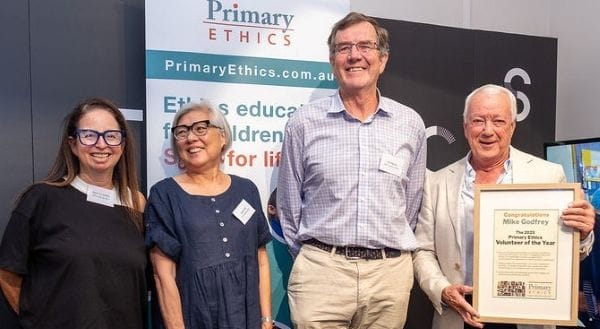
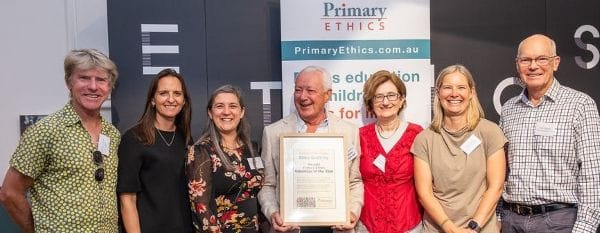
In December last year, Mike Godfrey was presented with our Volunteer of the Year award. Mike has been a dedicated volunteer in our classroom support team for 12 years. Many ethics volunteers have met Mike when they’ve reached out for support with a challenging situation and Mike has been there, on the phone or in person, to offer calm, professional and practical solutions – and continuing back-up.  

Mike himself is a volunteer and offered these thoughts about volunteering, especially as an older person, in his award acceptance speech.

“I want to talk about volunteering. This organisation doesn’t work without volunteers!

We often talk about how volunteers give back and what wonderful people they are — and yes, we are— but I want to tell you there’s two sides to this. We volunteers get a lot out of this too! I think there’s a message here which we can take to the community which may help drive more volunteering, especially in older age groups.

Mike with previous volunteers of the year - Barb La Ganza, Swee Goh and Jim Neely.

Listening hard: What I’ve got out of this (and I can only talk for myself but I do know some of this applies to others) are skills development as well as personal development.

One of the great things I’ve learnt is to be a better listener— because you can’t be in a classroom, either teaching or observing, unless you’re 100% engaged and listening hard. And I have to say —and I’ve taught communication skills over many years— I probably wasn’t the listener I could’ve been but ethics volunteering has really helped me improve.

Brain health: Social contact is important and being with like-minded people is healthy. And the mental and intellectual simulation is vital. You know, there isn’t a curriculum topic I’ve read which doesn’t stimulate me to consider what I really think about this. I love that it causes me to think deeply — to engage in topics which otherwise I wouldn’t have thought much about. And that’s growing me as a person. It’s good for my brain health too.

These are things we can get across to the community. You can still grow! You might be age 50/60/70/80. You can still grow and develop and learn and if you’ve got the energy, you can still teach ethics.

Mike

Relevance: I sat next to a lady in her late 60s in a doctor’s surgery years ago and she was telling me how she had lost her relevance. I thought that’s a really sad thing to have to say— she felt she just wasn’t relevant to her family, to society or to work any more. Had I known what I know now I would’ve suggested she join Primary Ethics as a volunteer! Relevance to society is very important for older people. It’s something Primary Ethics can provide.

Mike with the rest of the Classroom Support Team.

Staying in touch: Finally, one of the other things I have gained is it helps me stay in touch with the younger generations and their society. The way the scripts are written is stimulating. Listening to students respond to the scripts and enter into meaningful and respectful discussions on the various topics is incredibly interesting. And it really does help you stay in touch with younger people and how and what they think, which I just think is very important in many ways.”

The thriving ethics community of Bondi Beach

Evelyn Levisohn is an ethics volunteer at Bondi Beach – a teacher and team coordinator. She writes here about their thriving ethics community, who help children look beneath the surface and have come together in firm solidarity after the recent tragedy on their doorstep.

Beyond the surface: Surfers, sunshine, run clubs and speedos: these might be the first things you think of when you think of Bondi Beach. It’s a place often associated with the ‘surface’: the tans, the activewear, the perfectly poured Instagrammable matcha latte. [Though tragically, it is also now known for the terrible shootings that took place in December 2025. More on that later.]

Look a little further, past the tourists on the promenade, and you’ll find there is a community engaged in something much deeper. At Bondi Beach Public School, just across the road from the beach, we have a thriving ethics program that is teaching the next generation how to look beneath the surface and question the status quo.

I’ve been part of this organisation for six years now, teaching two classes a week and serving as the ethics coordinator. We currently run 11 classes every week, from Kindergarten to Year 6, powered by a dedicated team of nine volunteers.

The Bondi Beach team at the beach, Evelyn on left.

Journey into the ethics classroom: My journey into the classroom actually started at my day job. I’m a Marketing Manager for Studiosity, a purpose-driven edtech company that believes in the power of education to change the world. Because they value social impact, my work is flexible enough to allow me to teach and coordinate each year. In fact, I first heard about Primary Ethics because my boss was a volunteer. Every Wednesday, she would come into the office and regale us with stories about how funny the kids were, how fascinating the topics were and how rewarding and challenging the role was.

It sounded incredible and I signed up to teach at Bondi Beach the year before my eldest son even started there. I still remember the nerves of that first day teaching Kindergarten. They were so sweet and charming, offering unselfconscious answers with brash honesty. But the moment that truly hooked me, the moment I felt that click of satisfaction, was when a child made a logical argument about a story that even I hadn’t considered. Watching a child learn to reason, think and find their own voice is incredibly gratifying.

Becoming a coordinator: Eventually, my passion for the program outweighed my fear of stepping into the team coordinator role. When our previous coordinator moved away, I realised I was too invested to let anyone else take the reins. I cared deeply about the program’s success, especially as we navigated the long road back from the COVID shutdowns. Our school was actually the last in the state to bring scripture and ethics back onsite, only resuming in 2023. During that break, I kept my skills sharp by doing relief teaching at other local schools. When we finally came back onsite, my mission was clear: I wanted to build back a sense of belonging and camaraderie within the team. I started ensuring we had termly coffee catch-ups and end-of-year dinners.

The team out for dinner, Evelyn second from left.

Depth and compassion: Today, we have a thriving team from all walks of life, parents and community members alike. Our catch-ups are no longer just an admin checkbox; they are filled with deep personal reflections and philosophical musings. We support each other, as does the whole Bondi Beach community who came together with steadfast compassion when the school had to close for a few days following the shootings, ensuring nobody was feeling alone and the kids had a sense of togetherness and normalcy.

In the darkest of times, our community shone in its solidarity.

Evelyn

The world beyond the beach: Despite recent events, Bondi will always have its sunshine and its tourists, but what happens inside our classrooms is what prepares these kids for the world beyond the beach. Considering what our community has been through, and in an era of AI and global upheaval, these lessons in critical thinking and logical reasoning are what will truly help our children navigate the changing world. We aren’t teaching them to follow a specific set of beliefs; we’re teaching them to think for themselves. And there is nothing more important than that.

Celebrating team achievements. Evelyn is centre.
A new leader for Primary Ethics

The appointment of a new Chief Operating Officer for 2026 has been announced by Roger Reidy, Chair of the Primary Ethics Board. “It gives me great pleasure to announce the appointment of Laura Ramos as Primary Ethics’ new Chief Operating Officer. Laura will commence with us on 12 January 2026”, Mr Reidy said.

Laura brings a wealth of not-for-profit executive leadership experience to the organisation, Mr Reidy said. She impressed the Board as the standout person in a recruitment cycle that produced many talented candidates. “Laura will bring leadership, experience, business acumen and people management skills to build on our existing legacy and make our company even stronger,” Mr Reidy said.

“Primary Ethics is continuing to operate in a period of transition towards a potential merger with our parent body, The Ethics Centre”, he continued.  Laura will report to the Primary Ethics Board for the foreseeable future, as has retiring CEO Evan Hannah.

Laura’s expertise includes executive roles at the NSW Department of Education, NSW Department of Family and Community Services and Services Australia. In addition, she has led strategy as CEO, Schools Industry Partnership (a youth-focused not-for-profit in Western Sydney) and as CMO at Achieve Australia (a large NDIS provider).

She has also worked in the startup sector developing innovative services to support older women and persons living with cognitive impairment.

Laura’s academic background includes a Master of Business Administration (Executive) from the Australian Graduate School of Management and PhD research in Human Computer Interaction at the University of Technology Sydney.

Originally from Puerto Rico, Laura has called Sydney home since the early 2000s. “My two daughters have positive and lasting memories of the ethics lessons they took in primary school, supported by the dedicated volunteers and exceptional curriculum from Primary Ethics”, Laura said.

Eco-ethics at an urban farm

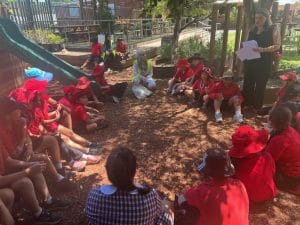
Primary Ethics has collaborated with Pocket City Farm, in inner-urban Camperdown, to create a half day of education about the ethics of sustainability. The pilot has run on two days this month, with visits from Y3 and Y4 students from Campsie Public School in Sydney’s south.

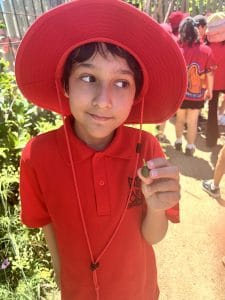
Sessions for groups of children were run by Farm educators and Primary Ethics teachers. The children learnt about forests, feeding weeds to the chooks and how the web of life keeps us all connected. Then in specially written ethics lessons, they explored protecting their environment.

Both days were very hot but the students were highly engaged – especially in the chookyard!

Danya: Building strong foundations

Danya Webb, with an extensive background in marketing and sales, is the training operations manager for Primary Ethics. Her team delivers all the new teacher training sessions. They also create all the e-learning modules for new teacher/coordinator training, as well as the many short courses and handouts available to volunteers. And they run monthly information webinars and collaborate with Classroom Support colleagues on professional development workshops.

My own journey with Primary Ethics began as a volunteer ethics teacher in 2018 when my younger daughter started kindergarten (her older sister had already been in ethics for a few years). My involvement grew when I took on the additional role of volunteer ethics coordinator at my children’s new school in 2021 to launch their ethics program. We now have a team of 12 ethics teachers at this K-12 school, covering almost all the demand for ethics from K-8. My younger daughter is now in Year 7 and I still teach her Stage 4 ethics class!

The power of the program is personal to me. I’ve seen both my children’s critical thinking and empathetic reasoning skills develop over the years thanks to their involvement in ethics education.

Danya

As training manager, I work with a dedicated team to ensure our volunteer ethics teachers and coordinators are well-prepared for their roles. Our commitment to continuous improvement and a supportive learning environment is at the heart of everything we do.

Our team of 14 trainers deliver regular interactive new teacher training workshops face-to-face in Sydney and Wollongong and online via Zoom. The online option makes our training more accessible to regional volunteers, as well as those who prefer the convenience of training from home or in the evenings.

We train all sorts of people – barristers and psychologists, cleaners and librarians. Regardless of background, everyone is trained in the same way, equipping all with the skills to become capable ethics teachers or coordinators.

We also develop and manage digital learning resources, including:

  • E-learning modules for new teacher and new coordinator training.
  • Many short courses and handouts available in our Document Library.
  • Collaborative professional development.
Danya and Snowflake

Learning doesn’t stop after the initial training. We strongly believe that every ethics lesson offers a chance to hone technique. We collaborate closely with the Classroom Support team to offer ongoing professional development, including:

  • Engage-Reflect-Connect workshops for ethics teachers
  • Coordinator Essentials workshops for ethics coordinators
  • Information webinars about ethics for parents and the community.
  • Commitment to continuous improvement.

To ensure our program remains current and impactful, we also run an annual program review. This evaluation is vital, helping us modify our approach to address any gaps and drive quality improvement.

Our training methodology has evolved significantly over the years — we are now on Version 11 of our new teacher training manual! This is a testament to our focus on integrating feedback, keeping up with best practice in adult learning methodology and adapting to the needs of our volunteers and students.

The Primary Ethics Volunteer of the Year for 2026

Primary Ethics is delighted to announce our Volunteer of the Year for 2026.  The winner is Mike Godfrey, who has been a dedicated volunteer in our classroom support team for 12 years.

This award brings public recognition and appreciation for the often-unsung efforts of our wonderful volunteers, as well as substantial prize money to go to the recipient’s chosen school or schools.

The award honours a volunteer who has:

  • made a significant contribution to our mission to deliver ethics education to children so that they develop skills in ethical reasoning, critical thinking and respectful discussion
  • conducted themselves in a manner true to our values of respect, integrity, independence, excellence and teamwork.

With the award we acknowledge team players, good communicators, those who are supportive of other volunteers, reliable and committed to our program of ethics education.

Mike epitomises those qualities.

Mike is an invaluable member of the classroom support team. Across 12 years he has helped countless volunteers improve their skills. He also helps train new classroom support volunteers and is often called on for advice by the manager and members of the team alike.

Mike is always willing to call or visit teachers in need no matter where in Sydney they are located. With his warm, engaging style and depth of knowledge, he creates a supportive environment for teachers to discuss their challenges.

Mike was shortlisted for Volunteer of the Year in 2023 and 2024.

Mike Godfrey

Volunteer feedback received after they had a discussion with Mike: ‘Dear Mike, I am pleased to say that by implementing the tips we discussed my next lesson was a hit … Needless to say I am so happy with how things went and would like to thank you for your kind support.’

A former CST manager says: “Mike has to be recognised for his high-quality service and care to ethics teachers over a significant length of time. He is the sort of person who always went the extra step to ensure teachers were supported and performing in accordance with Primary Ethics standards. Mike has also continued to provide this service with the many changes to curriculum, procedures and leadership of the team. He has played a key role as a senior CST member on many occasions, mentoring new members, living our company values and providing support wherever he was able. It is volunteers like Mike Godfrey who make us what we are at Primary Ethics.”

Congratulations Mike Godfrey!

@Home bulletin Term 4 2025

Welcome to @Home bulletin for Term 4 2025, where we let families know what your children, from kindergarten into secondary school, are exploring in their ethics lessons this term.

Subscribe here to receive our @Home email bulletin once a term.

The topics we show below are based on classes which begin at the beginning of the year. If your child tells you they are discussing a topic you don’t see in this bulletin, you can also look at the Curriculum section of our website.

We hope the students talk about ethics with you at home – ask them questions about it!

Term 4 curriculum selections

Kindergarten: Does telling the truth matter? Children often face tricky moments where honesty and kindness pull in different directions. This term, they’ll hear stories about friends who tell small untruths to spare feelings or avoid trouble and discuss whether it’s ever okay to make something up. They’ll explore why truth-telling matters, how lies can affect friendships and trust and whether it’s possible to be both kind and truthful at the same time.

Stage 1 – Years 1 & 2: Being kind Our Stage 1 students will explore what it really means to be kind. Through stories about Oli and her missing pet bird Tiwi – and other children trying to help in different ways – they’ll reflect on why people act kindly, what it means to understand how others feel and whether helping still counts as kindness if it’s done for the wrong reasons or only because someone told you to.

Stage 2 – Years 3 & 4: Cheating Fair play and honesty take centre stage this term. Students will unpack what it means to cheat – and whether it’s ever acceptable – across settings like backyard games, card matches and online competitions. They’ll consider why people bend the rules, when cheating seems less wrong and whether it’s possible to cheat yourself in a solo game.

Stage 3 – Years 5 & 6: Why should we trust science? Stage 3 students will explore how we decide what to believe and why science deserves our trust. They’ll learn about scientific ideas that changed the way people saw the world – like Galileo’s discovery that the Earth moves around the Sun – and discuss what makes a good scientific explanation. Along the way, they’ll consider how our beliefs about the world can shape our choices and actions.

Stage 4 – Years 7 & 8: The cost of a human life Our high schools will tackle one of the most challenging ethical questions of all – how to weigh the value of a human life when making decisions. They’ll explore why governments sometimes assign a dollar value to life, how those figures influence policies and what happened when these ideas were debated during the COVID-19 pandemic. Students will discuss fairness, dignity and whether every life should be valued equally, while considering whether it’s ever right to reduce human life to numbers.

Each term brings new ideas and questions, we hope these topics spark interesting conversations at home as well!

A webinar for Global Ethics Day 2025 – Misinformation & fake news

We celebrated Global Ethics Day 2025, 15 October, with a webinar featuring an ethics class composed of adults (also including one current high school student of ethics) discussing one of our high school lessons – on misinformation and fake news. You can watch the video of the class and discussion below.

The webinar was hosted by journalist Sarah Macdonald. Primary Ethics philosopher-in-residence and curriculum author Kelby Mason facilitated the lesson – an edited version of a lesson that is currently taught in secondary schools by Primary Ethics volunteer teachers. A Q&A followed the lesson.

Our special guest students included Allegra Spender MP (Member for Wentworth), Ed Coper (strategic communications specialist and author of Facts and Other Lies), Primary Ethics volunteer teachers Alexa Stuart (Bob Brown Young Environmentalist of the Year 2024), Winnie Tang (aeronautical engineer), Jean-Paul Leung (ethics team coordinator) and Kevin Farmer (corporate social responsibility consultant), plus current Year 7 ethics student Abby Webb.

Global Ethics Day 2025 webinar

Set aside some time to watch it here – well worth it!