Category: Events

Global Ethics Day – volunteer spotlight on William

It’s Global Ethics Day 2025 on Wednesday 15 October and to celebrate, we’ll turn the spotlight onto some of our volunteers and hear about the impact of ethics education in their own lives.

This global celebration of the importance of ethical tools highlights ethics as a process for finding solutions in the collaborative and respectful manner often missing in today’s world. We can use ethics to guide personal decisions, mitigate harmful outcomes, create a more respectful structure for debate, develop helpful public policy, build and deploy technologies responsibly and address some of the world’s most pressing challenges.

Ethics is not about getting everyone to agree on a single set of values. It’s about how we learn to live together, respect our differences and together face our major global challenges.

William Mitchell, volunteer in inner-west Sydney for 11 years

What drew you to ethics volunteering? My journey with Primary Ethics began through my interest in the Ethics Centre  and their Festival of Dangerous Ideas. After learning over coffee about a friend’s experience as an ethics facilitator, I was immediately convinced to volunteer. I’m now approaching my 11th year as a facilitator, currently teaching Stage 1 students at Taverners Hill Infant School in Petersham, having previously taught Early Stage 1 and Stage 2 classes.

Unlike many volunteers, I don’t have children or grandchildren of my own. Rather, philosophy was the focus of my undergraduate degree, so I thoroughly enjoy having the opportunity to help the children engage in the types of thinking and skill development that I am passionate about but didn’t get to explore until much later in my life.

What do you get out of the lessons? Has it given you a clearer sense of your own ethics? The benefits I derive are numerous and profound. As a lawyer by profession, it provides a refreshing contrast to my daily work (though there are surprising overlaps between the skills required to ensure the children keep discussion on track and respectful and running meetings as a professional). The program allows me to connect meaningfully with my local community and gives me a sense of accomplishment in helping children develop crucial life skills. The children’s unfiltered, creative responses serve as a reminder of the importance of maintaining open and innovative thinking in adult life – something we often lose touch with as we reach adulthood.

The curriculum has significantly influenced my own ethical framework and daily behaviour over the past decade. Preparing for classes requires deep personal reflection on the same questions we pose to the children. Likewise, the process of truly engaging with the children’s responses often challenges my own beliefs and introduces me to perspectives I hadn’t considered. This aligns perfectly with my background in philosophy and continues to enrich my understanding of ethical reasoning and subjects which, as the curriculum was designed to do, apply routinely to what is going on in my everyday life.

What do you see as the benefits for the children? The Primary Ethics curriculum offers children numerous valuable skills, but perhaps the most crucial are the abilities to engage in respectful disagreement and to be open to changing their minds based on new information or perspectives. It’s particularly heartening to witness students becoming increasingly comfortable with revising their positions as the school year progresses, demonstrating their growing capacity for reasoned discussion and intellectual flexibility. Seeing the hand of a child go up to let the group know that they’ve changed their mind on an earlier answer they gave based on someone else’s response or reasoning is exactly why I facilitate ethics.

Why is ethical decision-making important in today’s world? The Primary Ethics program provides children with essential life skills that aren’t expressly practised or developed throughout formal education. These skills and behaviours are fundamental to human interaction and decision-making, yet opportunities to develop them in a structured environment are rare and can be far more challenging to learn as an adult. By enabling the next generation to identify and meaningfully engage with ethical questions that are inherent in everyday life, we’re investing in the development of better communities and societies of which we are all a part. As a staunch believer in this mission, I volunteer my time to help children develop these crucial capabilities so that they can go on to help the world and achieve far greater accomplishments than I could ever hope to achieve as an individual.
Inquiring Minds Spring 2025

Welcome to Inquiring Minds for spring 2025, where we bring you stories and reflections from our ethics classrooms and our volunteers, as well as recent Primary Ethics highlights.

In this issue we collected stories from our wonderful volunteers, such as:

  • we hear from two professionals who put their skills learnt as ethics volunteers into practice at work
  • you can watch the video of our panel discussion on critical thinking and empathy in the age of AI
  • and we share a letter from a supporter whose father asked for him to be removed from Religion lessons in 1965.
  • Plus many more stories!

To receive the next Inquiring Minds direct to your inbox, make sure to subscribe to our newsletters.

Critical Thinking and Empathy in the Age of AI – panel discussion

In May 2025, Primary Ethics hosted a panel discussion on Critical Thinking and Empathy in the Age of AI. An appreciative audience saw host Sarah MacDonald (centre below), radio journalist, discuss the ethical thinking skills needed to address the AI challenge with panellists Kelby Mason (Primary Ethics curriculum author, left), Microsoft strategist and ethics volunteer Sinéad Fitzgerald (far right), digital education specialist Tim Powers (second from left) and coordinator of ethics at Pembroke School in South Australia, Gabrielle Corbett (second from right).


Northmead – volunteer team of the year

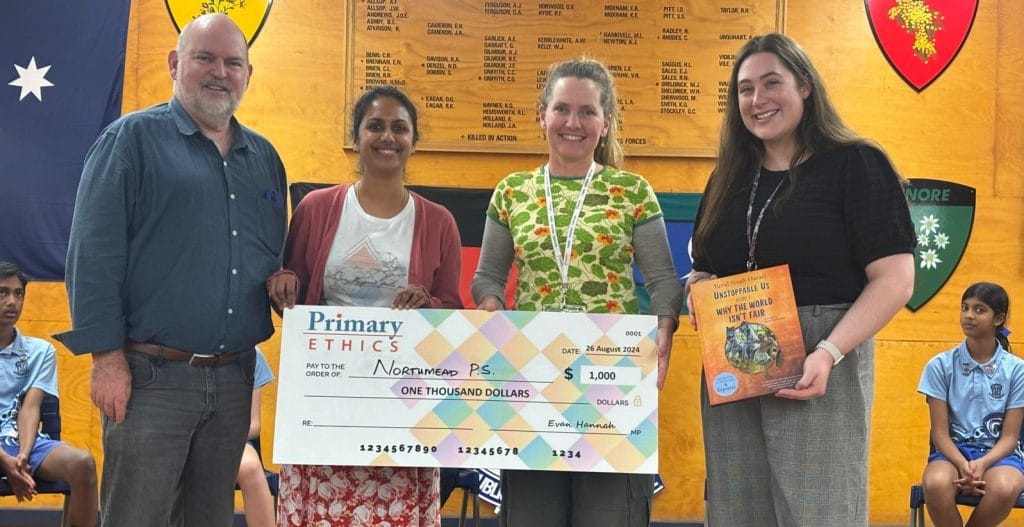
Northmead Public School ethics team were co-winners of the 2024 Kinghorn Volunteers of the Year award – in their school’s centenary year. At a recent school assembly they were presented with their $1000 winning cheque to go to their school library, as well as a hardback copy of Unstoppable Us by Yuval Noah Harari.

Evan Hannah, Primary Ethics, Mallika Ramaswamy, Veronica Roelink and the school librarian.

Northmead is a large, diverse school in western Sydney. The team have worked really hard at building a very strong, steady and committed presence to ensure that ethics is now offered across all years, having started with only two classes a decade ago. The reputation and popularity of the program has grown significantly and now almost one third of the school population is engaged in ethics lessons. The program is seen as an important part of school life and the team is well known and respected. With a diverse, committed and community-minded team, they’re not only teaching ethics — they’re building a lasting legacy. 

Our volunteers love the conversations and lessons we get to share with the kids and we especially love catching up each term to chat all things ethics and learning from each other's experiences. We all feel that we get as much from the experience of teaching ethics as we give to our students each week.

Former ethics coordinator Tania

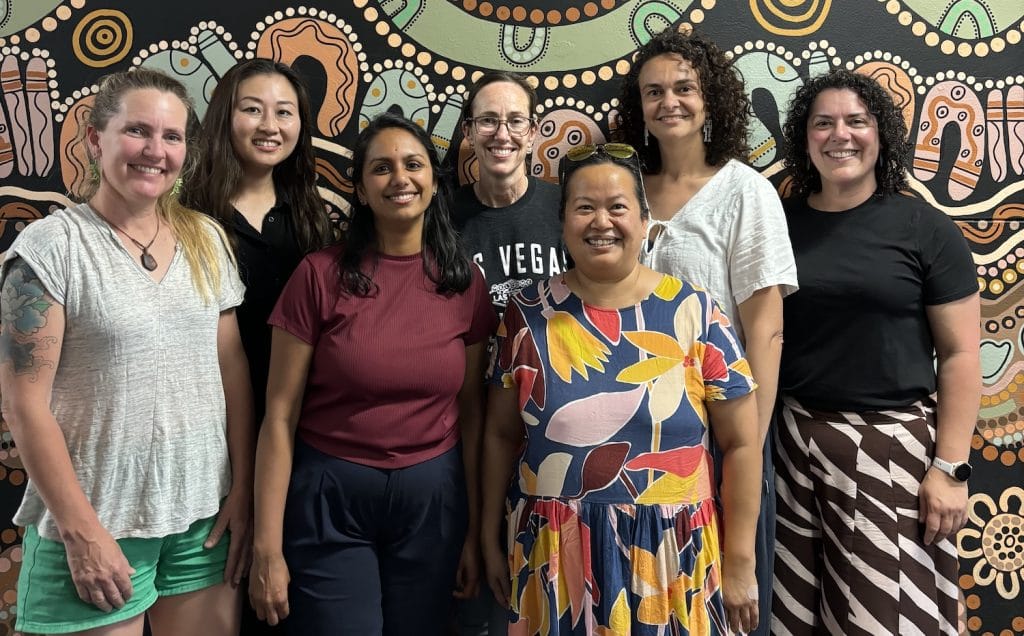
The 2024 Northmead ethics team, from left: Veronica, Christina, Mallika, Susannah, Myat, coordinator Tania, Elaine. Missing: Abha.

Volunteer Elaine

One of the team, Elaine Lee, told her story:

I have always wanted to volunteer in a program that has an impact for others. Taking a career break, I saw this opportunity  advertised at our school and jumped at the offer after reading up on the Primary Ethics program. My background is in Learning & Development and the program aligned with my values of instilling morale and critical reasoning, even more cause to volunteer with Primary Ethics.

What makes it great is that you don’t have to have facilitator experience! The training program is very well constructed, mine was led by Kelby Mason. 

 Knowing that I can make an impact for my child and the children of tomorrow makes it very rewarding and fulfilling. The curriculum is current with today’s scenarios and it’s such a pleasure to work with a cohort of like-minded volunteers who  want to make a difference. 

I encourage anyone who has the opportunity to participate in this program. I hope this becomes the norm as part of a child's learning in primary and high school. Thank you, Primary Ethics!

Elaine Lee. volunteer at Northmead Public School

Conference 2019: Reflecting on past challenges, planning for the future

As the world grapples with major economic, political and environmental change, our hope for the future lay in the ability of our emerging leaders to make well-reasoned decisions on issues with far-reaching consequences. This was the message Dr Simon Longstaff of the Ethics Centre had for the 160 attendees at Primary Ethics State Conference held on Saturday October 26.

On a personal level, we all benefit from the ability to think critically and to reason. Education in ethics is crucial in helping us, regardless of our age or stage in life, be better equipped to tackle the various challenges we face.

Not-for-profit group Primary Ethics’ second state conference was generously hosted by Western Sydney University in Parramatta. Ethics volunteers from around the state converged to participate in a day of ideas about the work they are engaged in and the path that lay ahead.

Keynote speaker Verity Firth, head of UTS Centre for Social Justice and Inclusion and former Minister for Education, revisited the challenges leading up to achieving legislative change in 2010 that permitted ethics classes to be delivered in NSW public schools alongside special religious education classes. Almost 10 years later, Primary Ethics represents the largest ethics education movement in Australia.

So where to now? Renee Bilston from Farmhouse Montessori spoke about the benefits of ethics classes to her school under the recent partnership with Primary Ethics. Primary Ethics’ Elizabeth Allen spoke of the workplace volunteering project that has seen 14 UNSW staff trained and supported to deliver ethics classes in schools near the university’s Randwick campus, not simply to engage and contribute to local community, but as a mechanism for staff wellbeing and meaning.

Meaning was a theme developed by Mitra Gusheh, Executive Manager, Social Impact at UTS in her presentation of the study by Dr Gianni Zappalà on the outcomes of volunteering in the lives of Primary Ethics volunteers.

Curriculum author Dr Sue Knight and philosopher Kelby Mason discussed the philosophical framework behind the Primary Ethics curriculum, with Classroom Support Manager Coral Sturgess and Trainer Sophie Patterson exploring implementation of the program in the classroom and its underpinning of 21st century skills.

The value of applied ethics was reflected upon in a lunchtime screening of The Final Quarter and a talk by 13-year-old Belle, who explained how ethics classes had helped her to have conversations with people with differing views on complex topics such as climate change.

In 2019, 45,000 children participated in weekly ethics classes in 500 schools across the state thanks to the contributions by donors and a team of 2800 trained volunteers.