Category: Grandparents

@Home bulletin for parents – Term 3 2026

Welcome to @Home bulletin for Term 3 2026, where we let families know what your children, from kindergarten into secondary school, are exploring in their ethics lessons this term.

The topics we show below are based on classes which begin at the beginning of the year – this can vary as schools start their ethics programs at different times. If your child tells you they are discussing a topic you don’t see in this bulletin, you can also look at the Curriculum section of our website.

We hope the students talk about ethics with you at home – ask them questions about it!

Kindergarten: Sadie and the machines (*new in 2026*): Machines make some things easier and other things possible – but does that mean we should use them all the time? Through stories about Sadie and her family, students explore what machines are for and what makes a machine helpful. They’ll consider questions like: is a machine useful if it looks good but doesn’t work properly? Is it okay to use machines just for fun? Would we want a robot helper to do everything for us? And are there some things we might be better off doing ourselves?
Later in the year, students consider the importance of owning up to mistakes.

Stage 1 – Years 1 & 2: Saying sorry: What does it really mean to say sorry – and when should an apology be followed by forgiveness? Through stories about a young emu named Kalaya, students explore apologies, accidents, broken rules and the reasons people do the wrong thing. They’ll consider whether it matters how an apology is made, whether the person means it and whether they try to make things better. Is saying sorry always enough? Does understanding why someone acted as they did make them easier to forgive? And does forgiving someone mean that what they did was okay?
Later in the year, students talk about standing up for what we believe is right.

Stage 2 – Years 3 & 4: Imagining how others feel: Being able to imagine how someone else feels can help us decide how to respond to them. Students begin with familiar situations involving friends before considering the life of a child whose experiences are very different from their own. They’ll explore questions like: how can we work out what another person might be feeling? Is it possible to imagine an experience we’ve never had ourselves? Can we care about someone else while also feeling disappointed or upset about what their situation means for us? And how might understanding another person’s feelings help us recognise when something should change.
Later in the year, students think about how different kinds of living things should be treated.

Stage 3 – Years 5 & 6: With AI who needs school … or childhood? (*new topic in 2026*): As artificial intelligence becomes increasingly capable, students explore how it might change schools and the way we learn. Is it okay to use AI to complete an assignment if a teacher hasn’t explicitly said not to? Is it fair if some students have access to AI tools and others don’t? Students will also consider whether relying on AI could weaken our ability to think for ourselves, whether teachers should use it to assess work and provide feedback, even whether schools and teachers will still be necessary in the future.
Later in the year, students consider what influences how morally responsible someone is for their actions.

Stage 4 – Years 7 & 8: What do I owe my people?: What responsibilities do we have to the teams, countries and cultures we belong to? Students explore whether loyalty means putting the group first and whether we should remain loyal when we think our country is doing something wrong. They’ll also consider whether young people have a responsibility to preserve their culture and language, particularly when that culture is at risk of disappearing. Finally, students examine who can claim ownership of cultural objects, traditions and art forms, asking when cultural exchange becomes cultural appropriation and whether museums should return artefacts taken from other cultures.
Later in the year, students discuss the ethics of being ignored and how to navigate fake news.

Each term brings new ideas and questions and we hope these topics spark interesting conversations at home as well!
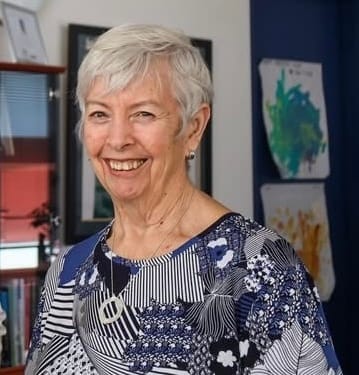

11 years in ethics: Gail’s story

Gail Batman has recently retired from ethics volunteering, having given 11 years as a teacher and then coordinator after retiring from work. Gail is one of our many unsung heroes, quietly and diligently bringing ethics lessons to children in public schools. Here is her story – thank you for a great effort Gail.

Gail’s story: I have completed 11 years since starting with Primary Ethics.

I’d been living in Canberra but was closely following the battle to get the ethics program introduced in NSW schools.  When I moved back to Sydney, my niece asked me to help out when she started ethics at Panania Public School (a southern Sydney suburb). I was retired and looking for a volunteer opportunity and I very much supported the ethics program, so I signed up. I transferred to Clemton Park (several kilometres away) when my elder granddaughter started school and subsequently saw both my granddaughters through the primary years until they moved to Melbourne some years ago.

As a grandparent, this has given me a wonderful connection to my grandchildren; I knew their teachers, their friends and the rhythm of their school year.

When I attended school events, I knew so many children from past ethics classes and watched them perform, compete and receive awards with great pleasure. Walking through the school grounds, I was greeted by many cries of “Hello, Mrs Batman” and sometimes had to nimbly avoid being hugged by a small child who was happy to see their old ethics teacher.

Becoming a coordinator: When the previous coordinator moved away, I took on the role of coordinator at Clemton Park as well. After a few years teaching, I had a good understanding of the school and apart from getting classes started at the beginning of the school year, it does not take much more time.  The biggest challenge is recruiting new teachers.

When my grandchildren moved to Melbourne, I continued teaching for a few more years but was struggling to hear well, so in recent years I was just coordinating. I have never felt I was a natural at teaching, but the Primary Ethics training and support is excellent and the lessons are very straightforward to deliver.

Over my years of volunteering in ethics, I think I must have taught both odds and even-year lessons of every stage.  So I’m very familiar with wombats, meerkats, caterpillars, whales, chimpanzees and the many other creatures that populate the Primary Ethics universe.

I have at times been, surprised, impressed and occasionally bewildered by things that my classes have said and done, but I am completely convinced that it has been worthwhile for all of us.

Gail Batman

Older students: I particularly enjoyed teaching Stage 3. The topics are really interesting (homelessness, voting, equality, etc) and after four or five years of ethics classes you notice how much the students have developed their ability to discuss issues and express their views respectfully.

Barry: A highlight of my week

For Seniors Week 2026, we asked some of our over-70 volunteers to tell us about their experience with us. There is no age limit to ethics volunteering – we have volunteers in their late 80s. At 73, Barry Richardson is in his eighth year of volunteering with Primary Ethics.

Barry’s experience

Eight years ago, I was transitioning to retirement, moving from a five-day working week to three days. I saw an advert for ethics teachers in our local community Gazette, teaching at our local primary school, Artarmon, which my now very grown-up children had attended many years ago. What a great way to give something back to our wonderful community.

I thoroughly enjoyed the training and meeting an eclectic group of people of varying ages, backgrounds, experience and interests.  The training introduced me to some great new skillsets.

My first ethics lessons were exciting, sometimes challenging, but always fun.  It was like going back to school myself, with all that that brings.

I have been lucky enough to teach all ages and stages, at one time taking three classes a day.  I’ve met some wonderful other volunteer teachers from our local area, as well as the school staff.  It is both enjoyable and rewarding to be involved with young, active minds engaged in critical thinking and to learn about respectful discussion.

Without doubt, my classes have been a highlight of my week.

Barry

I am now retired and have moved to the inner west, where I have transitioned to teaching ethics at the local high school.  More challenges, but always fun and certainly rewarding.

I also relief teach at the local primary school which three of my grandchildren attend or have attended.  Having moved to a new area after 40 years in Artarmon, ethics volunteering has been a great way to meet many people in the community through the local school.

You’re never too old to be an ethics teacher!

William: Ethics volunteering is meaningful, valuable and satisfying

For Seniors Week 2026, we asked some of our over-70 volunteers to tell us about their experience with us. There is no age limit to ethics volunteering – our oldest volunteer is currently 88. At 81, William Rodwell is in his ninth year of volunteering with Primary Ethics.

William’s experience

As an 81-year-old, I think it very worthwhile to let my fellow seniors into a secret. For those of you with an inquiring mind and an interest in our grandchildren’s and hence our society’s future, there is something for you that’s even better than the events of the NSW Seniors Festival. And you can enjoy it every week! That’s being a volunteer ethics teacher in a NSW school.  I am now in my ninth year of volunteering and it is undoubtedly my most rewarding weekly activity.

My proximate motivation for volunteering to teach ethics was to ensure that my grandsons had access to the Primary Ethics programme at their primary school. To me it also felt important to find a way to contribute to society after I was no longer doing that through work. The ethics programme provided a meaningful and valuable way to do so.  My grandsons are now well beyond primary school but teaching ethics is so satisfying that I continue to teach at their former school and now also at other schools.

We volunteer ethics teachers believe that the Primary Ethics curriculum provides a unique opportunity for school students.  It develops their moral sensibilities, including the capacity to empathise with others, consider other peoples’ points of view, be aware of the relevance of intentions and circumstances to ethical decisions, and so on.  The emphasis on the students providing reasoned arguments for their ethical standpoints also develops their capacity for critical thinking.  To me critical thinking is as valuable as the ethics component, as it is especially important in this age of false information – it provides students with the tools to distinguish specious arguments from valid ones.  The structure of our lessons as collaborative enquiry also develops the students’ ability to work together to reach a collective understanding of the ethical issues under discussion.  Importantly this does not mean they have to agree with each other, but they should understand other students’ points of view, which is so important in our contemporary polarised society.

The most consistent advice I see given to seniors to maximise health and wellbeing is to maintain their social engagement and mental stimulation.

Being a volunteer ethics teacher provides both. The kids’ openness to ideas, joie de vie and capacity to think seriously about quite demanding concepts is a joy to behold.  I think this interaction with children and seeing the value of the ethics program for students is very rewarding.  In addition, I find the syllabus we teach stimulating and thought-provoking for me, which adds to my enjoyment of the role and has contributed to my own philosophical development.

Moreover, the social engagement does not end with the students.  A group of people prepared to contribute their time to teaching ethics – ie the other volunteers at my schools – constitutes a lovely, supportive and interesting community.  As an old person it’s a treat to be involved in a group covering an age range from parents of Kindy children to long-retired persons like me.  Who wants to be confined to old peoples’ groups where the conversation inevitably turns to ailments, infirmities and funerals?  Not me!

When I suggest to retired people that they would enjoy becoming a Primary Ethics teacher they often say something like “I could never manage a group of primary school kids; it’s too daunting”.  I was also anxious about this at first.  I had been volunteering in several roles at my grandsons’ school, so I knew I enjoyed interacting with the pupils, but that’s not the same thing as controlling a class.  However, the students are not generally little demons itching to cause trouble – most are delightful. In addition, in most primary schools a regular teacher sits in the class to help with any behaviour management issues.  They don’t contribute to the teaching itself, but their mere presence is enough in most cases to ensure that the class behaves and they are there to help if some students don’t behave.

My only regret about embarking on volunteer ethics teaching is that my personal circumstances prevented me from becoming involved earlier!

William

Helen: Primary Ethics and ‘senior’ me

For Seniors Week 2026, we asked some of our over-70 volunteers to tell us about their experience as ethics volunteers. There is no age limit to ethics volunteering – our oldest volunteer is currently 88. In her later-70s, Helen Kerr-Roubicek is in her eighth year of volunteering with Primary Ethics.

Helen’s experience

When I took that Primary Ethics pamphlet at the Drummoyne Primary School fete, I opened the door to a very stimulating volunteering adventure. That was around eight years ago and I was approaching 70. I had three granddaughters at the school. After I began volunteering, while we only shared limited time in ethics classes together, I enjoyed the fact they now saw me in a broader role in their school context. They have all moved on to high school but I’m still here – loving being the coordinator for Primary Ethics of a brilliant team of nine volunteer teachers.

Over those years I have always found my PE journey stimulating, because I am challenged to think deeply about the philosophy and research behind contemporary issues. These form the background to the curriculum that is set out for we teachers to follow and facilitate in lessons.

When people ask me ‘so what do you tell the kids?’, I delight in explaining that it is not about ‘telling’. It is a community of enquiry approach that encourages students to think together about topics such as fairness, disagreeing respectfully, screen time and understanding diversity. They develop their own ideas and become more confident in expressing those to others and giving reasons for why they think what they think. They develop skills in reflecting and listening to what others think and say. PE is open to all faiths and belief systems. Mutual respect is a very important underpinning value for the classroom discussions.

People also ask ‘what’s involved as a volunteer?’ Then I can’t wait to explain that the setup has many amazing strengths:

  • It is very economical timewise and the time commitment is predictable – after training, a teacher typically needs to download and read over a lesson a few times and print copies of any pictures or activities in preparation for the average 35-minute lesson each week. There is a quick online feedback process after each lesson.
  • PE is an organisation that provides professional layers of user-friendly training and support. The technical support for the Internet materials is very effective and makes it easy to be involved with only basic skills (which are bound to improve as well). There is also good classroom support if issues arise and if all else fails there is a helpdesk at the end of the phone to clarify direction. All this is provided free – it is not expensive to become involved.
  • Undoubtedly the most exciting aspect is the opportunity to have regular contact with young people, exploring day to day issues with them, hearing their ideas and having the opportunity to support their personal growth.

After three to four years, I was offered the opportunity to become the PE team coordinator for the school. I was reluctant at first, lacking confidence. This is a liaison role with the school on all relevant matters including the setting up (online) and management of classes. Actually it has turned out to be a perfect extension of my favourite professional roles – resource linking, mentoring, recruiting, team building and with limited administration. There is also plenty of support for this role. And the best thing – it’s time limited too! Setting up at the beginning of each year is the busiest time.

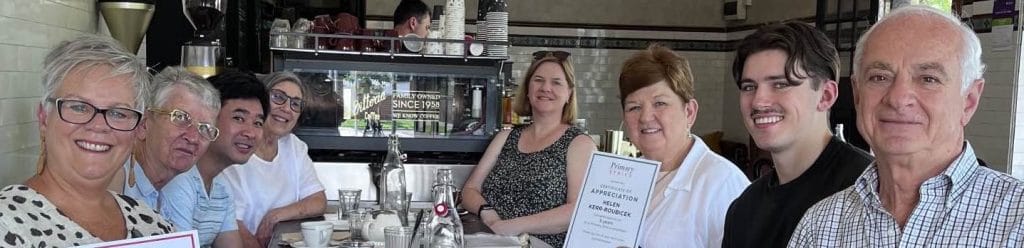
Helen third from right with other Drummoyne volunteers.

Our team is made up of a balance of retired older people who have a range of rich professional and community experiences, and keen parents of current students who keep us in touch with school news. We manage our team organisation through a Whatsapp group and look forward to catching up at our end of term dinners.

Over the past four years I have been through some tough times personally as I journeyed with my husband in his experience of serious illness until his recent death. The care and support from my team and the school-  from offering to take my classes or other tasks, to being available for ‘debrief’ coffees and messages – have made a real difference for me. And the regular classes with bright, lively faces each week ready for another discussion have provided a structure activity in my week that has also been helpful.

The camaraderie with my team and the wider PE community, including my regional manager, has been incredibly rewarding and uplifting. I realise as I look back over the eight years that this community building is at the heart of my PE experience and it is so good to feel that the lessons we provide are assisting students to do that in their own worlds.

Have I just been lucky with my school and team members? Would it be different somewhere else? There is no doubt that I have been fortunate and I know that there are many influences on how PE functions in different schools, including critical issues like when it is timetabled and how supportive the school executive is. But it is my belief now, that the community of enquiry approach as an underpinning of this program is right for this time and resonates with young people, parents, teachers and community members. Why else would we have growing numbers in our classes and more volunteers to teach in such a busy world?

Diana: Investing in future generations

For Seniors Week 2026, we asked some of our over-70 volunteers to tell us about their experience as ethics volunteers. There is no age limit to ethics volunteering – our oldest volunteer is currently 88. In her mid-70s, Diana Dagg is in her seventh year of volunteering with Primary Ethics.

Diana’s experience

I was drawn to this role because teaching ethics offered the chance to teach my grandchildren. Over the years I’ve taught ethics to two grandchildren at Arncliffe Public School (they’re now at high school) and currently two grandchildren at Marrickville West Public. But I discovered early on that this is much more than simply having an opportunity to spend time with my grandchildren.

Before I list the many benefits, it must be noted that ethics teaching is not just a cushy volunteering job. Without being too dramatic, becoming an ethics teacher is an investment of our time, our expertise and our belief in the importance of contributing to future generations.

To do the job properly, we as volunteers need to commit to preparing well for lessons, taking the time to learn our students’ names and to understand any of their particular needs. We must also be willing to ask for and accept advice from trainers and schoolteachers. There are lots of opportunities for continuous learning within the ethics teaching technique.

We don’t need to have been teachers before becoming ethics teachers. In fact, friends of mine who were schoolteachers before becoming ethics volunteers say they had to ‘unlearn’ the traditional teaching practice of rewarding ‘correct’ answers. This ethics teaching role is about helping our young students develop approaches to thinking for themselves.

Above all, to be authentic, we as volunteer ethics teachers must value and want to understand children.

Spending this teaching time with my grandchildren each week is rich with potential, including:

  • Hearing their opinions about issues that affect them
  • Meeting and hearing the opinions of their classmates as a group
  • Providing an intersection point for conversations with them outside of ethics
  • Meeting their teachers and understanding the school ‘culture’.

My relationship with my grandchildren has been strengthened by my ethics teaching role because:

  • we confidentially discuss (and I get to hear) what questions matter to them in our ethics class
  • their friends like and respect me as an ethics teacher using our humanitarian rules in class – that earns me points as a nanny!

There are many great things about this role apart from the strengthened bond with my grandchildren:

  • I have the opportunity to meet and work with students with disabilities, to help them learn
  • I have greater insight into the challenges teachers face each day
  • I’ve enjoyed some fun lunches and morning teas, sharing war stories with other ethics teachers.
  • I’m proud to be investing in future generations through rigorous teaching practice and a thoroughly researched ethics curriculum which reflects values similar to my own.

Are there rewards/benefits that I wasn’t expecting?

Hmm, probably it’s the opportunity to understand the needs of students with disabilities and to be mightily impressed by the skilled teachers who work with them. Also, the satisfaction of managing challenging situations well.

Any concerns about dealing with technology (EVIE) or coping with things like hearing impairment?

It’s been fine to use the technology but if there are problems, I know I can turn to the very helpful Primary Ethics staff on the Helpdesk or my ethics coordinator and/or school admin or teaching staff. I already have hearing aids (yikes!) so no probs with hearing in my classes.

My Journey as a Volunteer Ethics Teacher

COVID had an unexpected consequence for Lalita Kanetkar – it was the start of her journey to becoming an ethics teacher.

Lalita writes: During the COVID years, most parents had a very difficult and stressful time managing both their own jobs from home and the schoolwork of their children – particularly if the children were young. My younger daughter had a son in Year 1 and was dealing with her own job and home schooling. It got me wondering – could I be of any help with the home schooling?

When I put this to her, she was genuinely surprised … because, to be honest, I had never helped my girls with their schoolwork as they were growing up. Even so, my daughter accepted my offer. So the journey began, home schooling over Skype. I felt enormous relief and satisfaction when my grandson did really well that term, as evidenced by his school report. And so we continued with the home schooling and I had a sense of real success (in truth, the success belonged to my grandson!)

However, this success led to something quite unexpected. Around this time I started talking to a friend about Primary Ethics. She herself had been volunteering as an ethics teacher for a few years. My daughter’s encouragement and hearing about my friend’s experience got me really interested. I checked out the Primary Ethics website and registered my name. Following the interview, I undertook the training and so began my journey as a Primary Ethics teacher.

Lalita Kanetkar

The intention of ethics education is to teach children the skills they need for critical thinking from a very young age - recognising that it is so important in life to listen to different opinions, learn to question and develop the confidence to express one’s own point of view. After all, there are so many occasions in life when it not only important but also difficult to make choices and decisions. For example, how do we know if the choices we make are ‘right’ or ‘wrong’? Have we considered how they might affect others?

Lalita Kanetkar

These are the sorts of dilemmas the ethics curriculum aims to help children consider by introducing simple and relatable stories about choices and decisions they must make in their daily lives. By asking many questions, the lessons try to get children to think about why they agree or disagree with the opinions and decisions made by different characters in the stories.

For example, for younger children from Kindergarten to Year 2, we use simple stories on issues such as hurt feelings, teasing, telling the truth, showing empathy or accepting an apology. Children are able to relate to the characters and talk about whether they agree or disagree with them and whether they themselves would behave differently in the same situation. Slightly older children, from Year 3 and above, will have developed the capacity to think and question more critically. Again using stories, we consider topics of a more complex nature – be it keeping animals in zoos, bragging, etc.

To assist in critical thinking, the curriculum also introduces logic – recognising that the skills for logical thinking are an essential ingredient of critical thinking.

Since 2021 ethics has also been taught in Years 7 and 8 of public high schools.

Of course this means there is a great need for volunteers. In order to volunteer as a teacher, you need to obtain a Child Protection Certificate and a Police clearance. You also need to undertake a short training course. However, there is no requirement to have teaching experience.

Of course, being a volunteer means there is no financial remuneration. So you may well ask, what have I personally gained through my ethics teaching experience?

Well, my class goes for 30 minutes and I can assure you it is the most enjoyable half hour spent in the company of young, inquiring minds. I started teaching this group of children when they were in Kindergarten. They are now entering Year 3. It has been so exciting for me to see how their thinking has developed, how well they are now able to express themselves, set out their views and listen to each other. They understand that it is important to respect the opinions of their classmates though they themselves may disagree with those opinions.

And then of course, there are some heartwarming incidents. When for example, a child impulsively says, “I like you!” And once when I told my class I was going to be away for a couple of weeks, they cried out, “We’ll miss you!” I found that so touching.

And finally, teaching ethics is influencing me to think critically about my own day to day activities. The other day after a hard morning of housework, I finally sat down to watch a movie on Netflix. When it finished I was considering whether to watch another. And then the critically thinking voice inside me started questioning whether this would me a just reward for all my hard work in the morning or was I perhaps succumbing to laziness?

What do you think? If you were to join me in an ethics class I would love to hear your views. Better still, why don’t you consider starting your own journey as a volunteer ethics teacher!

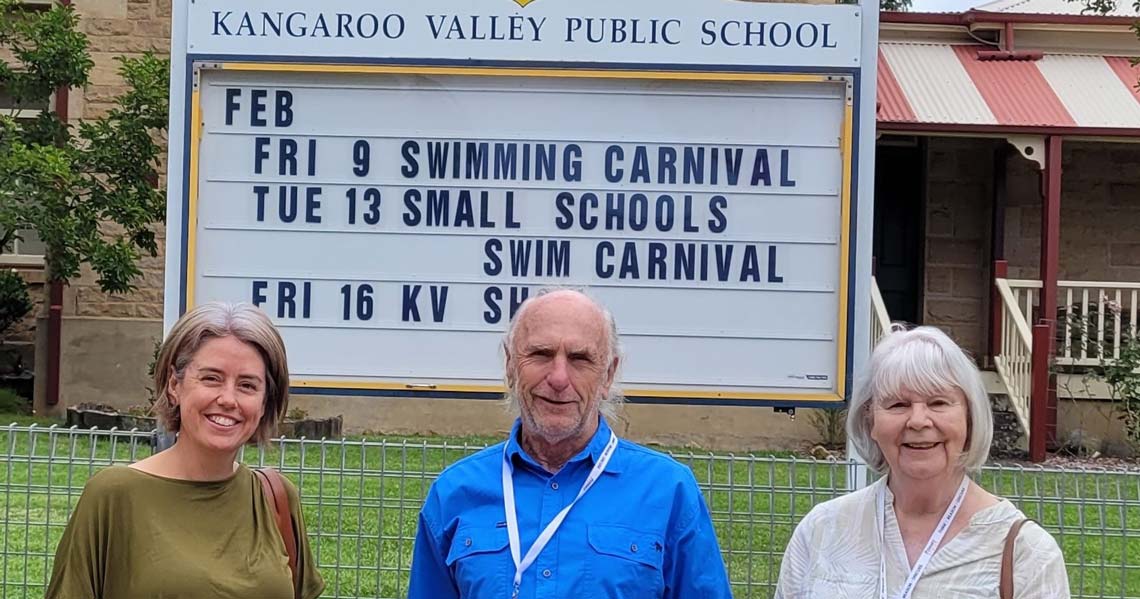
‘It’s a privilege’ – Kangaroo Valley ethics

Every Thursday in term time, three trained volunteers teach ethics at Kangaroo Valley Public School. In ethics classes, children from kindergarten onward are guided to develop their skills in critical thinking, ethical reasoning and respectful discussion. Ethics lessons explore everyday ethical issues such as truth and lying, getting even, being fair or unfair, cheating and friendship.

Michael Cox is entering his seventh year as an ethics volunteer. He started out teaching his grandchildren but they’ve moved on. Michael stayed because he wanted to keep contributing within his community and finds the course materials “excellent” and personally interesting.

“The course explores how we humans derive our sense of right and wrong and our principles such as honesty, fairness and equity, how we can live together in a way that facilitates human flourishing and wellbeing. We could do with a bit more of all that,” Michael says.

The capacity to evaluate

‘In these times where there is increasing blurring of what’s true and what’s not and lapses of ethical behaviour in some of our social institutions, I think children need to be equipped with the skills to reason out ethical dilemmas and to engage in respectful dialogue with others. And to develop the capacity to evaluate and make their own considered judgements about what they see, hear or read and to become proficient at spotting bias.”

Irene Dungey has also been volunteering for several years – in fact she taught ethics in Dapto and Port Kembla before moving to Kangaroo Valley.

“Initially, I was retired and searching for something to volunteer for in the community. When I heard about the ethics program, I was excited at the prospect of teaching something I believed in. I found my initial training excellent and we were given feedback that was very useful.

“When the fires went through the valley in 2020/21 our house was destroyed. By the time I was back on my feet I heard that ethics had started at our local school and here I am.”

Gai Halcrow also initially began teaching ethics outside of Kangaroo Valley. “I first volunteered for Berry Primary School when my child was in preschool. Then when he started at our local small school here in Kangaroo Valley, I joined Michael and started teaching my son as part of the kindergarten class. We are now up to Grade 4.”

Each of these volunteers greatly enjoys teaching ethics.

Says Michael, “I sometimes feel quite inspired by the ability of the children to address complex issues … when a child comes up with an insightful way of looking at a problem we’ve posed and others pick up on this and make a further contribution, even though there may be no clear black and white answer.

“I feel I’m making some humble contribution to the emerging generation of good citizens and community members. I would hope they feel that it has been of benefit to them in developing ways of figuring out what’s okay and why it is okay – or not. And we have a bit of fun.”

Irene echoes this. “The lessons constantly make me rethink some of the ideas I had about certain topics and hearing the children’s perspective is encouraging to me.

“I enjoy the interaction with the students. Giving them the space and time to think about the reasons for their decisions is, I believe, a big step towards them understanding and thinking more deeply about the question. Hearing what others think and say can guide their mind to thinking in another direction, other possibilities.”

What are Gai’s reasons for volunteering with Primary Ethics? “Firstly, volunteering with small schools is a really lovely way of being a part of this community. Secondly, I’m an aid worker by profession and I’ve always appreciated the values and ideas behind ethics and the types of discussions we have around social justice issues. Thirdly, the kids! Each ethics circle as the years have progressed, they bring their own perspectives and ways of thinking through topics.”

Pro-social behaviours

Michael explains how he came to be an ethics teacher. “I had never taught children before, but as a grandparent I have a personal interest in fostering the ability of children to think for themselves, solve problems in living and develop pro-social behaviours. Having retired from work I had the time available.

I undertook a two day in-person training course [there are also fully-online training courses]. I did not find the course material difficult, I think it is excellent and well thought out.”

Michael estimates that he spends 30 to 60 minutes in preparation each week, a bit of time printing out material [some people read the lesson scripts from a tablet], 20 minutes each way in travel. Kangaroo Valley’s class time is 50 minutes.

“The classes are discussion-based and follow a clear format provided in the lesson script each week. I don’t impose my own views but try to draw out ideas from the children using the course material provided. Questions are posed, stories read that raise issues for consideration within the group or sometimes in pairs.”

Irene feels that being an ethics teacher is a privilege. “To have the opportunity to teach children ethics is a fulfilling and rewarding experience.”

Gai agrees. “It’s a privilege and it’s great to have our little valley school be able to support this program and to have our numbers grow to the point we can offer three classes this year.”

In fact there is demand for a fourth ethics class at Kangaroo Valley Public School in 2024 but all ethics lessons require a volunteer to teach them. If you have a spare hour a week on Thursdays, find out more about what is required on our website. To chat about options, call the helpdesk between 9am-5pm on weekdays on (02) 8068 7752.

Jo: ‘Joy, amusement and the intangible benefits of volunteering’

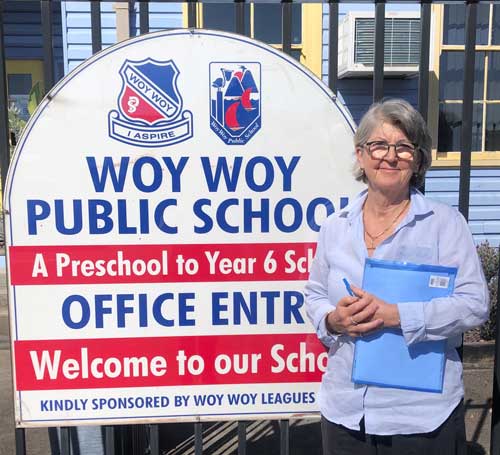
Jo Gardner began volunteering as an ethics teacher at local schools on the Central Coast six years ago. She was motivated by a sense of wanting to give back, having a connection with the young generation and providing an option for parents who don’t want their children to participate in religious education. Jo says she has found “joy, amusement and all the intangible benefits of volunteering” along the way.

Jo Gardner Woy Woy Public School

“Initially I saw an article about ethics classes in the local newspaper”, Jo said. “I’ve always had an interest in ethics and heard Simon Longstaff of the Ethics Centre speak on a number of occasions. The free training workshop with Primary Ethics was a wonderful experience and I’ve now learnt so much for myself about ethics and philosophy. I believe that critical thinking is an important skill for us all and being able to, in some small way, help kids develop these skills is a privilege.”

Jo teaches two classes a week and says it takes her about an hour to prepare for each, reading carefully through the lesson script which is supplied to her by Primary Ethics.

The best part of being an ethics teacher is the children. I am exposed to their wonder in life.

Jo Gardner – Volunteer Ethics Teacher

“I like seeing the kids thinking and then coming up with ideas… Their talkative natures with great explaining of their thoughts, sometimes a bit convoluted but always considered and revealing their willingness to think about ethical issues. Watching them have ‘aha’ moments and learning how to build on other children’s point of view. Also their willingness to disagree.”

Jo’s grandson has been in her ethics classes for the past two years. “I have been rewarded seeing him mature into a thinking, empathetic young boy. We’ve been able to discuss things in the lessons that would not normally come up in conversations between a grandparent and child.”

Jo says she would encourage anyone with a spare hour or two in their week to volunteer as an ethics teacher. No previous teaching experience is needed. Like Jo, you will get a lot out of it yourself, as well as contributing to the richness of your students’ lives.