Category: student

Eli aged 11: What I value most about ethics classes

At a recent evening with renowned philosopher Professor AC Grayling, 11-year-old Eli welcomed him to the Dulwich Hill Public School stage with these thoughts about being an ethics student.

Here at Dulwich Hill Public, some of us are lucky enough to do ethics classes on a Wednesday. I’ve had Catherine Grayling teaching me ethics since Year 2. I am now very ethical.

I think these classes give us some really important skills. Usually, Catherine gives us a dilemma and draws out our different opinions. She asks us whether our views change with new information. She teaches us to listen to what other people have to say, even if we don’t agree with them – because that helps us make our ideas better or more nuanced.

Sometimes it can be hard to listen to someone that you don’t agree with or when you think they’re wrong. But when you do listen, sometimes you learn something that you didn’t know or hadn’t thought of, or in working out why you don’t agree with them, it strengthens your own reasoning.

Eli

Over the years, we’ve grappled with lots of dilemmas. One week, it was a girl who had put in a heap of effort to grow sugar snap beans for her grandmother, but her brother did nothing and then got all the credit. Another time, it was about whether it was okay to lie to a bully about where your friend was.

In one class last year, Catherine asked us about palm oil and whether it was justified to cut down rainforest trees to make oil. Some people thought it was – it meant people could make money and then use the cleared land to build homes or schools and that would help grow and strengthen their community. Other people didn’t agree at all, because of the impact on the environment and the animals living in that area. As I sat there and listened to all the different ideas, I could see that there was merit to most of them, which then made me wonder whether there could be a solution that protected the animals and helped the people. Understanding competing interests can be a very powerful tool, as can developing advocacy skills. Both are proving quite handy with my parents.

Understanding competing interests can be a very powerful tool, as can developing advocacy skills. Both are proving quite handy with my parents.

Eli

* Please note that the photo above is not of Eli.*
Inquiring Minds Spring 2025

Welcome to Inquiring Minds for spring 2025, where we bring you stories and reflections from our ethics classrooms and our volunteers, as well as recent Primary Ethics highlights.

In this issue we collected stories from our wonderful volunteers, such as:

  • we hear from two professionals who put their skills learnt as ethics volunteers into practice at work
  • you can watch the video of our panel discussion on critical thinking and empathy in the age of AI
  • and we share a letter from a supporter whose father asked for him to be removed from Religion lessons in 1965.
  • Plus many more stories!

To receive the next Inquiring Minds direct to your inbox, make sure to subscribe to our newsletters.

Stories from National Student Volunteer Week

It’s National Student Volunteer Week, a great opportunity to showcase stories from our many student ethics volunteers.

Volunteering does look good on your resume, which is especially valuable for people starting out on their career, but ethics volunteering offers so much more than that. Top of the list from many of our students is what they learn themselves, which can be productively applied in their future work lives – knowing how to maintain neutrality, listen carefully, develop empathy and learn that it’s okay to change their mind about something, just as the school students learn to.

Reports from student ethics volunteers

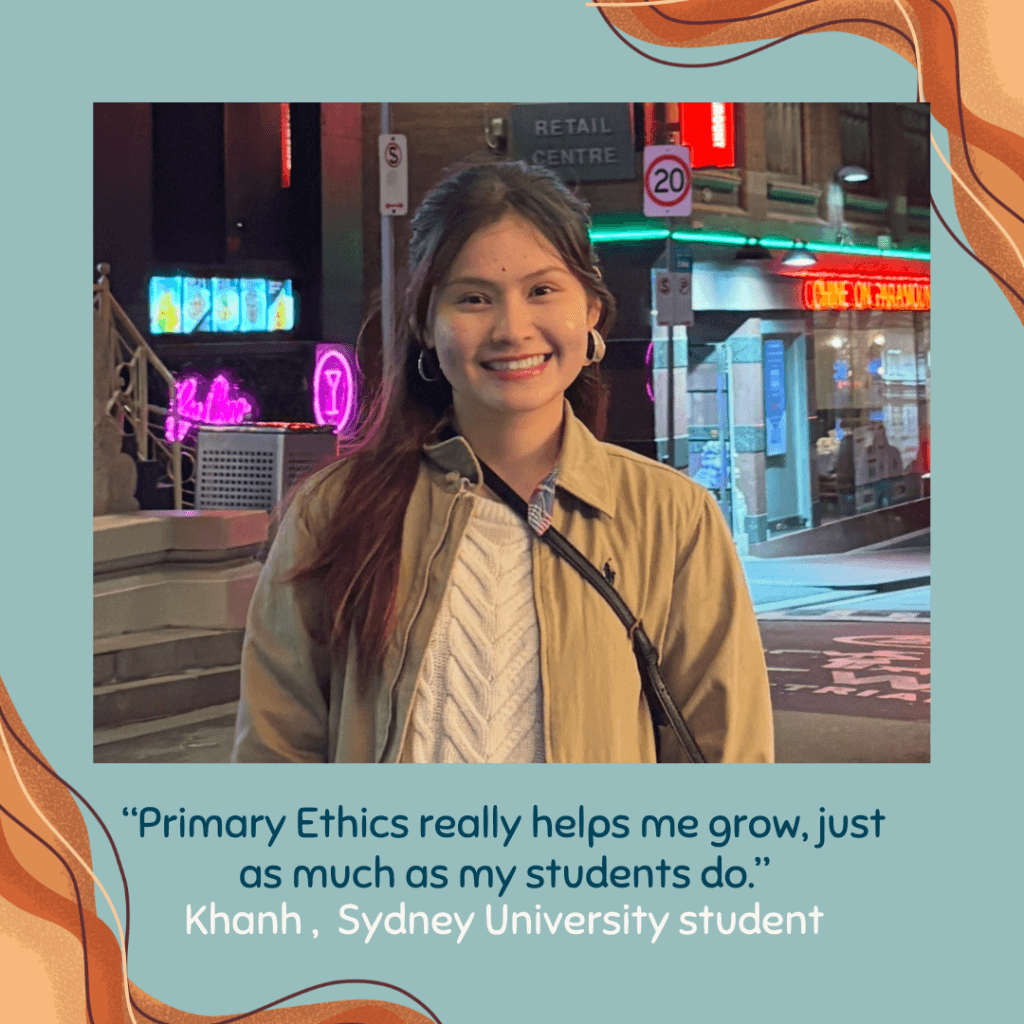
Khanh is a student of Nursing at Sydney University.

“I grew up in a culture where young children weren’t encouraged to speak up. With Primary Ethics, I get to help children feel heard and think for themselves – something I wish I’d had growing up.

Volunteering in ethics hasn’t just been meaningful, it’s helped me become more curious, thoughtful and connected to people. I ask ‘why’ a lot more now (maybe to an annoying degree!), but it helps me understand the people around me better, even those I already know well.

I am thrilled to be a part of Primary Ethics and would love to have more student volunteers as my colleagues. I truly appreciate what ethics brings to the community and to me personally. Being able to volunteer here feels like a once-in-a-lifetime experience.

Primary Ethics really helps me grow just as much as my students do.”

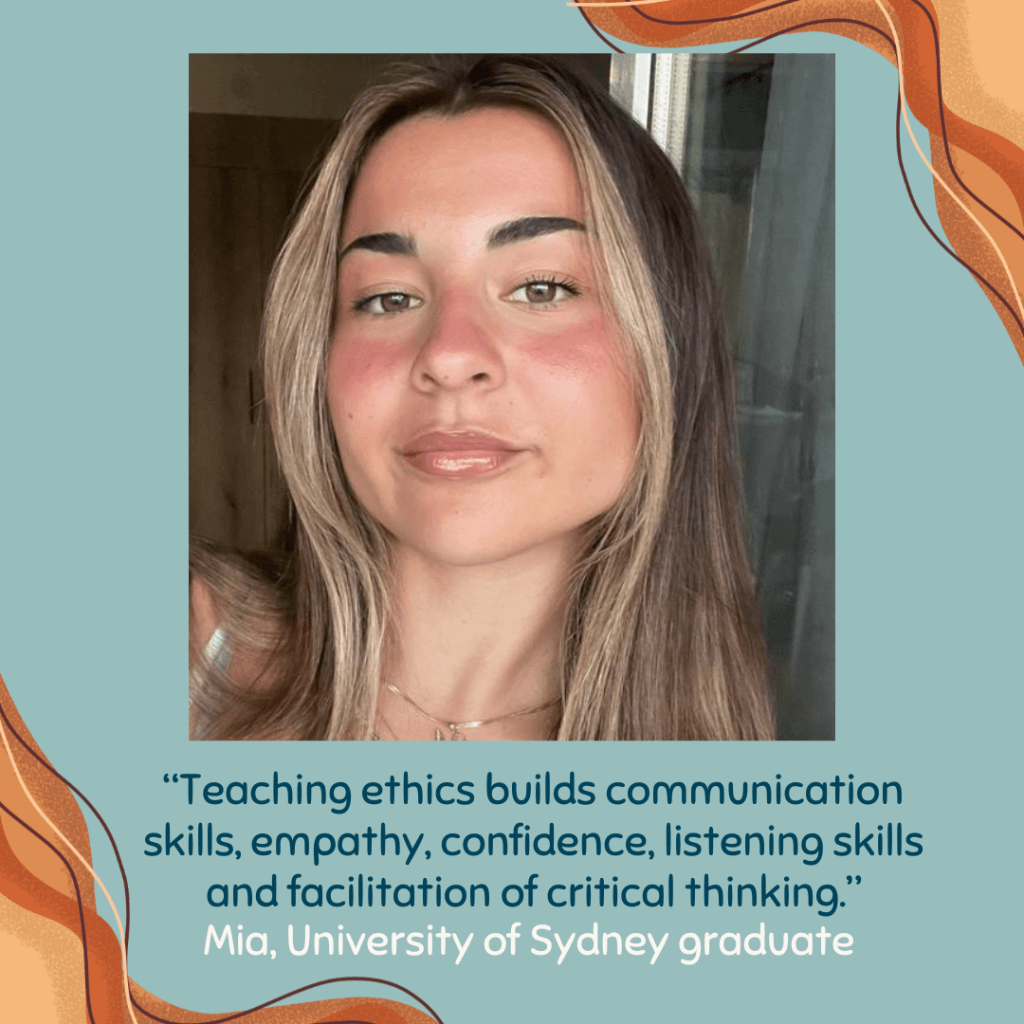
Mia is a recent graduate in the Bachelor of Medical Science from the University of Sydney.

“I started volunteering in ethics when I was 18, during the first year of my degree. I decided to begin my ethics journey to develop my critical thinking, reasoning, problem solving and communication skills, all of which are incredibly important in the medical field. My mother was (and still is) an ethics volunteer and together we became the first mother-daughter ethics teaching duo for Primary Ethics!

Volunteering for Primary Ethics is incredibly enriching for tertiary students. There is a common belief that ethics volunteering is especially good for students in education, psychology, health or social sciences, but I believe that teaching ethics builds communication skills, empathy, confidence, listening skills and facilitation of critical thinking no matter what your field of study or interest is.For students out there considering becoming an ethics teacher, seeking meaningful volunteering experience or even wishing to develop their interpersonal skills, I would highly recommend pursuing a volunteering role at Primary Ethics!”

Bharathi is studying Philosophy and Sociology at the University of Wollongong.

“At a time when young people are feeling powerless, helping children to think critically and have respectful discussions makes me feel empowered – that I can help create a world where young people feel better able to speak and be listened to on issues that impact them. If you’re a student and would like to be a part of that too, I’d highly recommend volunteering with Primary Ethics.”

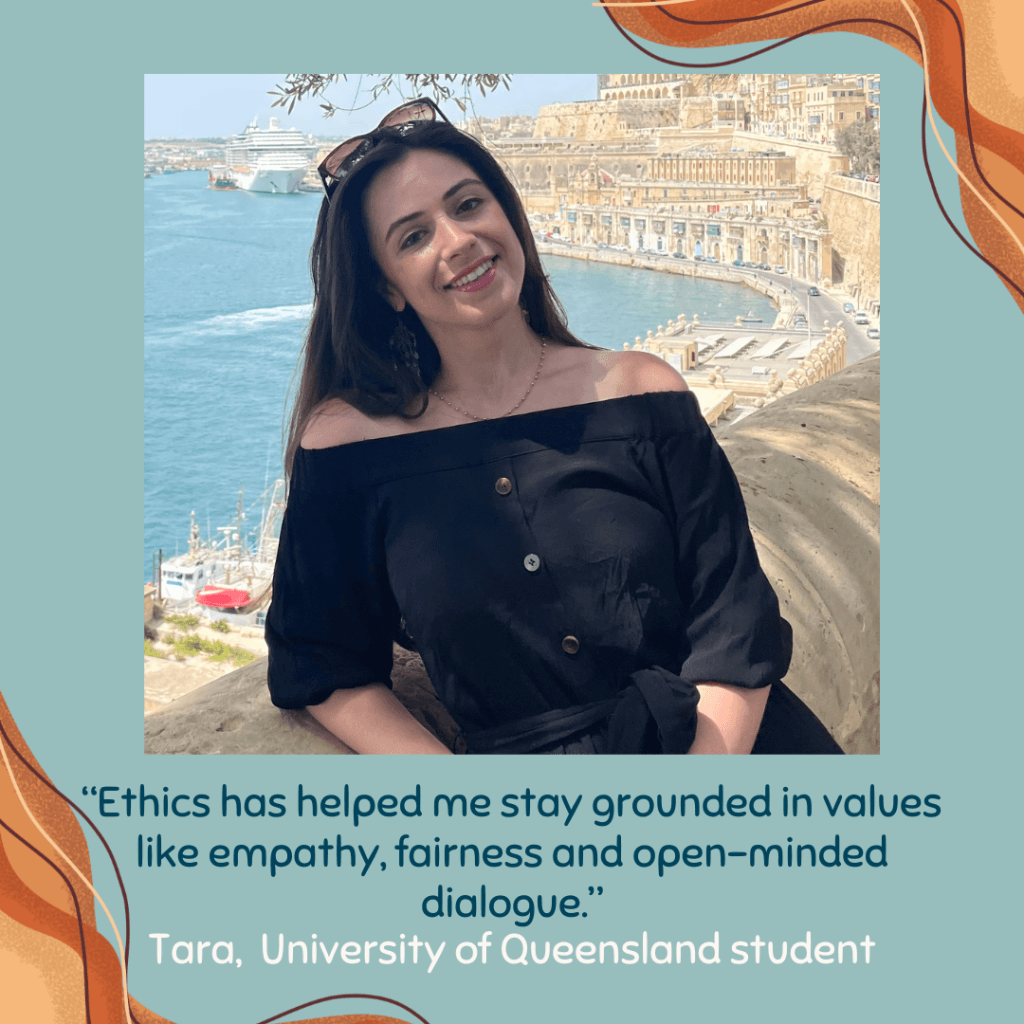
Tara is currently pursuing a Masters in Medicine at the University of Queensland.

“Volunteering with Primary Ethics has shaped how I communicate—with patients, colleagues, and children alike. It’s taught me to listen without rushing to judgment and to approach each conversation with curiosity and care.
I’m currently completing a Master of Medicine in Skin Cancer through the University of Queensland and working as a Dermatology Research Fellow at The Skin Hospital. Amidst the science and clinical work, ethics has helped me stay grounded in values like empathy, fairness, and open-minded dialogue. Being a Primary Ethics coordinator is one of the most rewarding things I do—it reminds me that respectful listening is a skill we can all keep building. I’d absolutely encourage other students to get involved. You don’t need to be an expert—just willing to ask questions and think deeply.”

An ethics student speaks out

“Ethics classes have been a huge help to me, both in primary and now in secondary school,” writes 16-year-old Keean from southwest Sydney.

“In ethics classes, I have seen so many shy students gain confidence and we have had so many interesting discussions. I learnt how to critically think about problems and delve deeper into my opinions and why I thought certain things.

Instead of just stating my opinion, I was able to understand how to reason and how to convey my opinions in a thought out manner instead of blankly stating them.

I also learnt how to have a functional group discussion with people with different opinions in a respectful manner.

Ethics classes have helped me in high school as well. They taught me not just to trust any information I come across, but rather check other sources and gather more information before coming to a final decision or answering a question.

Keean

Overall, ethics classes were so enjoyable, rewarding and so helpful for me, I highly recommend participating.”