Category: Volunteering

All about ethics lessons: webinars

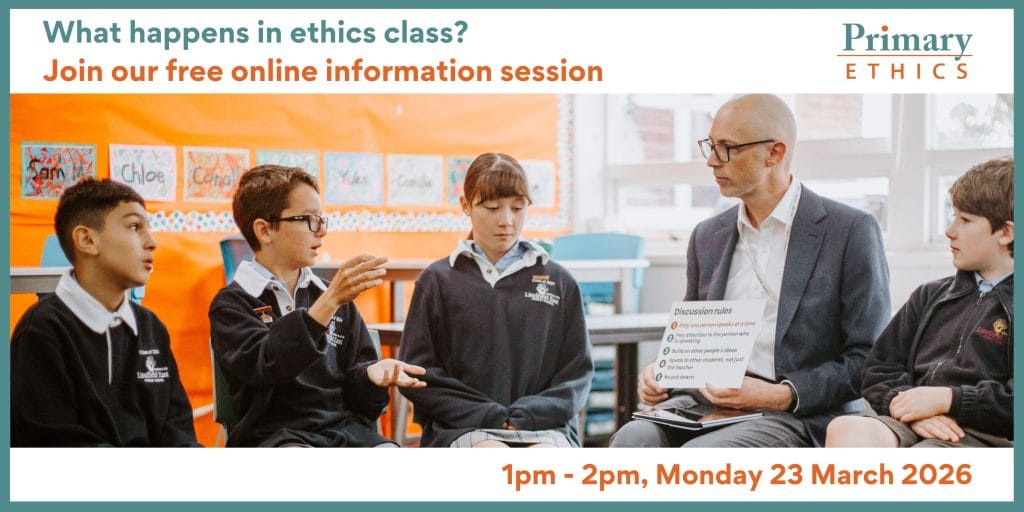
We run regular one-hour webinars for anyone interested to find out more about what happens in ethics lessons or about volunteering with us.

In the webinar, you’ll be able to participate in a demo lesson to see our teaching style in action, hear first-hand from current ethics volunteers, hear about what impact ethics lessons have on children, plus all about our comprehensive free training and what’s involved in volunteering with us.

Click on an image for any session below to register.
The secret weapon against polarisation – Osher Günsberg

Osher Günsberg, radio and television presenter and now popular podcaster, has joined the ranks of ethics volunteers at his son’s school. Osher says: “When I open my phone, it explodes in a cascade of fear, fury and furphies… leaving me spinning in a tizz of desperation and powerlessness. … I think I have found something that makes that feeling less intense and instead gives me the feeling that I am actually doing something that will make a difference.”  Thanks Osher for this lovely reflection, we wish you the best in your year of ethics volunteering ahead.

Thoughts about volunteering – from Mike Godfrey

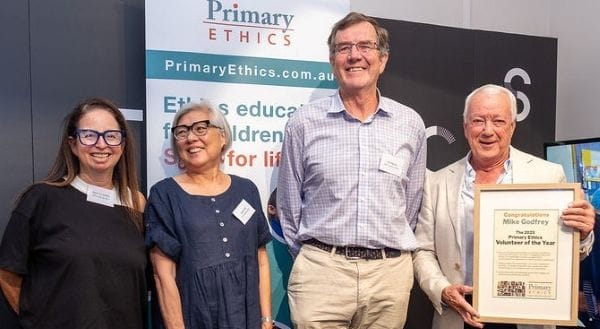
In December last year, Mike Godfrey was presented with our 2025 Volunteer of the Year award. Mike has been a dedicated volunteer in our classroom support team for 12 years. Many ethics volunteers have met Mike when they’ve reached out for support with a challenging situation and Mike has been there, on the phone or in person, to offer calm, professional and practical solutions – and continuing back-up.  

Mike himself is a volunteer and offered these thoughts about volunteering, especially as an older person, in his award acceptance speech.

“I want to talk about volunteering. This organisation doesn’t work without volunteers!

We often talk about how volunteers give back and what wonderful people they are — and yes, we are— but I want to tell you there’s two sides to this. We volunteers get a lot out of this too! I think there’s a message here which we can take to the community which may help drive more volunteering, especially in older age groups.

Mike with previous volunteers of the year - Barb La Ganza, Swee Goh and Jim Neely.

Listening hard: What I’ve got out of this (and I can only talk for myself but I do know some of this applies to others) are skills development as well as personal development.

One of the great things I’ve learnt is to be a better listener— because you can’t be in a classroom, either teaching or observing, unless you’re 100% engaged and listening hard. And I have to say —and I’ve taught communication skills over many years— I probably wasn’t the listener I could’ve been but ethics volunteering has really helped me improve.

Brain health: Social contact is important and being with like-minded people is healthy. And the mental and intellectual simulation is vital. You know, there isn’t a curriculum topic I’ve read which doesn’t stimulate me to consider what I really think about this. I love that it causes me to think deeply — to engage in topics which otherwise I wouldn’t have thought much about. And that’s growing me as a person. It’s good for my brain health too.

These are things we can get across to the community. You can still grow! You might be age 50/60/70/80. You can still grow and develop and learn and if you’ve got the energy, you can still teach ethics.

Mike

Relevance: I sat next to a lady in her late 60s in a doctor’s surgery years ago and she was telling me how she had lost her relevance. I thought that’s a really sad thing to have to say— she felt she just wasn’t relevant to her family, to society or to work any more. Had I known what I know now I would’ve suggested she join Primary Ethics as a volunteer! Relevance to society is very important for older people. It’s something Primary Ethics can provide.

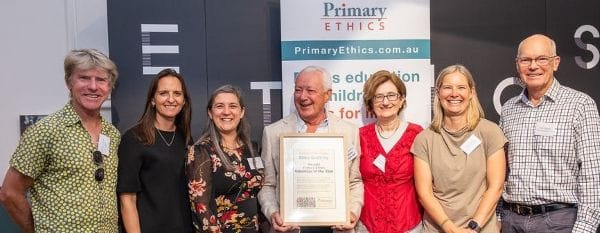
Mike with the rest of the Classroom Support Team.

Staying in touch: Finally, one of the other things I have gained is it helps me stay in touch with the younger generations and their society. The way the scripts are written is stimulating. Listening to students respond to the scripts and enter into meaningful and respectful discussions on the various topics is incredibly interesting. And it really does help you stay in touch with younger people and how and what they think, which I just think is very important in many ways.”

The thriving ethics community of Bondi Beach

Evelyn Levisohn is an ethics volunteer at Bondi Beach – a teacher and team coordinator. She writes here about their thriving ethics community, who help children look beneath the surface and have come together in firm solidarity after the recent tragedy on their doorstep.

Beyond the surface: Surfers, sunshine, run clubs and speedos: these might be the first things you think of when you think of Bondi Beach. It’s a place often associated with the ‘surface’: the tans, the activewear, the perfectly poured Instagrammable matcha latte. [Though tragically, it is also now known for the terrible shootings that took place in December 2025. More on that later.]

Look a little further, past the tourists on the promenade, and you’ll find there is a community engaged in something much deeper. At Bondi Beach Public School, just across the road from the beach, we have a thriving ethics program that is teaching the next generation how to look beneath the surface and question the status quo.

I’ve been part of this organisation for six years now, teaching two classes a week and serving as the ethics coordinator. We currently run 11 classes every week, from Kindergarten to Year 6, powered by a dedicated team of nine volunteers.

The Bondi Beach team at the beach, Evelyn on left.

Journey into the ethics classroom: My journey into the classroom actually started at my day job. I’m a Marketing Manager for Studiosity, a purpose-driven edtech company that believes in the power of education to change the world. Because they value social impact, my work is flexible enough to allow me to teach and coordinate each year. In fact, I first heard about Primary Ethics because my boss was a volunteer. Every Wednesday, she would come into the office and regale us with stories about how funny the kids were, how fascinating the topics were and how rewarding and challenging the role was.

It sounded incredible and I signed up to teach at Bondi Beach the year before my eldest son even started there. I still remember the nerves of that first day teaching Kindergarten. They were so sweet and charming, offering unselfconscious answers with brash honesty. But the moment that truly hooked me, the moment I felt that click of satisfaction, was when a child made a logical argument about a story that even I hadn’t considered. Watching a child learn to reason, think and find their own voice is incredibly gratifying.

Becoming a coordinator: Eventually, my passion for the program outweighed my fear of stepping into the team coordinator role. When our previous coordinator moved away, I realised I was too invested to let anyone else take the reins. I cared deeply about the program’s success, especially as we navigated the long road back from the COVID shutdowns. Our school was actually the last in the state to bring scripture and ethics back onsite, only resuming in 2023. During that break, I kept my skills sharp by doing relief teaching at other local schools. When we finally came back onsite, my mission was clear: I wanted to build back a sense of belonging and camaraderie within the team. I started ensuring we had termly coffee catch-ups and end-of-year dinners.

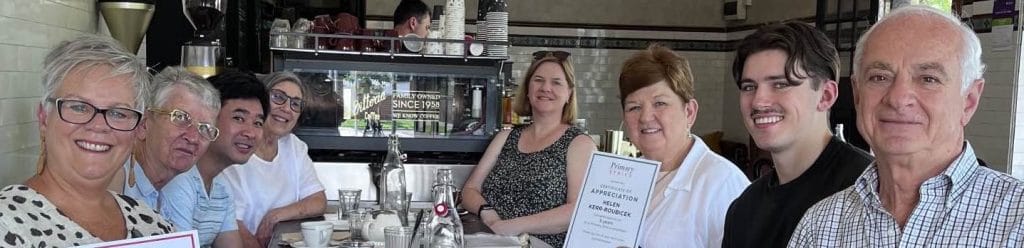
The team out for dinner, Evelyn second from left.

Depth and compassion: Today, we have a thriving team from all walks of life, parents and community members alike. Our catch-ups are no longer just an admin checkbox; they are filled with deep personal reflections and philosophical musings. We support each other, as does the whole Bondi Beach community who came together with steadfast compassion when the school had to close for a few days following the shootings, ensuring nobody was feeling alone and the kids had a sense of togetherness and normalcy.

In the darkest of times, our community shone in its solidarity.

Evelyn

The world beyond the beach: Despite recent events, Bondi will always have its sunshine and its tourists, but what happens inside our classrooms is what prepares these kids for the world beyond the beach. Considering what our community has been through, and in an era of AI and global upheaval, these lessons in critical thinking and logical reasoning are what will truly help our children navigate the changing world. We aren’t teaching them to follow a specific set of beliefs; we’re teaching them to think for themselves. And there is nothing more important than that.

Celebrating team achievements. Evelyn is centre.
The Primary Ethics 2025 Volunteer of the Year

Primary Ethics is delighted to announce our Volunteer of the Year 2025 . The winner is Mike Godfrey, who has been a dedicated volunteer in our classroom support team for 12 years.

This award brings public recognition and appreciation for the often-unsung efforts of our wonderful volunteers, as well as substantial prize money to go to the recipient’s chosen school or schools.

The award honours a volunteer who has:

  • made a significant contribution to our mission to deliver ethics education to children so that they develop skills in ethical reasoning, critical thinking and respectful discussion
  • conducted themselves in a manner true to our values of respect, integrity, independence, excellence and teamwork.

With the award we acknowledge team players, good communicators, those who are supportive of other volunteers, reliable and committed to our program of ethics education.

Mike epitomises those qualities.

Mike is an invaluable member of the classroom support team. Across 12 years he has helped countless volunteers improve their skills. He also helps train new classroom support volunteers and is often called on for advice by the manager and members of the team alike.

Mike is always willing to call or visit teachers in need no matter where in Sydney they are located. With his warm, engaging style and depth of knowledge, he creates a supportive environment for teachers to discuss their challenges.

Mike was shortlisted for Volunteer of the Year in 2023 and 2024.

Mike Godfrey

Volunteer feedback received after they had a discussion with Mike: ‘Dear Mike, I am pleased to say that by implementing the tips we discussed my next lesson was a hit … Needless to say I am so happy with how things went and would like to thank you for your kind support.’

A former CST manager says: “Mike has to be recognised for his high-quality service and care to ethics teachers over a significant length of time. He is the sort of person who always went the extra step to ensure teachers were supported and performing in accordance with Primary Ethics standards. Mike has also continued to provide this service with the many changes to curriculum, procedures and leadership of the team. He has played a key role as a senior CST member on many occasions, mentoring new members, living our company values and providing support wherever he was able. It is volunteers like Mike Godfrey who make us what we are at Primary Ethics.”

Congratulations Mike Godfrey!

Global Ethics Day 2025 – Spotlight on volunteer Alokita

During this week surrounding Global Ethics Day 2025 (Wednesday 15 October), we are turning the spotlight onto our volunteers to hear about the impact of ethics education in their own lives.

This global celebration highlights ethics as a process for finding solutions in the collaborative and respectful manner often missing in today’s world. It’s about how we learn to live together, respect our differences and together face our major global challenges.

Alokita Shankhar, ethics volunteer northern Sydney for seven years

I started teaching ethics when my daughter began Kindergarten at our local public school at Hornsby. At the time there weren’t enough volunteers, so I decided to train as an ethics teacher and taught my first Year 1 class. Since then, I’ve had the joy of teaching Kindergarten, Year 1, and Year 2 and yes, even the special experience of teaching both my children along the way.

Teaching ethics opens up a window into how children think about the world which is both humbling and enlightening. Hearing their perspectives reminds me to stay curious, patient and open-minded. It has given me so much. In addition to being a weekly circuit breaker to my job, it has helped me grow as a parent and member of the community, reinforcing the importance of listening to understand, not just to respond. And I can also say, there have been many funny and heart-warming moments with the children along the way too, which I also cherish!

Some people say Kindergarten is too early to start ethics, but I have seen firsthand that it’s never too early to nurture curiosity and respectful discussion. At our school, teachers can choose to move up with their cohort and I’ve done that for three years; from Kindergarten through to Year 2. Watching the children develop not only in confidence but also in their ability to listen, question,and consider others’ viewpoints is a benefit of the program.

Ethical decision-making is more important now than ever. The world is changing rapidly and that includes socially, environmentally and technologically, with developments like AI reshaping how we live and work. As technology moves faster than we can sometimes process, helping children develop curiosity, empathy and critical-thinking skills becomes essential. Through ethics, they learn that there is no right answer but that they can get to a good answer by asking thoughtful questions and weighing consequences and then make decisions that consider different perspectives.

Global Ethics Day 2025 – Volunteer spotlight on Rita

During this week surrounding Global Ethics Day 2025 (Wednesday 15 October), we are turning the spotlight onto our volunteers to hear about the impact of ethics education in their own lives.

This global celebration highlights ethics as a process for finding solutions in the collaborative and respectful manner often missing in today’s world. It’s about how we learn to live together, respect our differences and together face our major global challenges.

Rita Kusevskis-Hayes, Ethics volunteer beachside Sydney for three years

My first contact with the ethics program was when my son was in primary where they were running the initial trial. I was impressed and hopeful it would be taken up across NSW schools – which it has been!

I have always been the sort of person who thrives on a challenge and I love engaging with people especially in my local community. I have over 30 years in the education and equity sector, have a deep passion for people and innovation and a fascination with how opportunities or problems can be solved creatively – bringing together people, process and technology.

During the past couple of years I’ve been doing contract work so had time available for volunteering. I read a delightful piece on social media calling on volunteers to teach ethics at  Maroubra Junction Public School. As the time required each week is not onerous, it has fitted in well with my other commitments. For many years I’ve been involved with higher education and now am thoroughly enjoying working in primary education at my local school.

I have been teaching Stages 2 and 3 for three years now. I work with an incredible school co-ordinator and amazing students.  I have been so  impressed with the program that I wanted to share my teaching experience and knowledge further. So two years ago I began  volunteering with the dedicated Classroom Support Team, reaching out to support ethics volunteers across NSW as well as running workshops.

Every lesson brings new insights and completely different perspectives from the students. It is exciting as an adult and long term teacher to hear fresh views and reflections from primary children as they develop their views on the world. The structure is perfect for safe discussions, exploring issues with respect whilst building on each other’s ideas. Over the course of the year, and teaching across stages, I’ve observed the students work on their communication skills, especially in evaluating the shared ideas, forming deeper opinions based on evidence.

I strongly value the opportunity to spend time with these enquiring students each week, talking, listening, doing role plays, think-pair-shares and activities. Sometimes they come up with ideas I would never have thought of and often say the funniest, smartest things.

Teaching ethics has reminded me to take time in a busy life to reflect and to listen. Everyone should definitely volunteer to teach ethics at some point, no matter what your background, whether you’re a parent, grandparent, carer or just wanting to give back to your local area, like me.

Am loving the ethics program!

Global Ethics Day 2025 – Volunteer spotlight on Ken

It’s Global Ethics Day 2025 on Wednesday 15 October and to celebrate, we turn the spotlight onto some of our volunteers and hear about the impact of ethics education in their own lives.

This global celebration of the importance of ethical tools highlights ethics as a process for finding solutions in the collaborative and respectful manner often missing in today’s world. It’s about how we learn to live together, respect our differences and together face our major global challenges.

Ken Welsh, ethics volunteer southern Sydney for five years

For five years I’ve volunteered as the manager of two regions – Kogarah and Beverly Hills. In those regions the ethics program is taught in 12 schools to over 600 students by 32 ethics teachers.

I was a high school teacher and principal in NSW, Queensland and the ACT. Then for 15 years immediately prior to retirement I worked within the Australian Department of Defence assisting ADF members with the education of their children. These children frequently changed schools because of their parents being posted around Australia. Parents were sometimes absent due to overseas deployments or distant training. All this impacted on their children’s education.

Becoming a volunteer with Primary Ethics allowed me to continue to be involved in education more broadly and to make a contribution to my local community.

As manager of the two regions I have oversight of the program, work with ethics coordinators in some schools to promote Primary Ethics, advertise and recruit volunteers to teach in schools that do not have an ethics coordinator, allocate teachers to classes in those schools and liaise with appropriate Department of Education staff to ensure the successful implementation of the program. Because of my background I hope I also can provide support to all those 32 teachers and the coordinators if and when they need it.

‘Think critically, reason ethically and discuss respectfully’ are the three keystones of the ethics program. I can’t think of anything more important than developing those qualities in young people who live in a world that is so conflicted by differing ideas, powered by an influential social media environment and which doesn’t seem willing to listen to others. It’s a huge enough challenge for us as adults, so how important is it for us to do what we can to prepare young people to live in this future world. As adults we can become complacent in our attitudes and values – it is much easier than being challenged to examine what we hold so dear and possible re-evaluate that.

My major subject when I was a teacher was modern history. It doesn’t just require the ability to recall names, events and dates (Wikipedia can do that!) but rather the ability to examine why events occurred and how they impacted on people and societies. By questioning we learn and by learning we can change – ourselves and our societies – for the better. Primary Ethics provides opportunities for young people to do just that too. To consider how they think and feel about a particular topic. To listen to what others think and feel. To evaluate our thoughts and feelings. And maybe to change.

This old History teacher is thankful that besides the usual teachers working away in our schools there is also a group of volunteers offering their time and talents to develop enquiring minds. I’m very satisfied that I still play some part in that development.

Global Ethics Day – Volunteer spotlight on Vicky

It’s Global Ethics Day 2025 on Wednesday 15 October and to celebrate, we turn the spotlight onto some of our volunteers and hear about the impact of ethics education in their own lives.

This global celebration of the importance of ethical tools highlights ethics as a process for finding solutions in the collaborative and respectful manner often missing in today’s world. Ethics is not about getting everyone to agree on a single set of values. It’s about how we learn to live together, respect our differences and together face our major global challenges.

Vicky Votoupal, second year volunteering in northwest Sydney

Just over two years ago I saw an ad in my children’s school newsletter, calling out for Primary Ethics volunteer teachers. At the time I had been coaching/managing one of my children’s sports team and really enjoyed that opportunity to have a positive impact for children in our local community. I was also finishing up a contract work role that had been very meaningful and saw ethics as a chance to contribute in a way I might not have the scope for in a new work role. Having completed my training, my youngest child asked if I could teach their year group and I took that as an endorsement!

My first year was 2024, teaching Stage 1. The student group has mostly been the same from last year to this year, which is great. I’ll move up to Stage 2 with the same group next year.

At work I’m a procurement professional, so ethics ties in really nicely to that. Conduct, transparency and fairness are all essential in my line of work. It’s sometimes easier to talk ethics with children than with adults! I also like to be able to discuss current affairs with my children in an age-appropriate way and I think our Primary Ethics training really helps with that.

As for the students, I enjoy watching their minds open when they hear other opinions that may be different to their own. My favourite lessons are when, after a discussion, I ask if they think the actions of a person in the story are okay and they answer “A bit yes and a bit no”. They often start from a definite position because they have only considered one perspective, but most of the time at least some of the group will consider other points of view that have been raised throughout the discussion. I also think it’s important to point out to the children when there isn’t a consensus in the group. In real life, there is often no definitive yes or no yet we still need to find a pathway forward in those situations.

We hear in the media that we live in a more divided world than ever, which is a scary concept. I like to think that most people most of the time are simply trying their best to take on the challenges of daily life. If we can teach our children the concepts of fairness and equity, the ability to listen to others with curiosity and to keep an open mind, that will certainly make the world a better place.