Category: Volunteering

Northmead – volunteer team of the year

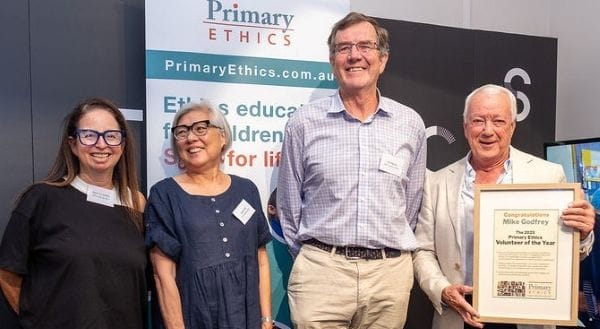
Northmead Public School ethics team were co-winners of the 2024 Kinghorn Volunteers of the Year award – in their school’s centenary year. At a recent school assembly they were presented with their $1000 winning cheque to go to their school library, as well as a hardback copy of Unstoppable Us by Yuval Noah Harari.

Evan Hannah, Primary Ethics, Mallika Ramaswamy, Veronica Roelink and the school librarian.

Northmead is a large, diverse school in western Sydney. The team have worked really hard at building a very strong, steady and committed presence to ensure that ethics is now offered across all years, having started with only two classes a decade ago. The reputation and popularity of the program has grown significantly and now almost one third of the school population is engaged in ethics lessons. The program is seen as an important part of school life and the team is well known and respected. With a diverse, committed and community-minded team, they’re not only teaching ethics — they’re building a lasting legacy

Our volunteers love the conversations and lessons we get to share with the kids and we especially love catching up each term to chat all things ethics and learning from each other's experiences. We all feel that we get as much from the experience of teaching ethics as we give to our students each week.

Former ethics coordinator Tania

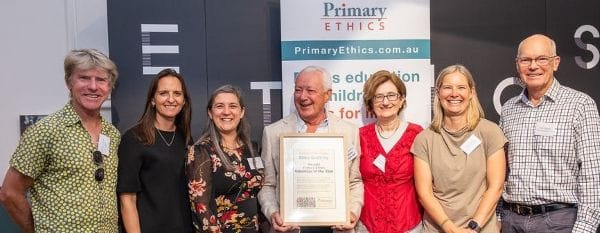
The 2024 Northmead ethics team, from left: Veronica, Christina, Mallika, Susannah, Myat, coordinator Tania, Elaine. Missing: Abha.

Volunteer Elaine

One of the team, Elaine Lee, told her story:

I have always wanted to volunteer in a program that has an impact for others. Taking a career break, I saw this opportunity  advertised at our school and jumped at the offer after reading up on the Primary Ethics program. My background is in Learning & Development and the program aligned with my values of instilling morale and critical reasoning, even more cause to volunteer with Primary Ethics.

What makes it great is that you don’t have to have facilitator experience! The training program is very well constructed, mine was led by Kelby Mason. 

Knowing that I can make an impact for my child and the children of tomorrow makes it very rewarding and fulfilling. The curriculum is current with today’s scenarios and it’s such a pleasure to work with a cohort of like-minded volunteers who  want to make a difference. 

I encourage anyone who has the opportunity to participate in this program. I hope this becomes the norm as part of a child's learning in primary and high school. Thank you, Primary Ethics!

Elaine Lee. volunteer at Northmead Public School

Integrating space exploration ethics into early-stage education

Inspired by our ethics curriculum, Winnie Tang, an aeronautical engineer and volunteer ethics teacher, has written a paper for the International Astronautical Congress, taking place in Sydney in October, on integrating the ethics of space exploration into science education for primary children. 

Winnie is a systems engineer working at Thales, with a degree in Aerospace Engineering (Hons) and Physics from UNSW. These pictures of Winnie were taken at the Houston Space Centre and Frontiers of Flight Museum, USA.

How Winnie became an ethics volunteer
I have done volunteering and fundraising my whole life, I love giving back to the community and meeting people from all walks of life.

I was volunteering at a soup kitchen in Bondi and, in a particularly memorable moment, a group of young primary school girls came in to collect the cupcakes we’d baked for a single mother who was unable to cook for herself or her family while she was fighting cancer. They were such bright little kids, so full of energy, kindness and compassion. I was struck by how remarkable they were, showing such understanding and empathy about the situation at such a young age. That’s when I realised how I wanted to be part of children’s lives in a more meaningful way. Their ability to think, understand and empathise inspired me to be part of the process to support and nurture children as they grow.

When I started looking for more local opportunities (since Bondi was too far from my place), I came across Primary Ethics on Seek. I decided to volunteer at my local primary school in Hurstville, where I had also gone as a little girl, so it was nostalgic and exciting to return as a teacher! I had (and still have) an amazing experience teaching children. They’re cheeky, smart, creative and their answers often surprise me in the best way possible. I feel like I learn from them just as much as they learn from me.

Ethics in space
Ethics is integrated into my job every single day. Ethics establishes the principles for engineers and guides us in our professional conduct, prioritising the safety, health and welfare of the public, along with honesty, integrity and competence in our professional lives. Over the past few years, we’ve seen how fast space activity is accelerating. Commercial launches, lunar missions and talk of settlements in space are no longer science fiction. This raises major ethical questions that our community is currently talking about.

Winnie gives a lightning talk about her paper.

Young people are ready!
Teaching in primary classrooms convinced me that young people are ready to grapple with the ethical questions these developments raise, if we give them the right tools. Additionally, the IAC (International Astronautical Congress) will be held in Australia soon! This was an opportunity I didn’t want to miss and I decided to put together something on a subject I am passionate about. So I wrote Inspiring Ethical Minds: Integrating Space Exploration Ethics into Early-Stage Education. [The full paper was published after 3 October in the IAC 2025 conference proceedings. See below.]

What does my paper argue?
My paper proposes a practical case for introducing space ethics into Stage 3 (Years 5–6) classrooms. It focuses on three themes that are already shaping international policy and industry practice: planetary protection, resource allocation and human settlement (space colonisation). No one knows what the right answer is! We are currently still debating what kind of laws should exist in that domain. The growth of the industry opens up many ethical dilemmas that we are yet to catch up on. 

So rather than telling students the 'right answer', the aim is to build reasoning, dialogue and civic awareness … skills they’ll need as future voters, scientists, engineers, leaders and aware citizens in general.

Why space ethics, why now?
Global frameworks like the Outer Space Treaty, ongoing UN COPUOS discussions and the Artemis Accords show that questions of contamination, resource equity and governance are being debated today. These aren’t just technical issues; they’re deeply ethical. Topics surrounding sustainability and AI are no longer just applicable to what we have on Earth, these concepts surround space too. Bringing space ethics into primary classrooms connects science learning with real-world decision-making and helps students see themselves as participants in those conversations.

How does it fit the curriculum?
The approach aligns with the NSW Stage 3 Science and Technology syllabus. They start learning about Earth and Space at this stage and it supports ACARA’s general capabilities (ethical understanding, critical and creative thinking, literacy, personal and social capability and intercultural understanding). In other words, I don’t want to add content on top, but rather use ethical inquiry as a lens while students study the solar system and technologies and design solutions.

What does it look like in class?
I have proposed classroom implementation following the proven Primary Ethics pedagogy. Each theme comes with a short, concrete scenario and structured questions. (This is further elaborated in the paper.) These activities are deliberately open-ended. Students learn how to think by giving reasons, listening respectfully, changing their minds when a better argument appears, rather than being led to a predetermined conclusion.

What have I found?
Embedding ethics in science units is feasible without cognitive overload; it naturally assesses syllabus outcomes (eg. comparing planetary features, applying design thinking, communicating conclusions) while developing ethical literacy. The approach is grounded in scientific content and age-appropriate dialogue, making it suitable for Stage 3 and adaptable to other stages.

What next?
Because both the research base and the ethical themes are international, the framework can be adapted beyond NSW and Australia. The next step is collaboration with curriculum specialists (Primary Ethics) and teachers to refine lessons, pilot them and share resources.

The goal is simple and ambitious: equip young people to reason well about the choices humanity faces as we become a spacefaring species.

Winnie Tang

Stories from National Student Volunteer Week

It’s National Student Volunteer Week, a great opportunity to showcase stories from our many student ethics volunteers.

Volunteering does look good on your resume, which is especially valuable for people starting out on their career, but ethics volunteering offers so much more than that. Top of the list from many of our students is what they learn themselves, which can be productively applied in their future work lives – knowing how to maintain neutrality, listen carefully, develop empathy and learn that it’s okay to change their mind about something, just as the school students learn to.

Reports from student ethics volunteers

Khanh is a student of Nursing at Sydney University.

“I grew up in a culture where young children weren’t encouraged to speak up. With Primary Ethics, I get to help children feel heard and think for themselves – something I wish I’d had growing up.

Volunteering in ethics hasn’t just been meaningful, it’s helped me become more curious, thoughtful and connected to people. I ask ‘why’ a lot more now (maybe to an annoying degree!), but it helps me understand the people around me better, even those I already know well.

I am thrilled to be a part of Primary Ethics and would love to have more student volunteers as my colleagues. I truly appreciate what ethics brings to the community and to me personally. Being able to volunteer here feels like a once-in-a-lifetime experience.

Primary Ethics really helps me grow just as much as my students do.”

Mia is a recent graduate in the Bachelor of Medical Science from the University of Sydney.

“I started volunteering in ethics when I was 18, during the first year of my degree. I decided to begin my ethics journey to develop my critical thinking, reasoning, problem solving and communication skills, all of which are incredibly important in the medical field. My mother was (and still is) an ethics volunteer and together we became the first mother-daughter ethics teaching duo for Primary Ethics!

Volunteering for Primary Ethics is incredibly enriching for tertiary students. There is a common belief that ethics volunteering is especially good for students in education, psychology, health or social sciences, but I believe that teaching ethics builds communication skills, empathy, confidence, listening skills and facilitation of critical thinking no matter what your field of study or interest is.For students out there considering becoming an ethics teacher, seeking meaningful volunteering experience or even wishing to develop their interpersonal skills, I would highly recommend pursuing a volunteering role at Primary Ethics!”

Bharathi is studying Philosophy and Sociology at the University of Wollongong.

“At a time when young people are feeling powerless, helping children to think critically and have respectful discussions makes me feel empowered – that I can help create a world where young people feel better able to speak and be listened to on issues that impact them. If you’re a student and would like to be a part of that too, I’d highly recommend volunteering with Primary Ethics.”

Tara is currently pursuing a Masters in Medicine at the University of Queensland.

“Volunteering with Primary Ethics has shaped how I communicate—with patients, colleagues, and children alike. It’s taught me to listen without rushing to judgment and to approach each conversation with curiosity and care.
I’m currently completing a Master of Medicine in Skin Cancer through the University of Queensland and working as a Dermatology Research Fellow at The Skin Hospital. Amidst the science and clinical work, ethics has helped me stay grounded in values like empathy, fairness, and open-minded dialogue. Being a Primary Ethics coordinator is one of the most rewarding things I do—it reminds me that respectful listening is a skill we can all keep building. I’d absolutely encourage other students to get involved. You don’t need to be an expert—just willing to ask questions and think deeply.”

Ethics teaching – a family affair

This year a third member of the Scott family has become an ethics volunteer. Peter Scott describes their journey to being an ethics family.

As ethics teachers, we often reflect on the benefits the Primary Ethics program has for our students. I have been an ethics teacher at Glenmore Rd Public Sschool in Paddington for 13 years now. Not only have I seen it benefit my many students over that time, but ethics volunteering has given my family a sense of common purpose and brought us closer together as we grow older.

In my second year I taught our younger son Lachlan, who was in Year 6. He was a little embarrassed to have his dad in front of his mates, although he got used to it as I brought my soccer coaching skills to bear. Our older son Alasdair had already left for high school when I started ethics teaching and felt a little left out of the conversations we were having at the family table.

Eight years later their mother Sarah became an ethics teacher too, partly to better inform her architectural work designing early childhood education facilities. She could see how much value I was getting from teaching the curriculum. Now she is part of our group of eight teachers at the school and absolutely loves it.

Sarah tells this story about witnessing the impact of ethics thinking skills in her class:

``One of my favourite ethics moments occurred with the lesson about the intent and structure of an ethics class. I followed the script, starting the class with random questions about unrelated topics which they could not possibly have answers for. They were all initially very puzzled and confused, but then one girl had a lightbulb moment and put her hand up with much animation. 'I know what this is!' she exclaimed excitedly, then in a conspiratorial voice she added, 'It’s an ethics class about ethics classes!' They all went 'Ahhhh'.``

Sarah Scott

After all these years the wheel has now turned full circle. Alasdair, who just missed out on being a student in the primary school ethics program, finally had some time to contribute after completing six years of university. We did the teacher training together in January 2025 – it was my second time and after 13 years it was completely different. Not only had the curriculum evolved, so had the teaching techniques.

So now Alasdair too has become part of our group of teachers and also loves it.

So we are an ethics teaching family! We sit down at the dinner table, speak one at a time, there are no putdowns and we build upon each other’s ideas … Okay, no, that doesn’t quite happen – we are a normal family and all talk at once. However, we  all recognise that the ethics program offers a really positive way of engaging with younger generations and listening to each other in order to build a future together.

Peter, Lachlan, Sarah and Alasdair Scott
Jim Neely Q+A

We asked Jim Neely, who, alongside the Northmead Public School team, was Kinghorn Volunteer of the Year 2024, to do a Q+A for us.

Jim is embarking on his second decade of volunteering this year, having started in 2015! He has quite a spread of experience with ethics, from the school level down to the lesson level. He’s regional manager for ethics programs in seven schools in the broader Queanbeyan region in southern NSW – four in Queanbeyan as well as Bungendore, Jerrabomberra and Sutton. Between them they deliver lessons to thousands of students each week. Currently, he supports 12 ethics teachers and himself teaches five classes every week in four different schools.

When accepting the Kinghorn Award, Jim said: As you all know, we are delivering a very worthwhile and important program and I get a lot of satisfaction out of my engagement with the students, as well as with the other volunteers – which is what keeps me motivated.

“I’d also like to acknowledge the wonderful support we receive from what I consider the ‘head office’ team: from the Help Desk, to the classroom support team, the trainers, area managers, communications team, the curriculum team…

“Your helpfulness, expertise and ongoing striving to improve the program and the volunteer experience contributes enormously to the satisfaction I get from my Primary Ethics volunteering.”

Jim Neely

Here’s Jim’s Q+A.

How did you hear about ethics and what drew you to volunteer?

Originally I read stories in the Sydney Morning Herald about the attempts to establish Primary Ethics in NSW public primary schools and thought, ‘What a great idea’! It was obviously such an important program for children. When I heard that the program was in place at Queanbeyan Public School, I volunteered.

Jim with Barb LaGanza (Kinghorn 2023), Jill Kinghorn and Swee Goh (Kinghorn 2022).

What have you done over your 10 years as an ethics volunteer?

I’ve continued as an ethics teacher and coordinator across that decade, but after retiring I also took on the Regional Manager role and worked to establish the program in more schools in the Queanbeyan area, plus Goulburn, which I looked after for a couple of years.

It’s very satisfying to now see many more children in the area having the opportunity to attend ethics classes.

What do you see the kids get from ethics and what do you get from it for yourself?

It’s very rewarding to see the development in the students’ ability to engage with the topics – to listen to each other and give thoughtful responses to the questions.

When a child says, ‘building on what so-and-so said’, I give an internal fist-pump! Also, when a class is going well, I feel a real sense of community develop, a level of trust, which is reflected in how the students engage with the discussions.

I also very much value working with such an inspiring bunch of people from different walks of life, many of whom I know have full lives already, managing work and children, but who also manage to fit in this commitment because of the value they place on it. I also value the sense of community that has developed between the volunteers in the different schools and the willingness to help each other out.

What’s your favourite lesson topic?

A number come to mind. With the little kids, the topic involving meerkats. This is one I know they remember. With Stage 3, I like the way the topic on Authority develops over four lessons, from a girl who shows courage at school in standing up for a disabled student, to the story of Rosa Parks and the Civil Rights movement in the US.  This topic always engages the students.

Are there other rewards you weren’t expecting? 

As time has gone by, I’ve come to appreciate more the broader benefits the children get out of the classes, beyond the development of their critical thinking/ethical reasoning skills, such as increased self-confidence, empowerment… For example, I recall one girl in a class who was initially very reluctant to contribute but became more confident as the year went on. When I asked in the end-of-year lesson, ‘How did you feel when you were talking and everyone else was listening?’, she said ‘Respect’.

Another reward is hearing about our impact. One school invited me and other community volunteers to an end-of-year morning tea. In speaking to the assembled group, the school’s SRE/SEE coordinator specifically mentioned our program and commented that the conversations from ethics often continued afterwards in the regular classes. That was very gratifying to hear.

Thanks Jim!

My Journey as a Volunteer Ethics Teacher

COVID had an unexpected consequence for Lalita Kanetkar – it was the start of her journey to becoming an ethics teacher.

Lalita writes: During the COVID years, most parents had a very difficult and stressful time managing both their own jobs from home and the schoolwork of their children – particularly if the children were young. My younger daughter had a son in Year 1 and was dealing with her own job and home schooling. It got me wondering – could I be of any help with the home schooling?

When I put this to her, she was genuinely surprised … because, to be honest, I had never helped my girls with their schoolwork as they were growing up. Even so, my daughter accepted my offer. So the journey began, home schooling over Skype. I felt enormous relief and satisfaction when my grandson did really well that term, as evidenced by his school report. And so we continued with the home schooling and I had a sense of real success (in truth, the success belonged to my grandson!)

However, this success led to something quite unexpected. Around this time I started talking to a friend about Primary Ethics. She herself had been volunteering as an ethics teacher for a few years. My daughter’s encouragement and hearing about my friend’s experience got me really interested. I checked out the Primary Ethics website and registered my name. Following the interview, I undertook the training and so began my journey as a Primary Ethics teacher.

Lalita Kanetkar

The intention of ethics education is to teach children the skills they need for critical thinking from a very young age - recognising that it is so important in life to listen to different opinions, learn to question and develop the confidence to express one’s own point of view. After all, there are so many occasions in life when it not only important but also difficult to make choices and decisions. For example, how do we know if the choices we make are ‘right’ or ‘wrong’? Have we considered how they might affect others?

Lalita Kanetkar

These are the sorts of dilemmas the ethics curriculum aims to help children consider by introducing simple and relatable stories about choices and decisions they must make in their daily lives. By asking many questions, the lessons try to get children to think about why they agree or disagree with the opinions and decisions made by different characters in the stories.

For example, for younger children from Kindergarten to Year 2, we use simple stories on issues such as hurt feelings, teasing, telling the truth, showing empathy or accepting an apology. Children are able to relate to the characters and talk about whether they agree or disagree with them and whether they themselves would behave differently in the same situation. Slightly older children, from Year 3 and above, will have developed the capacity to think and question more critically. Again using stories, we consider topics of a more complex nature – be it keeping animals in zoos, bragging, etc.

To assist in critical thinking, the curriculum also introduces logic – recognising that the skills for logical thinking are an essential ingredient of critical thinking.

Since 2021 ethics has also been taught in Years 7 and 8 of public high schools.

Of course this means there is a great need for volunteers. In order to volunteer as a teacher, you need to obtain a Child Protection Certificate and a Police clearance. You also need to undertake a short training course. However, there is no requirement to have teaching experience.

Of course, being a volunteer means there is no financial remuneration. So you may well ask, what have I personally gained through my ethics teaching experience?

Well, my class goes for 30 minutes and I can assure you it is the most enjoyable half hour spent in the company of young, inquiring minds. I started teaching this group of children when they were in Kindergarten. They are now entering Year 3. It has been so exciting for me to see how their thinking has developed, how well they are now able to express themselves, set out their views and listen to each other. They understand that it is important to respect the opinions of their classmates though they themselves may disagree with those opinions.

And then of course, there are some heartwarming incidents. When for example, a child impulsively says, “I like you!” And once when I told my class I was going to be away for a couple of weeks, they cried out, “We’ll miss you!” I found that so touching.

And finally, teaching ethics is influencing me to think critically about my own day to day activities. The other day after a hard morning of housework, I finally sat down to watch a movie on Netflix. When it finished I was considering whether to watch another. And then the critically thinking voice inside me started questioning whether this would me a just reward for all my hard work in the morning or was I perhaps succumbing to laziness?

What do you think? If you were to join me in an ethics class I would love to hear your views. Better still, why don’t you consider starting your own journey as a volunteer ethics teacher!

Kinghorn Volunteers of the Year 2024

Primary Ethics is delighted to announce the winners of the Kinghorn Volunteers of the Year 2024.

Yes, that’s winners, plural. This was the first year in which nominations could be made for a team as well as an individual.

[Read more about the Award here.]

So the 2024 winners are Jim Neely, Regional Manager, ethics teacher and coordinator in the Queanbeyan region near Canberra, and the Northmead Public School ethics team from western Sydney. Jim, who coordinates three schools in Queanbeyan, receives $$3000 in prize money to distribute to the library services in his schools, while the Northmead team receives $1000.

The judging panel was Jill Kinghorn, Bruce Hogan (Primary Ethics Chair), Barb La Ganza (winner 2023), Kaye Remington (community volunteer), Martin Bregozzo (parent volunteer) and Evan Hannah (CEO).

jim-neely
Jim Neely

Jim Neely is currently regional manager for five ethics programs in the Queanbeyan region, which deliver lessons to thousands of students every week. Currently, he is keeping 15 ethics teachers engaged and himself teaches four classes every week in three different schools.

Jim is dedicated to growing ethics education and works diligently to recruit via local events and media. Besides his five schools, he explores every option to launch new programs in other schools in the region.

From one of his team: “Jim strongly supports teachers at Queanbeyan schools and graciously relieves us when we can’t take our class or seeks out another teacher who can. Behind the scenes, I know he works with the Queanbeyan schools to encourage their participation and active support for ethics classes. My own class had only six students in Term 1 this year. Through his efforts with the school, I now have about 13. And a happy class it is!”

“I nominate Jim because I believe he epitomises the qualities and ethos that are so necessary in an organisation that relies on volunteers in order to be effective and respected. Any organisation would be lucky to have Jim. Primary Ethics is fortunate that we are where he chooses to commit his time and effort. I feel fortunate to volunteer in his area.”

northmead-team-2024
The Northmead team 2024, f rom left: Veronica, Mallika, Susannah, coordinator Tania, Christina (back), Myat (front), Elaine. Missing: Abha.

Northmead Public School ethics team: This team volunteers in a large, diverse school in western Sydney and this nomination is particularly special this year – it is the school’s centenary year!

The team have worked really hard at building a very strong, steady and committed presence to ensure that ethics is now offered across all the school years, having started 10 years ago with only two classes. The reputation and popularity of the program has grown significantly and there are now over 200 students engaged in weekly lessons. This represents almost one third of the school population. The program is seen as an important part of school life and the team is well known and respected as very community-minded.

As well as the two winners, the judging panel gave a special commendation to Faith Weisbrot, who has been on every shortlist since the award commenced in 2022. Faith is a coordinator, teacher and relief teacher at schools in the eastern suburbs of Sydney.

Most weeks Faith teaches from three to five lessons, making sure no children are missing out. Faith has proven year on year what a great team leader she is. She is always available to her teams, mentoring the newer volunteers, making sure to catch up once a term, fostering a sense of team bonding. She organises Classroom Support workshops and observations where feasible.

Faith embodies the true spirit of a Primary Ethics volunteer, humble and hardworking.

faith-weisbrot
Faith Weisbrot
Arpana: ‘So much more than I ever expected’

“I started as an ethics volunteer when my eldest daughter was in Stage 2 and now she’s at university! Teaching ethics has given me so much more than I ever expected.”

Arpana writes about her journey as an ethics teacher.

“When my daughter started school, I was looking to get involved in the school community. I became an active member of the P&C but wanted to find other ways to apply my interests in children’s learning for life skills. Then, one day, I saw a callout in her school newsletter for ethics volunteers. The idea of contributing to children’s learning in this way was incredibly exciting, even though I had no prior experience in the teacher role. Thankfully, the process of signing up was extremely simple. I submitted my resume, attended a weekend training workshop and learned how to deliver the scripted lessons. The training made it clear I didn’t need to be an expert. Everything I needed was provided and we even practised running discussions. I couldn’t wait to try it with real students!

“I still remember the day I taught my first ethics lesson. I was nervous about meeting the students and running an interactive lesson, but the kids were so engaged. They jumped into the discussions straightaway and it was wonderful to see how much they enjoyed it.

arpana-schofields-public-school
Arpana at the school where she teaches in Sydney's west.

The principal asked a group of students what the best part of their day was and there was an overwhelming response of 'today’s ethics lesson'!

Arpana

“Later that day, the school’s Twitter page shared an update. The principal had asked a group of students what the best part of their day was and there was an overwhelming response of “today’s ethics lesson!” This served as a major confidence boost for me and from then on ethics became a highlight of my week.

“Currently, I dedicate just 30 minutes a week teaching ethics, although this has varied over the 10+ years I have been a volunteer. One thing that has stayed constant is how valuable each lesson is — not just for the students, but for also for me. I’ve been pleasantly surprised on multiple occasions by how thoughtful and mature the student discussions are. They’re learning to be open-minded, to listen to others’ perspectives, to share their own in a way that’s respectful. It’s inspiring to see them build on each other’s ideas and sometimes even change their minds after hearing someone else’s point of view.

“There have also been moments that really stayed with me. Once, I missed a class because I wasn’t feeling well. When I came back the next week, the children were all asking, “Where were you? Why didn’t you come?” I explained I’d been unwell and one of them piped up, “That’s not good — why didn’t you send your husband?” It made me laugh, but it also hit me how much they valued ethics lessons. They don’t see it as being about me; it’s about the lessons and the conversations we share.

“Over the years, I’ve also received more formal recognition for my efforts. I was honoured as a nominee for the NSW Volunteer of the Year Awards in 2018. Such credits really make me feel like I’m part of a larger team, with the shared vision of bringing these ethics lessons to many students.

“Watching my daughter grow up has been a reminder of how quickly time passes, but ethics has stayed a constant part of my life. It’s such an inclusive program, not tied to any religion or culture, which is what makes schools the perfect place for it. I hope these lessons can reach as many kids as possible because they’re learning skills that will stay with them for life.

“Teaching ethics has taught me to see things differently, to listen better and to appreciate the diversity of thoughts that young minds bring. It’s been an incredible journey and I’m so grateful to have had the chance to be part of something so meaningful.”

Find out more about volunteering >>

Graduating to high school ethics

Adam Bennett and Billie Acosta, after many years of teaching ethics in primary schools, have finally graduated to teaching high school ethics.

Billie and Adam have both taught ethics to their own children for over seven years, teaching all stages at primary school as their kids grew up. This year, they began teaching ethics at Smith’s Hill High School in Wollongong. Both have children at the school and in 2024 the school began offering ethics to year 7 and 8 students for the first time.

'More challenging...'


I’ve certainly appreciated the evolution of responses, when it comes to teaching high school ethics.

smiths hill

Adam Bennett has always enjoyed teaching ethics but was a little nervous about high school classes. “Even the most engaged children become more challenging as they get older, gain experience and develop more confidence. It can be hard to keep students engaged and pace the lesson just right to keep them involved. You never know which topic will captivate them and which will bore them.”

The Primary Ethics high school training observes how 11-to-13-year-olds can appreciate more advanced material and techniques and helped prepare Adam for the more self-assured students.
smiths-hill-students
Some of the ethics class from Smiths Hill High School

Even so, both teachers are finding that employing the new discussion moves, introduced with the high school curriculum, can be hit-and-miss. They notice that there seems to be an implicit consensus among the students that the point of ethics classes is to argue. The year 7 and 8 students seem to enjoy verbal sparring, as they debate their points of view. But with occasional reminders of the guidelines for healthy discussion, they do respectfully disagree, giving reasons and examples.

Billie Acosta has noticed that building on others’ points remains a popular strategy for Stage 4 classes, which have discussed topics including the environment and custodianship vs. ownership, politics and the media, social and cultural responsibility, human longevity and how it affects society, mindful communication and respect, among others. However, not all topics receive rave reviews from the students. As Billie recounted, “If you’re a fan of the pithy response, I offer you this from one of our students after one lesson – ‘some topics have overstayed their welcome!’ I don’t disagree.”

Is this the age where it happens and we, as ethics teachers, get to witness it first hand?

Both teachers find that the new discussion moves serve as a crucial fallback when organic debate is not flowing freely, but timing can be very important. Guiding the class in this way is not always aligned with class feeling about the topic and can just as easily stall the conversation as prompt fresh ideas. One of the main aims is to make sure the lesson continues to be a safe space: students are safe to disagree, provide their reasons and to express their point of view. Arguing for one side of an issue or another is an important element of the class, which many of the students may have learned from primary school, and it can be challenging to keep some students from arguing all possible angles of a given question.

billie-adam
Billie and Adam

We realise there’s a need for curriculum and lesson plans but sometimes this may not leave the time or scope to tease out nuances in a particular discussion. Obviously, the demographic plays a part in student responses and Smiths’ Hill is certainly a specific demographic, as an academically selective school. Watching the students subconsciously sort through the issues and build on or try to refute each other’s ideas remains hugely satisfying. Occasionally, however, the discussion grinds to a halt.

Adam and Billy say: “As teachers, we often learn some interesting new slang and sometimes a little more about our students and the culture they live in, during these ‘brick wall conversations’. Sometimes we get stuck here and have to limp back to our questions and discussion moves, to get things moving again. Sometimes, the students surprise us with their lateral thinking and this level of understanding leads to a whole new class of ethical discussion.”

Adam and Billy agree: “Teaching ethics is a rewarding way to help children become skilled critical thinkers, able to identify and evaluate different opinions, formulate cogent arguments and disagree respectfully, as well as learning from each other.

Although we got involved to teach our own kids, even after 7+ years, teaching ethics is still great fun and we’d recommend it to anyone!”