@Home bulletin for parents Term 2 2025

Welcome to @Home bulletin for Term 2 2025, where we let families know what your children, from kindergarten into secondary school, could be exploring in their ethics lessons this term.

Subscribe here to receive our @Home email bulletin once a term.

The topics we show below are based on classes which begin at the beginning of the year. Schools start at different times of the year, some lessons go faster or slower than others, some schools skip ethics for the first and last weeks of the term while others teach every single week – and so on. 

We hope the students talk about ethics with you at home – ask them questions about it!

If your child tells you they are discussing a topic you don’t see in this bulletin, you can also look at the Curriculum section of our website.

Kindergarten: Making things up and showing off 

Young children are learning to navigate social situations – and this term, they’ll explore why people sometimes make things up or show off. Is it wrong to invent a story to hide a mistake? Why do people brag when they win? Students will reflect on honesty, pride and how our words make others feel.

Stage 1 – Years 1 & 2: Different kinds of animals and different kinds of needs 

Most kids know pets need food and water – but what about play, space and freedom? Is it just as important to play with a fish as it is to play with a dog? And is it okay to keep a wild animal as a pet, as long as it has everything it needs? This term, Stage 1 students will explore the needs of different animals and think about how we care for living things – even when their needs are very different from our own.

Stage 2 – Years 3 & 4: Persuading 

Children are often natural persuaders – but not all persuasion is equal. This term, students will explore how we try to influence others and what makes persuasion fair or unfair. Is it okay to exaggerate a little? Or only tell part of the truth? And what about advertising – should companies be allowed to use tricks to make us want things? These conversations will help students think about honesty, fairness and how far to go when trying to persuade someone.

Stage 3 – Years 5 & 6: Being vain 

As children grow, appearance often starts to matter to them more – both how they see themselves and how they think others see them. This term, Stage 3 students will explore questions about vanity and appearance. Is it okay to want to look good – or better than others? Where do we draw the line between taking pride in how we look and caring too much? And how do our choices about appearance affect the people around us?

Stage 4 – Years 7 & 8: Giving and accepting apologies 

Every day, all around the world, people apologise – sometimes sincerely, sometimes awkwardly, sometimes because they have to. But what makes an apology genuine? Can you really apologise if you don’t understand what you did wrong? And do people always have to accept a good apology? This term, Stage 4 students will reflect on what it means to say sorry – and explore more complex questions about group responsibility and when, if ever, someone can apologise on behalf of others.

Each term brings new ideas and questions and we hope these topics spark interesting conversations at home as well!

Inquiring Minds March 2025

Welcome to Inquiring Minds for autumn 2025, where we bring you stories and reflections from our ethics classrooms, as well as recent Primary Ethics highlights.

In this issue we collected stories from many of our wonderful volunteers, such as:

  •  Sinéad Fitzgerald, who works for Microsoft and thinks the skills we teach in ethics are ideal for preparing this generation to thrive in the age of AI.
  • While Karina Morgan finds her own life enhanced by five lessons she’s learnt as an ethics volunteer.
  • Five years ago, COVID launched Lalita Kanetkar on her journey to be an ethics teacher.
  • And Jim Neely teaches a remarkable five lessons a week in four different schools in the south of the state.

To receive the next Inquiring Minds, make sure to subscribe to our newsletters at the bottom of our home page.

Jim Neely Q+A

We asked Jim Neely, who, alongside the Northmead Public School team, was Kinghorn Volunteer of the Year 2024, to do a Q+A for us.

Jim is embarking on his second decade of volunteering this year, having started in 2015! He has quite a spread of experience with ethics, from the school level down to the lesson level. He’s regional manager for ethics programs in seven schools in the broader Queanbeyan region in southern NSW – four in Queanbeyan as well as Bungendore, Jerrabomberra and Sutton. Between them they deliver lessons to thousands of students each week. Currently, he supports 12 ethics teachers and himself teaches five classes every week in four different schools.

When accepting the Kinghorn Award, Jim said: As you all know, we are delivering a very worthwhile and important program and I get a lot of satisfaction out of my engagement with the students, as well as with the other volunteers – which is what keeps me motivated.

“I’d also like to acknowledge the wonderful support we receive from what I consider the ‘head office’ team: from the Help Desk, to the classroom support team, the trainers, area managers, communications team, the curriculum team…

“Your helpfulness, expertise and ongoing striving to improve the program and the volunteer experience contributes enormously to the satisfaction I get from my Primary Ethics volunteering.”

Jim Neely

Here’s Jim’s Q+A.

How did you hear about ethics and what drew you to volunteer?

Originally I read stories in the Sydney Morning Herald about the attempts to establish Primary Ethics in NSW public primary schools and thought, ‘What a great idea’! It was obviously such an important program for children. When I heard that the program was in place at Queanbeyan Public School, I volunteered.

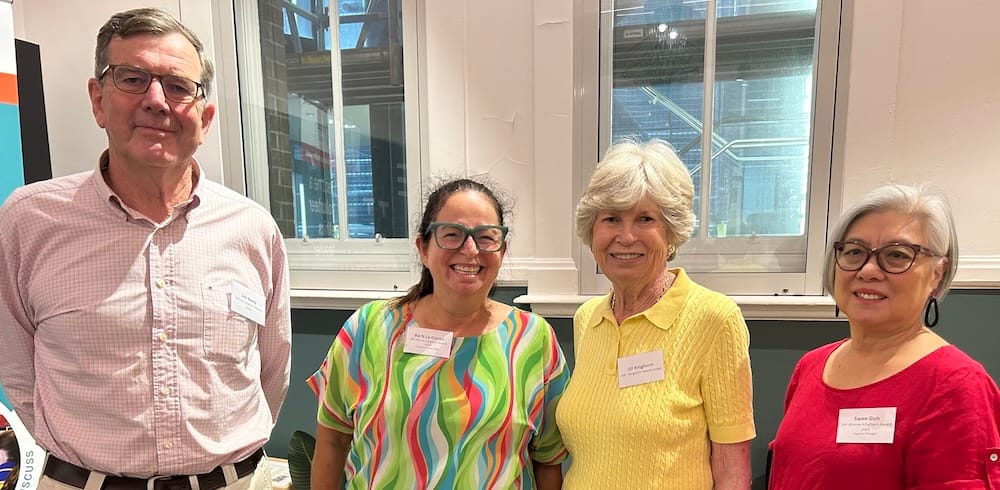
Jim with Barb LaGanza (Kinghorn 2023), Jill Kinghorn and Swee Goh (Kinghorn 2022).

What have you done over your 10 years as an ethics volunteer?

I’ve continued as an ethics teacher and coordinator across that decade, but after retiring I also took on the Regional Manager role and worked to establish the program in more schools in the Queanbeyan area, plus Goulburn, which I looked after for a couple of years.

It’s very satisfying to now see many more children in the area having the opportunity to attend ethics classes.

What do you see the kids get from ethics and what do you get from it for yourself?

It’s very rewarding to see the development in the students’ ability to engage with the topics – to listen to each other and give thoughtful responses to the questions.

When a child says, ‘building on what so-and-so said’, I give an internal fist-pump! Also, when a class is going well, I feel a real sense of community develop, a level of trust, which is reflected in how the students engage with the discussions.

I also very much value working with such an inspiring bunch of people from different walks of life, many of whom I know have full lives already, managing work and children, but who also manage to fit in this commitment because of the value they place on it. I also value the sense of community that has developed between the volunteers in the different schools and the willingness to help each other out.

What’s your favourite lesson topic?

A number come to mind. With the little kids, the topic involving meerkats. This is one I know they remember. With Stage 3, I like the way the topic on Authority develops over four lessons, from a girl who shows courage at school in standing up for a disabled student, to the story of Rosa Parks and the Civil Rights movement in the US.  This topic always engages the students.

Are there other rewards you weren’t expecting? 

As time has gone by, I’ve come to appreciate more the broader benefits the children get out of the classes, beyond the development of their critical thinking/ethical reasoning skills, such as increased self-confidence, empowerment… For example, I recall one girl in a class who was initially very reluctant to contribute but became more confident as the year went on. When I asked in the end-of-year lesson, ‘How did you feel when you were talking and everyone else was listening?’, she said ‘Respect’.

Another reward is hearing about our impact. One school invited me and other community volunteers to an end-of-year morning tea. In speaking to the assembled group, the school’s SRE/SEE coordinator specifically mentioned our program and commented that the conversations from ethics often continued afterwards in the regular classes. That was very gratifying to hear.

Thanks Jim!

@Home Bulletin for parents Term 1 2025

Welcome to @Home for Term 1 2025, where we let families know what your children, from kindergarten into secondary school, could be exploring in their ethics lessons this term.

Subscribe here to receive our @Home email bulletin once a term.

The topics we show below are based on classes which begin at the beginning of the year. Schools start at different times of the year, some lessons go faster or slower than others, some schools skip ethics for the first and last weeks of the term while others teach every single week – and so on. 

We hope the students talk about ethics with you at home – ask them questions about it!

If your child tells you they are discussing a topic you don’t see in this bulletin, you can also look at the Curriculum section of our website.

Kindergarten: Being curious and asking questions
Young children are naturally curious and our curriculum is designed to nurture their curiosity, thinking and questioning skills – helping them grow into confident, independent thinkers. In their first topic of the year, students will explore why we ask questions and consider why it can sometimes feel difficult to ask questions out loud, especially when we’re worried about looking silly.

Stage 1 – Years 1 & 2: When is it fair?
Our Stage 1 students will explore fairness, starting with a story about some animals baking bread – where all but one help with the work. Should the animal who didn’t help still get to share in the bread? Later, they’ll discuss fairness in different contexts, including how to divide slices of cake. Through these discussions, they’ll consider different ways of thinking about fairness and what makes something feel fair or unfair.

Stage 2 – Years 3 & 4: Being greedy
Stage 2 students will think about what it means to be greedy, starting with the story of King Midas, who wished that everything he touched would turn to gold. They’ll also explore stories of children collecting things and discuss questions like: Is it wrong to want more toys than you can use? Is there anything wrong with wanting to be the richest person in the world? They’ll consider different perspectives on greed and whether wanting more is always a bad thing.

Stage 3 – Years 5 & 6: Voting
Our Stage 3 students will explore questions about voting, beginning with student elections. Should you vote for someone just because they’re your friend? How should we balance self-interest with the needs of others when deciding who to vote for? They’ll also consider whether voting should be compulsory or voluntary.

Stage 4 – Years 7 & 8: You’re not the boss of me
Stage 4 students will reflect on how much control they should have over their own lives. They’ll start by considering screen time – who should decide how much is too much, and why? They’ll also look at smoking laws and explore why some rules exist to protect individuals from harm. What right do parents, adults and governments have to limit teenagers’ freedoms? Why do we have age limits? Is it ever okay to stop people from doing things for their own protection? These discussions will encourage them to think critically about rights, responsibilities and personal autonomy.

Each term brings new ideas and questions and we hope these topics spark interesting conversations at home as well!

Dr Simon Longstaff is our new Chair

Dr Simon Longstaff AO, CEO of The Ethics Centre and longstanding member of the Primary Ethics Board, has become our new Chair on the retirement of founding Chair Bruce Hogan.

Dr Longstaff said, “It is with a deep sense of honour that I have accepted the Primary Ethics Board’s invitation to succeed Bruce Hogan as Chair.

“I have had the privilege of being part of Primary Ethics’ unfolding story from the first. It began with an email from a parent of children attending Neutral Bay Public School. Peter Carre asked if it might be possible to offer ethics classes to those not attending Special Religious Education (Scripture) – and the ball began to roll.”

Dr Longstaff paid tribute to founding Chair Bruce Hogan.

“Bruce has been a committed volunteer in the service of this proudly volunteer-driven organisation. He has given his all – wisdom, passion, experience, time and energy – in helping Primary Ethics become the force for good that it is today. I extend to Bruce our deep  thanks and respect.”

Evan Hannah, CEO of Primary Ethics, also saluted the outgoing Chair. “Quite literally Primary Ethics would not be operating without Bruce’s hard work gathering funds and supporters in our early years. His energy, vision and passion are the reason we are still here, along with his own outstanding personal generosity. What we have achieved rests largely on his shoulders and all of us – volunteers, staff and directors – owe him a significant debt.

“Bruce can be proud of bringing ethics classes to the many thousands of students who have benefitted since our launch 15 years ago.”

Simon Longstaff taking up the role of Chair coincides with Primary Ethics moving to share The Ethics Centre offices. Simon sees the need for ethics education as only growing. “Primary Ethics was established by The Ethics Centre as a heartfelt response to the plight of children who were subjected to unjust treatment – simply for not attending scripture classes. There is still much to be done to realise the original mission. And we can’t diverge from working towards that goal for as long as the need remains. Our curriculum and distinctive mode of teaching and learning has vast, untapped potential.”

Simon went on to acknowledge everyone who contributes to the work of Primary Ethics. “The parents who entrust their children to our care; the school communities who host our program; our dedicated staff who enable and support a high-quality program to be delivered every week; our donors and supporters who enable this work to be done.

“Above all, I thank our thousands of trained volunteers, who build the capacity of young people in ethical decision-making and thus help make a better world.

“I look forward to working with them all to broaden and deepen our impact.”

Five lessons I’ve learnt from teaching ethics

Karina Morgan is a volunteer ethics teacher who’s learnt as much from her class of seven-to-nine year olds as they learn from the ethics curriculum. Here Karina describes her own five lessons learnt.

Each week, for 45 minutes, I sit down with a group of Year 2 students and discuss ethics. We’ll tackle an ethical concept or dilemma, typically in the form of a story, with questions designed to draw out deep discussion amongst the class.

The Ethics Centre established Primary Ethics as an independent not-for-profit in 2010, tasked with developing a curriculum and recruiting volunteers to run weekly ethics classes as an alternative in the scripture timeslot in public schools. They now deliver lessons to 45,000 children in 500 schools from kindergarten to year eight.

Classes are led by trained volunteers, who act as impartial facilitators. Our role is to model active listening and ask questions that build critical thinking skills and encourage collaborative learning.

For me, it feels like the most important gift I can give to the next generation. And if I’m honest, I find I am learning in each and every class right alongside them. Here are five lessons I’ve learned from teaching the Primary Ethics curriculum:

1. Curiosity is the gateway to critical thinking

Embracing curiosity is how we learn; it’s the driving force for growth, discovery and innovation. The innate curiosity in children is a vital foundation for developing skills like critical thinking, empathy and thoughtful decision-making.

You see, a curious mind doesn’t accept information at face value; it probes deeper, asking why, how and what if? It fuels the critical examination of ideas, helps us identify biases, to sort fact from fiction and consider situations from multiple perspectives.

I admire the unbridled curiosity of the students I teach. It’s contagious. As adults, we can get stuck in our routines and belief systems. We accept the status quo and stop exploring what’s possible.

2. There is power in saying ‘I don’t know’

One of the most powerful moments last year came when a student asked a question I couldn’t answer. I took a breath and said, “I don’t know – what do other students think?”

And just like that, the room lit up. I had given the students permission to be knowledge holders and had modelled the open-minded growth mindset we want to cultivate through ethics lessons. Since then I have witnessed so much more willingness from everyone in the room to have a go.

It turns out there’s a kind of magic in admitting you don’t have all the answers. Teaching ethics is not about being an authority; it’s about being a partner in figuring things out. Admitting you don’t know doesn’t make you weaker – it opens the door for connection and learning.

3. To disagree respectfully, we need to be open to learning from each other

Nine-year-olds are full of opinions. But what also stands out to me is how open they are to new points of view, to listen to each other, even when they disagree. Recently, a student in my class said she disagreed with the person sitting next to her. That student smiled, said, ‘that’s okay’ and leaned into hearing her peer explain why. Imagine if we could cultivate that across the political divide.

Kids don’t assume the worst in someone who thinks differently – they assume they are trying their best, just as they themselves are. Watching them address and debate differing points of view without engaging in personal attack or any attempt to discredit each other is a beautiful reminder that respectful disagreement starts with empathy, assuming good intentions and willingness to learn from each other.

4. Psychological safety empowers new ideas and even changes minds

There’s a sense of psychological safety built through collaborative inquiry, because everyone’s ideas and questions are valid here. The kids thrive in the freedom it offers to explore, build on each other’s ideas and even to change their minds.

When I started teaching this class two years ago, everyone was itching to have their turn and to get the answer ‘right’. Now they have begun to really listen to each other – not just to respond, but to understand each other’s opinions.

This year there have been instances where students have discussed feeling conflicted over a question, proposed merit across differing sides of a debate and even changed their mind after listening to other points of view.

It’s a powerful reminder of how active listening can transform conversations. Making someone feel heard deepens trust, fosters empathy and makes room for challenging conversations. It isn’t just a tool for learning; it’s a tool for connection.

5. Ethics in education can establish a resiliency for life

Resilience, I fear, is a word that’s lost some of its charm for a lot of adults. Through ethics lessons I’ve been reminded that resilience isn’t the nefarious push-through mentality or the ability to bounce back from a setback. It can also be staying engaged with challenging situations, even when the answers are messy or unclear. It’s regulating emotions, processing stress and being adaptable to change.

Ethics lessons are about grappling with tough questions, sometimes without any resolution. Nine-year-olds handle this better than you’d think, certainly better than a lot of adults. When there’s no clear answer, they meet the discomfort of uncertainty with curiosity and creative thinking.

Primary Ethics CEO stepping down

After almost eight years leading Primary Ethics, Evan Hannah is stepping down as CEO.

Evan said: “This is a busy, challenging and satisfying role, but I have decided to begin a transition into retirement and help find and install a new CEO as I slow down. I have been in this role since 2017. When I started, I’d been the ethics coordinator at my son’s primary school. He starts university this year!

“Since I began in the role, it has become increasingly busy – a new CEO will have plenty to do! There are challenges ahead to improve sustainable levels of funding in order to support strategies to take the benefits of our program to a wider audience. And, as ever, we have to ensure our core program in NSW public schools remains healthy by recruiting more volunteers and meeting demand for ethics classes in all schools.

“We’ve achieved a great deal since we began in 2011 and much is due to the continuing dedication and passion of our volunteers. In recent years Primary Ethics has  increased our focus on volunteer support, which improves outcomes for students. We’ve adopted a scrupulous approach to continuing development and improvement of our curriculum and training. Plus we have vastly more positive relationships with schools, the Department of Education and SRE (scripture) providers.

“It’s been an honour to lead Primary Ethics and a pleasure to work for an organisation that brings such clear benefit to our society. The link between effort and positive result is clear and deeply satisfying.

“We have a great team of committed and passionate staff providing support and guidance to our thousands of volunteers – they’re going to make a new CEO very welcome.

“My thanks to all staff, to every volunteer and past volunteers for your wonderful support for our program and the benefit you bring to the thousands of school children who join our lessons each week.”

The ad for the new CEO can be found here.

Chief Executive Officer: Primary Ethics

Primary Ethics is an independent not-for-profit organisation dedicated to providing free ethics education in NSW public schools. Through a volunteer-led model, Primary Ethics delivers structured lessons that equip children with critical thinking, ethical reasoning and respectful discussion skills. With over 2000 volunteers and a dedicated team of 15 staff, the organisation fosters a strong sense of purpose and community engagement. 

The role: The Chief Executive Officer (CEO) of Primary Ethics plays a pivotal role in leading and managing the organisation’s strategy, operations and stakeholder engagement. Reporting to the Board, the CEO will drive the organisation’s vision, ensuring the successful delivery of ethics classes across NSW. This role offers an exciting opportunity to shape the growth of a financially stable, volunteer-powered organisation, leveraging leadership, fundraising and operational expertise to expand its reach. The ideal candidate will be an inspiring leader with a passion for education and ethical discourse, capable of mobilising volunteers, engaging key stakeholders and sustaining long-term impact in a highly valued community program.

To apply: People for Purpose is partnering with Primary Ethics to lead the search for this role.

We invite you to read the position description located on the People for Purpose website under Current Opportunities. To review annual reports and financial statements, please visit the Primary Ethics website.

Once you have absorbed this information and completed your own research, if you have specific questions, please email Roger Reidy on roger.reidy@bpsconsulting.com.au

Your application will include your CV, as well as a cover letter outlining how your skills and experience align to this opportunity and why you are interested in joining Primary Ethics.  A considered cover letter will be an important part of your application.
 
Applications close at 5pm on Sunday, 16 March 2025.

Area manager position with Primary Ethics

Primary Ethics is an independent not-for-profit organisation delivering an engaging, age-appropriate philosophical ethics curriculum to students from Early Stage 1- to Stage 4 (Kindergarten to Year 8). We provide this free of charge via a network of trained and accredited volunteer teachers. Ethics classes have been enthusiastically adopted in schools across NSW and we take pride in our reputation as an effective and well-regarded education provider within the public school system.

To apply for this position, please address the essential skills, experience and attributes and send your application to Elizabeth Allen at elizabeth.allen@primaryethics.com.au by 10am Monday 17 February 2025.

Role purpose

Area managers play a vital role in driving and supporting volunteer recruitment, fostering volunteer engagement and building productive relationships with schools. This role is responsible for ensuring a sustainable pipeline of ethics teachers and coordinators through effective recruitment channels and localised support. Additionally, it serves as the primary liaison between volunteers and the organisation, facilitating clear communication and providing support to ensure compliance, satisfaction and retention.

Organisational position

The role reports to the CEO.

Hours and location

This role may be full-time or part-time. Specify your preference in your application. Work may be carried out at the Primary Ethics offices or remotely, with a minimum office presence as directed. Travel may also be required to other locations for meetings with external parties or community events.

Roles and responsibilities

Key responsibilities of the role include:

Volunteer recruitment

  • Promote ethics teacher and coordinator recruitment opportunities through appropriate channels, such as SEEK, social media, and school parent communities.
  • Support ethics coordinators with local recruitment activity, or recruit directly where there is no ethics coordinator.
  • Screen candidates for suitability, conduct interviews and approve interviews conducted by ethics coordinators.
  • Follow up teachers who are onboarding to ensure completion of training within a reasonable timeframe.
  • Work in partnership with the communications manager on alternative recruitment channels such as radio, newspaper, magazine articles etc.

Volunteer management

  • Build strong working relationship with coordinators, providing support. mentoring and guidance as required and be the first point of contact for the volunteers, particularly coordinators
  • Encourage coordinators to organise team-based catch-ups to ensure volunteers can connect with each other.
  • Recognise long-term volunteers through delivery of pins and certificate.
  • Provide key communication to volunteers and be the main contact point for changes in Department of Education policies as well as changes in Primary Ethics procedures, policies or programs.
  • Build volunteer capability, including low-level Classroom Support team support and referring to Classroom Support as appropriate.
  • Develop the knowledge base and processes of each coordinator and their team, to ensure smooth and efficient running of the ethics program
  • Drive renewal process each year, ensuring volunteers meet training compliance requirements
  • Address complaints and issues of volunteer underperformance appropriately, in conjunction with Classroom Support team, the Engagement and Administration Manager or the CEO as appropriate.
  • Provide support to sole teachers to ensure stability of vulnerable schools
  • Ensure volunteers complete post-lesson reports.

School Management

  • Provide key communication to the School and be the main contact point for changes in Department of Education policies as well as changes in Primary Ethics procedures, policies or programs
  • Ensure School is compliant with the relevant Department of Education procedures – especially the current SRE/SEE Implementation Procedures document
  • Raise issues early to our school liaison officer when difficulties arise, work in partnership with the school liaison officer as appropriate to resolve conflicts
  • Provide sufficient information for parents through the school to raise awareness of our ethics program and give them the ability to choose ethics for their child(ren)

Administration

Ensure accurate recording of data in our database EVIE, including:

  • Set up and maintenance of classes and lessons, and assisting coordinators to make these changes
  • School status
  • First/last lesson dates to manage Authorised Volunteer List flow
  • Updating volunteer status promptly: Inactive/Raincheck/Withdrawn/Terminated
  • Logging calls and emails to detail contact with volunteers and schools
  • Case management notes
  • Other tasks as requested to support the needs of the team and organisation.

Skills, experience and personal attributes

Essential

  • Proven experience in managing and supporting volunteers, ideally within an educational or nonprofit setting.
  • Strong interpersonal skills with the ability to establish and maintain positive relationships with diverse groups, including school leaders, volunteers, and community members.
  • Ability to coordinate multiple activities and manage time effectively in a role that spans recruitment, support, administration and program oversight.
  • Clear and effective verbal and written communication skills to engage and inform volunteers and school stakeholders.
  • A commitment to the mission of Primary Ethics and a genuine interest in fostering critical thinking and ethical reasoning in our students.
  • Comfortable using Microsoft Suite programs including Teams, Word, Excel. Experience with CRM system/s (particularly Salesforce) will be very useful.

Desirable

  • Knowledge of the Primary Ethics curriculum or previous experience in ethics education.
  • Familiarity with the public education system and community engagement.

Commitment to diversity

Great people come from all walks of life. At Primary Ethics, we are committed to creating a diverse, inclusive and flexible workforce that reflects the wider community and the communities we serve.  We welcome and encourage applications from all people regardless of age, gender, ability, ethnicity, cultural background and sexual orientation.