Stories from National Student Volunteer Week

It’s National Student Volunteer Week, a great opportunity to showcase stories from our many student ethics volunteers.

Volunteering does look good on your resume, which is especially valuable for people starting out on their career, but ethics volunteering offers so much more than that. Top of the list from many of our students is what they learn themselves, which can be productively applied in their future work lives – knowing how to maintain neutrality, listen carefully, develop empathy and learn that it’s okay to change their mind about something, just as the school students learn to.

Reports from student ethics volunteers

Khanh is a student of Nursing at Sydney University.

“I grew up in a culture where young children weren’t encouraged to speak up. With Primary Ethics, I get to help children feel heard and think for themselves – something I wish I’d had growing up.

Volunteering in ethics hasn’t just been meaningful, it’s helped me become more curious, thoughtful and connected to people. I ask ‘why’ a lot more now (maybe to an annoying degree!), but it helps me understand the people around me better, even those I already know well.

I am thrilled to be a part of Primary Ethics and would love to have more student volunteers as my colleagues. I truly appreciate what ethics brings to the community and to me personally. Being able to volunteer here feels like a once-in-a-lifetime experience.

Primary Ethics really helps me grow just as much as my students do.”

Mia is a recent graduate in the Bachelor of Medical Science from the University of Sydney.

“I started volunteering in ethics when I was 18, during the first year of my degree. I decided to begin my ethics journey to develop my critical thinking, reasoning, problem solving and communication skills, all of which are incredibly important in the medical field. My mother was (and still is) an ethics volunteer and together we became the first mother-daughter ethics teaching duo for Primary Ethics!

Volunteering for Primary Ethics is incredibly enriching for tertiary students. There is a common belief that ethics volunteering is especially good for students in education, psychology, health or social sciences, but I believe that teaching ethics builds communication skills, empathy, confidence, listening skills and facilitation of critical thinking no matter what your field of study or interest is.For students out there considering becoming an ethics teacher, seeking meaningful volunteering experience or even wishing to develop their interpersonal skills, I would highly recommend pursuing a volunteering role at Primary Ethics!”

Bharathi is studying Philosophy and Sociology at the University of Wollongong.

“At a time when young people are feeling powerless, helping children to think critically and have respectful discussions makes me feel empowered – that I can help create a world where young people feel better able to speak and be listened to on issues that impact them. If you’re a student and would like to be a part of that too, I’d highly recommend volunteering with Primary Ethics.”

Tara is currently pursuing a Masters in Medicine at the University of Queensland.

“Volunteering with Primary Ethics has shaped how I communicate—with patients, colleagues, and children alike. It’s taught me to listen without rushing to judgment and to approach each conversation with curiosity and care.
I’m currently completing a Master of Medicine in Skin Cancer through the University of Queensland and working as a Dermatology Research Fellow at The Skin Hospital. Amidst the science and clinical work, ethics has helped me stay grounded in values like empathy, fairness, and open-minded dialogue. Being a Primary Ethics coordinator is one of the most rewarding things I do—it reminds me that respectful listening is a skill we can all keep building. I’d absolutely encourage other students to get involved. You don’t need to be an expert—just willing to ask questions and think deeply.”

@Home bulletin for parents Term 3 2025

Welcome to @Home bulletin for Term 3 2025, where we let families know what your children, from kindergarten into secondary school, could be exploring in their ethics lessons this term.

Subscribe here to receive our @Home email bulletin once a term.

The topics we show below are based on classes which begin at the beginning of the year. Schools start at different times of the year, some lessons go faster or slower than others, some schools skip ethics for the first and last weeks of the term while others teach every single week – and so on. 

We hope the students talk about ethics with you at home – ask them questions about it!

If your child tells you they are discussing a topic you don’t see in this bulletin, you can also look at the Curriculum section of our website.

Kindergarten: Changing your mind
Sometimes we change our minds – and sometimes we don’t want to. This term, young students will explore what it means to change our mind and why we sometimes hold onto ideas even when new reasons are offered. Is changing your mind a sign of weakness or strength? They’ll practise recognising when it’s time to rethink and when it’s okay to stand firm – and why good reasons for having an opinion matter.

Stage 1 – Years 1 & 2: Stereotyping
This term, Stage 1 students will explore the idea of stereotypes. They’ll start with playful examples – like assuming all wombats are grumpy – before turning to more serious ones, such as assumptions about people based on how they look. They’ll consider whether it’s fair to judge someone before getting to know them and discuss why generalisations can be both helpful and harmful.

Stage 2 – Years 3 & 4: Intentions
When someone causes harm but didn’t mean to – is it still wrong? And what if someone tries to do something wrong but ends up helping? Stage 2 students will explore how much our intentions matter and whether we should judge actions based on what people meant to do or what actually happened. They’ll reflect on praise, blame and the difference between accidents and choices.

Stage 3 – Years 5 & 6: Stealing
Most kids know that stealing is wrong – but what counts as stealing and why is it wrong? Is it stealing to use someone else’s Netflix account? What about watching a fireworks display you didn’t pay for? Stage 3 students will examine different types of stealing and think about whether something can be morally wrong even if it’s not illegal – and whether stealing is always wrong in every situation.

Stage 4 – Years 7 & 8: Does it matter if everyone disagrees with you?
Teenagers are often encouraged to ‘think for yourself’ – but what happens when everyone else disagrees? Does that mean you’re wrong? This term, students will explore disagreement and confidence in our own views. They’ll discuss examples from food, art and ethics and consider whether some opinions are just a matter of taste – or whether it’s possible to be mistaken, even about your own point of view.

Each term brings new ideas and questions and we hope these topics spark interesting conversations at home as well!

Ethics teaching – a family affair

This year a third member of the Scott family has become an ethics volunteer. Peter Scott describes their journey to being an ethics family.

As ethics teachers, we often reflect on the benefits the Primary Ethics program has for our students. I have been an ethics teacher at Glenmore Rd Public Sschool in Paddington for 13 years now. Not only have I seen it benefit my many students over that time, but ethics volunteering has given my family a sense of common purpose and brought us closer together as we grow older.

In my second year I taught our younger son Lachlan, who was in Year 6. He was a little embarrassed to have his dad in front of his mates, although he got used to it as I brought my soccer coaching skills to bear. Our older son Alasdair had already left for high school when I started ethics teaching and felt a little left out of the conversations we were having at the family table.

Eight years later their mother Sarah became an ethics teacher too, partly to better inform her architectural work designing early childhood education facilities. She could see how much value I was getting from teaching the curriculum. Now she is part of our group of eight teachers at the school and absolutely loves it.

Sarah tells this story about witnessing the impact of ethics thinking skills in her class:

``One of my favourite ethics moments occurred with the lesson about the intent and structure of an ethics class. I followed the script, starting the class with random questions about unrelated topics which they could not possibly have answers for. They were all initially very puzzled and confused, but then one girl had a lightbulb moment and put her hand up with much animation. 'I know what this is!' she exclaimed excitedly, then in a conspiratorial voice she added, 'It’s an ethics class about ethics classes!' They all went 'Ahhhh'.``

Sarah Scott

After all these years the wheel has now turned full circle. Alasdair, who just missed out on being a student in the primary school ethics program, finally had some time to contribute after completing six years of university. We did the teacher training together in January 2025 – it was my second time and after 13 years it was completely different. Not only had the curriculum evolved, so had the teaching techniques.

So now Alasdair too has become part of our group of teachers and also loves it.

So we are an ethics teaching family! We sit down at the dinner table, speak one at a time, there are no putdowns and we build upon each other’s ideas … Okay, no, that doesn’t quite happen – we are a normal family and all talk at once. However, we  all recognise that the ethics program offers a really positive way of engaging with younger generations and listening to each other in order to build a future together.

Peter, Lachlan, Sarah and Alasdair Scott
Primary Ethics to merge with The Ethics Centre

Primary Ethics, the not-for-profit organisation delivering Special Ethics Education in NSW public primary schools, will merge with its founding body, The Ethics Centre, in a strategic move to enhance ethics education opportunities.

Established by The Ethics Centre in 2010, Primary Ethics has equipped more than 250,000 students in over 650 NSW public schools with vital skills in critical thinking, ethical reasoning and respectful discussion, thanks to the dedication of thousands of trained volunteers.

For over three decades, The Ethics Centre has been a leader in developing innovative and impactful ethics education initiatives in Australian primary and high schools, including initiatives such as Moral Courage and Common Ground. The Centre is committed to developing programs that help young people navigate the ethical challenges they face now and in the future, guided by a Youth Advisory Council.

“This merger brings together two organisations that share a deep commitment to building ethical literacy in Australia,” said Dr Simon Longstaff AO, Chair of the Primary Ethics Board and Executive Director of The Ethics Centre. “We’re immensely proud of the impact Primary Ethics has made in NSW schools and this step allows us to explore future possibilities to build on that legacy.”

While the merger will bring opportunities for collaboration and growth, the day-to-day delivery of Primary Ethics classes in NSW public schools will remain unchanged. The quality of the curriculum, the role of volunteers and the integrity of donations to Primary Ethics will all be preserved.

Dr Longstaff said: “The ethics education program that our volunteers, supporters and families know and value will continue to operate as it does today. What’s changing is the opportunity to do more – to innovate, to reach new communities and to bring ethics education to a broader audience. This is about broadening horizons while staying true to our roots.”

Detailed planning for the merger is underway, with full implementation to follow stakeholder consultation.

MEDIA CONTACTS

Primary Ethics: Susan Ardill – communications@primaryethics.com.au M: 0478356969

The Ethics Centre: Kathleen Evesson – communications@ethics.org.au M: 0414171945

@Home bulletin for parents Term 2 2025

Welcome to @Home bulletin for Term 2 2025, where we let families know what your children, from kindergarten into secondary school, could be exploring in their ethics lessons this term.

Subscribe here to receive our @Home email bulletin once a term.

The topics we show below are based on classes which begin at the beginning of the year. Schools start at different times of the year, some lessons go faster or slower than others, some schools skip ethics for the first and last weeks of the term while others teach every single week – and so on. 

We hope the students talk about ethics with you at home – ask them questions about it!

If your child tells you they are discussing a topic you don’t see in this bulletin, you can also look at the Curriculum section of our website.

Kindergarten: Making things up and showing off 

Young children are learning to navigate social situations – and this term, they’ll explore why people sometimes make things up or show off. Is it wrong to invent a story to hide a mistake? Why do people brag when they win? Students will reflect on honesty, pride and how our words make others feel.

Stage 1 – Years 1 & 2: Different kinds of animals and different kinds of needs 

Most kids know pets need food and water – but what about play, space and freedom? Is it just as important to play with a fish as it is to play with a dog? And is it okay to keep a wild animal as a pet, as long as it has everything it needs? This term, Stage 1 students will explore the needs of different animals and think about how we care for living things – even when their needs are very different from our own.

Stage 2 – Years 3 & 4: Persuading 

Children are often natural persuaders – but not all persuasion is equal. This term, students will explore how we try to influence others and what makes persuasion fair or unfair. Is it okay to exaggerate a little? Or only tell part of the truth? And what about advertising – should companies be allowed to use tricks to make us want things? These conversations will help students think about honesty, fairness and how far to go when trying to persuade someone.

Stage 3 – Years 5 & 6: Being vain 

As children grow, appearance often starts to matter to them more – both how they see themselves and how they think others see them. This term, Stage 3 students will explore questions about vanity and appearance. Is it okay to want to look good – or better than others? Where do we draw the line between taking pride in how we look and caring too much? And how do our choices about appearance affect the people around us?

Stage 4 – Years 7 & 8: Giving and accepting apologies 

Every day, all around the world, people apologise – sometimes sincerely, sometimes awkwardly, sometimes because they have to. But what makes an apology genuine? Can you really apologise if you don’t understand what you did wrong? And do people always have to accept a good apology? This term, Stage 4 students will reflect on what it means to say sorry – and explore more complex questions about group responsibility and when, if ever, someone can apologise on behalf of others.

Each term brings new ideas and questions and we hope these topics spark interesting conversations at home as well!

Inquiring Minds March 2025

Welcome to Inquiring Minds for autumn 2025, where we bring you stories and reflections from our ethics classrooms, as well as recent Primary Ethics highlights.

In this issue we collected stories from many of our wonderful volunteers, such as:

  •  Sinéad Fitzgerald, who works for Microsoft and thinks the skills we teach in ethics are ideal for preparing this generation to thrive in the age of AI.
  • While Karina Morgan finds her own life enhanced by five lessons she’s learnt as an ethics volunteer.
  • Five years ago, COVID launched Lalita Kanetkar on her journey to be an ethics teacher.
  • And Jim Neely teaches a remarkable five lessons a week in four different schools in the south of the state.

To receive the next Inquiring Minds, make sure to subscribe to our newsletters at the bottom of our home page.

Jim Neely Q+A

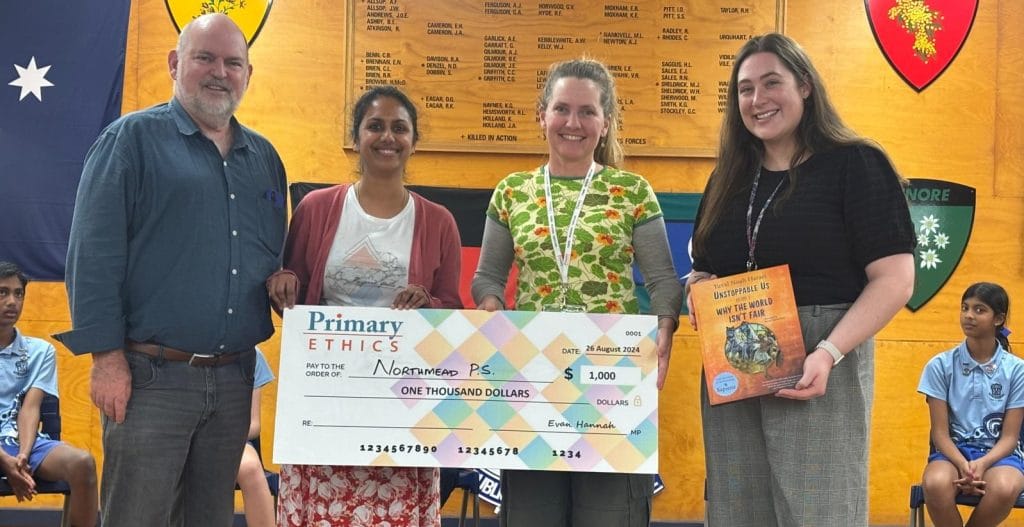
We asked Jim Neely, who, alongside the Northmead Public School team, was Kinghorn Volunteer of the Year 2024, to do a Q+A for us.

Jim is embarking on his second decade of volunteering this year, having started in 2015! He has quite a spread of experience with ethics, from the school level down to the lesson level. He’s regional manager for ethics programs in seven schools in the broader Queanbeyan region in southern NSW – four in Queanbeyan as well as Bungendore, Jerrabomberra and Sutton. Between them they deliver lessons to thousands of students each week. Currently, he supports 12 ethics teachers and himself teaches five classes every week in four different schools.

When accepting the Kinghorn Award, Jim said: As you all know, we are delivering a very worthwhile and important program and I get a lot of satisfaction out of my engagement with the students, as well as with the other volunteers – which is what keeps me motivated.

“I’d also like to acknowledge the wonderful support we receive from what I consider the ‘head office’ team: from the Help Desk, to the classroom support team, the trainers, area managers, communications team, the curriculum team…

“Your helpfulness, expertise and ongoing striving to improve the program and the volunteer experience contributes enormously to the satisfaction I get from my Primary Ethics volunteering.”

Jim Neely

Here’s Jim’s Q+A.

How did you hear about ethics and what drew you to volunteer?

Originally I read stories in the Sydney Morning Herald about the attempts to establish Primary Ethics in NSW public primary schools and thought, ‘What a great idea’! It was obviously such an important program for children. When I heard that the program was in place at Queanbeyan Public School, I volunteered.

Jim with Barb LaGanza (Kinghorn 2023), Jill Kinghorn and Swee Goh (Kinghorn 2022).

What have you done over your 10 years as an ethics volunteer?

I’ve continued as an ethics teacher and coordinator across that decade, but after retiring I also took on the Regional Manager role and worked to establish the program in more schools in the Queanbeyan area, plus Goulburn, which I looked after for a couple of years.

It’s very satisfying to now see many more children in the area having the opportunity to attend ethics classes.

What do you see the kids get from ethics and what do you get from it for yourself?

It’s very rewarding to see the development in the students’ ability to engage with the topics – to listen to each other and give thoughtful responses to the questions.

When a child says, ‘building on what so-and-so said’, I give an internal fist-pump! Also, when a class is going well, I feel a real sense of community develop, a level of trust, which is reflected in how the students engage with the discussions.

I also very much value working with such an inspiring bunch of people from different walks of life, many of whom I know have full lives already, managing work and children, but who also manage to fit in this commitment because of the value they place on it. I also value the sense of community that has developed between the volunteers in the different schools and the willingness to help each other out.

What’s your favourite lesson topic?

A number come to mind. With the little kids, the topic involving meerkats. This is one I know they remember. With Stage 3, I like the way the topic on Authority develops over four lessons, from a girl who shows courage at school in standing up for a disabled student, to the story of Rosa Parks and the Civil Rights movement in the US.  This topic always engages the students.

Are there other rewards you weren’t expecting? 

As time has gone by, I’ve come to appreciate more the broader benefits the children get out of the classes, beyond the development of their critical thinking/ethical reasoning skills, such as increased self-confidence, empowerment… For example, I recall one girl in a class who was initially very reluctant to contribute but became more confident as the year went on. When I asked in the end-of-year lesson, ‘How did you feel when you were talking and everyone else was listening?’, she said ‘Respect’.

Another reward is hearing about our impact. One school invited me and other community volunteers to an end-of-year morning tea. In speaking to the assembled group, the school’s SRE/SEE coordinator specifically mentioned our program and commented that the conversations from ethics often continued afterwards in the regular classes. That was very gratifying to hear.

Thanks Jim!

@Home Bulletin for parents Term 1 2025

Welcome to @Home for Term 1 2025, where we let families know what your children, from kindergarten into secondary school, could be exploring in their ethics lessons this term.

Subscribe here to receive our @Home email bulletin once a term.

The topics we show below are based on classes which begin at the beginning of the year. Schools start at different times of the year, some lessons go faster or slower than others, some schools skip ethics for the first and last weeks of the term while others teach every single week – and so on. 

We hope the students talk about ethics with you at home – ask them questions about it!

If your child tells you they are discussing a topic you don’t see in this bulletin, you can also look at the Curriculum section of our website.

Kindergarten: Being curious and asking questions
Young children are naturally curious and our curriculum is designed to nurture their curiosity, thinking and questioning skills – helping them grow into confident, independent thinkers. In their first topic of the year, students will explore why we ask questions and consider why it can sometimes feel difficult to ask questions out loud, especially when we’re worried about looking silly.

Stage 1 – Years 1 & 2: When is it fair?
Our Stage 1 students will explore fairness, starting with a story about some animals baking bread – where all but one help with the work. Should the animal who didn’t help still get to share in the bread? Later, they’ll discuss fairness in different contexts, including how to divide slices of cake. Through these discussions, they’ll consider different ways of thinking about fairness and what makes something feel fair or unfair.

Stage 2 – Years 3 & 4: Being greedy
Stage 2 students will think about what it means to be greedy, starting with the story of King Midas, who wished that everything he touched would turn to gold. They’ll also explore stories of children collecting things and discuss questions like: Is it wrong to want more toys than you can use? Is there anything wrong with wanting to be the richest person in the world? They’ll consider different perspectives on greed and whether wanting more is always a bad thing.

Stage 3 – Years 5 & 6: Voting
Our Stage 3 students will explore questions about voting, beginning with student elections. Should you vote for someone just because they’re your friend? How should we balance self-interest with the needs of others when deciding who to vote for? They’ll also consider whether voting should be compulsory or voluntary.

Stage 4 – Years 7 & 8: You’re not the boss of me
Stage 4 students will reflect on how much control they should have over their own lives. They’ll start by considering screen time – who should decide how much is too much, and why? They’ll also look at smoking laws and explore why some rules exist to protect individuals from harm. What right do parents, adults and governments have to limit teenagers’ freedoms? Why do we have age limits? Is it ever okay to stop people from doing things for their own protection? These discussions will encourage them to think critically about rights, responsibilities and personal autonomy.

Each term brings new ideas and questions and we hope these topics spark interesting conversations at home as well!

Dr Simon Longstaff is our new Chair

Dr Simon Longstaff AO, CEO of The Ethics Centre and longstanding member of the Primary Ethics Board, has become our new Chair on the retirement of founding Chair Bruce Hogan.

Dr Longstaff said, “It is with a deep sense of honour that I have accepted the Primary Ethics Board’s invitation to succeed Bruce Hogan as Chair.

“I have had the privilege of being part of Primary Ethics’ unfolding story from the first. It began with an email from a parent of children attending Neutral Bay Public School. Peter Carre asked if it might be possible to offer ethics classes to those not attending Special Religious Education (Scripture) – and the ball began to roll.”

Dr Longstaff paid tribute to founding Chair Bruce Hogan.

“Bruce has been a committed volunteer in the service of this proudly volunteer-driven organisation. He has given his all – wisdom, passion, experience, time and energy – in helping Primary Ethics become the force for good that it is today. I extend to Bruce our deep  thanks and respect.”

Evan Hannah, CEO of Primary Ethics, also saluted the outgoing Chair. “Quite literally Primary Ethics would not be operating without Bruce’s hard work gathering funds and supporters in our early years. His energy, vision and passion are the reason we are still here, along with his own outstanding personal generosity. What we have achieved rests largely on his shoulders and all of us – volunteers, staff and directors – owe him a significant debt.

“Bruce can be proud of bringing ethics classes to the many thousands of students who have benefitted since our launch 15 years ago.”

Simon Longstaff taking up the role of Chair coincides with Primary Ethics moving to share The Ethics Centre offices. Simon sees the need for ethics education as only growing. “Primary Ethics was established by The Ethics Centre as a heartfelt response to the plight of children who were subjected to unjust treatment – simply for not attending scripture classes. There is still much to be done to realise the original mission. And we can’t diverge from working towards that goal for as long as the need remains. Our curriculum and distinctive mode of teaching and learning has vast, untapped potential.”

Simon went on to acknowledge everyone who contributes to the work of Primary Ethics. “The parents who entrust their children to our care; the school communities who host our program; our dedicated staff who enable and support a high-quality program to be delivered every week; our donors and supporters who enable this work to be done.

“Above all, I thank our thousands of trained volunteers, who build the capacity of young people in ethical decision-making and thus help make a better world.

“I look forward to working with them all to broaden and deepen our impact.”