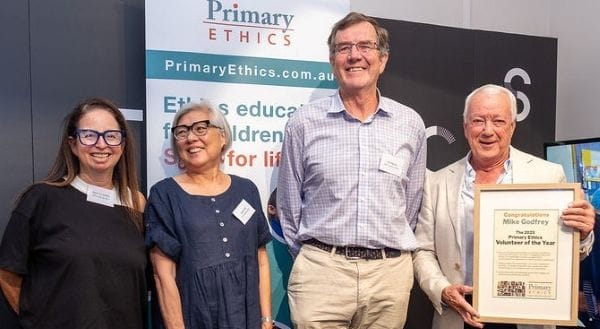
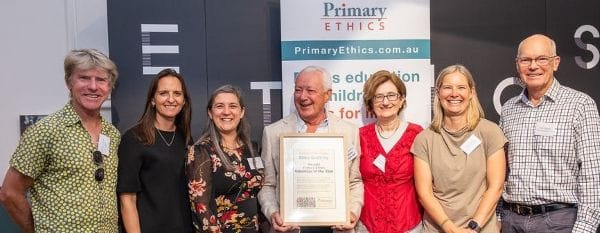
In December last year, Mike Godfrey was presented with our Volunteer of the Year award. Mike has been a dedicated volunteer in our classroom support team for 12 years. Many ethics volunteers have met Mike when they’ve reached out for support with a challenging situation and Mike has been there, on the phone or in person, to offer calm, professional and practical solutions – and continuing back-up.
Mike himself is a volunteer and offered these thoughts about volunteering, especially as an older person, in his award acceptance speech.
“I want to talk about volunteering. This organisation doesn’t work without volunteers!
We often talk about how volunteers give back and what wonderful people they are — and yes, we are— but I want to tell you there’s two sides to this. We volunteers get a lot out of this too! I think there’s a message here which we can take to the community which may help drive more volunteering, especially in older age groups.
Listening hard: What I’ve got out of this (and I can only talk for myself but I do know some of this applies to others) are skills development as well as personal development.
One of the great things I’ve learnt is to be a better listener— because you can’t be in a classroom, either teaching or observing, unless you’re 100% engaged and listening hard. And I have to say —and I’ve taught communication skills over many years— I probably wasn’t the listener I could’ve been but ethics volunteering has really helped me improve.
Brain health: Social contact is important and being with like-minded people is healthy. And the mental and intellectual simulation is vital. You know, there isn’t a curriculum topic I’ve read which doesn’t stimulate me to consider what I really think about this. I love that it causes me to think deeply — to engage in topics which otherwise I wouldn’t have thought much about. And that’s growing me as a person. It’s good for my brain health too.
These are things we can get across to the community. You can still grow! You might be age 50/60/70/80. You can still grow and develop and learn and if you’ve got the energy, you can still teach ethics.
Mike
Relevance: I sat next to a lady in her late 60s in a doctor’s surgery years ago and she was telling me how she had lost her relevance. I thought that’s a really sad thing to have to say— she felt she just wasn’t relevant to her family, to society or to work any more. Had I known what I know now I would’ve suggested she join Primary Ethics as a volunteer! Relevance to society is very important for older people. It’s something Primary Ethics can provide.
Staying in touch: Finally, one of the other things I have gained is it helps me stay in touch with the younger generations and their society. The way the scripts are written is stimulating. Listening to students respond to the scripts and enter into meaningful and respectful discussions on the various topics is incredibly interesting. And it really does help you stay in touch with younger people and how and what they think, which I just think is very important in many ways.”