Category: Teaching

Global Ethics Day 2025 – Volunteer spotlight on Ken

It’s Global Ethics Day 2025 on Wednesday 15 October and to celebrate, we turn the spotlight onto some of our volunteers and hear about the impact of ethics education in their own lives.

This global celebration of the importance of ethical tools highlights ethics as a process for finding solutions in the collaborative and respectful manner often missing in today’s world. It’s about how we learn to live together, respect our differences and together face our major global challenges.

Ken Welsh, ethics volunteer southern Sydney for five years

For five years I’ve volunteered as the manager of two regions – Kogarah and Beverly Hills. In those regions the ethics program is taught in 12 schools to over 600 students by 32 ethics teachers.

I was a high school teacher and principal in NSW, Queensland and the ACT. Then for 15 years immediately prior to retirement I worked within the Australian Department of Defence assisting ADF members with the education of their children. These children frequently changed schools because of their parents being posted around Australia. Parents were sometimes absent due to overseas deployments or distant training. All this impacted on their children’s education.

Becoming a volunteer with Primary Ethics allowed me to continue to be involved in education more broadly and to make a contribution to my local community.

As manager of the two regions I have oversight of the program, work with ethics coordinators in some schools to promote Primary Ethics, advertise and recruit volunteers to teach in schools that do not have an ethics coordinator, allocate teachers to classes in those schools and liaise with appropriate Department of Education staff to ensure the successful implementation of the program. Because of my background I hope I also can provide support to all those 32 teachers and the coordinators if and when they need it.

‘Think critically, reason ethically and discuss respectfully’ are the three keystones of the ethics program. I can’t think of anything more important than developing those qualities in young people who live in a world that is so conflicted by differing ideas, powered by an influential social media environment and which doesn’t seem willing to listen to others. It’s a huge enough challenge for us as adults, so how important is it for us to do what we can to prepare young people to live in this future world. As adults we can become complacent in our attitudes and values – it is much easier than being challenged to examine what we hold so dear and possible re-evaluate that.

My major subject when I was a teacher was modern history. It doesn’t just require the ability to recall names, events and dates (Wikipedia can do that!) but rather the ability to examine why events occurred and how they impacted on people and societies. By questioning we learn and by learning we can change – ourselves and our societies – for the better. Primary Ethics provides opportunities for young people to do just that too. To consider how they think and feel about a particular topic. To listen to what others think and feel. To evaluate our thoughts and feelings. And maybe to change.

This old History teacher is thankful that besides the usual teachers working away in our schools there is also a group of volunteers offering their time and talents to develop enquiring minds. I’m very satisfied that I still play some part in that development.

Global Ethics Day – Volunteer spotlight on Vicky

It’s Global Ethics Day 2025 on Wednesday 15 October and to celebrate, we turn the spotlight onto some of our volunteers and hear about the impact of ethics education in their own lives.

This global celebration of the importance of ethical tools highlights ethics as a process for finding solutions in the collaborative and respectful manner often missing in today’s world. Ethics is not about getting everyone to agree on a single set of values. It’s about how we learn to live together, respect our differences and together face our major global challenges.

Vicky Votoupal, second year volunteering in northwest Sydney

Just over two years ago I saw an ad in my children’s school newsletter, calling out for Primary Ethics volunteer teachers. At the time I had been coaching/managing one of my children’s sports team and really enjoyed that opportunity to have a positive impact for children in our local community. I was also finishing up a contract work role that had been very meaningful and saw ethics as a chance to contribute in a way I might not have the scope for in a new work role. Having completed my training, my youngest child asked if I could teach their year group and I took that as an endorsement!

My first year was 2024, teaching Stage 1. The student group has mostly been the same from last year to this year, which is great. I’ll move up to Stage 2 with the same group next year.

At work I’m a procurement professional, so ethics ties in really nicely to that. Conduct, transparency and fairness are all essential in my line of work. It’s sometimes easier to talk ethics with children than with adults! I also like to be able to discuss current affairs with my children in an age-appropriate way and I think our Primary Ethics training really helps with that.

As for the students, I enjoy watching their minds open when they hear other opinions that may be different to their own. My favourite lessons are when, after a discussion, I ask if they think the actions of a person in the story are okay and they answer “A bit yes and a bit no”. They often start from a definite position because they have only considered one perspective, but most of the time at least some of the group will consider other points of view that have been raised throughout the discussion. I also think it’s important to point out to the children when there isn’t a consensus in the group. In real life, there is often no definitive yes or no yet we still need to find a pathway forward in those situations.

We hear in the media that we live in a more divided world than ever, which is a scary concept. I like to think that most people most of the time are simply trying their best to take on the challenges of daily life. If we can teach our children the concepts of fairness and equity, the ability to listen to others with curiosity and to keep an open mind, that will certainly make the world a better place.

Global Ethics Day – volunteer spotlight on William

It’s Global Ethics Day 2025 on Wednesday 15 October and to celebrate, we’ll turn the spotlight onto some of our volunteers and hear about the impact of ethics education in their own lives.

This global celebration of the importance of ethical tools highlights ethics as a process for finding solutions in the collaborative and respectful manner often missing in today’s world. We can use ethics to guide personal decisions, mitigate harmful outcomes, create a more respectful structure for debate, develop helpful public policy, build and deploy technologies responsibly and address some of the world’s most pressing challenges.

Ethics is not about getting everyone to agree on a single set of values. It’s about how we learn to live together, respect our differences and together face our major global challenges.

William Mitchell, volunteer in inner-west Sydney for 11 years

What drew you to ethics volunteering? My journey with Primary Ethics began through my interest in the Ethics Centre  and their Festival of Dangerous Ideas. After learning over coffee about a friend’s experience as an ethics facilitator, I was immediately convinced to volunteer. I’m now approaching my 11th year as a facilitator, currently teaching Stage 1 students at Taverners Hill Infant School in Petersham, having previously taught Early Stage 1 and Stage 2 classes.

Unlike many volunteers, I don’t have children or grandchildren of my own. Rather, philosophy was the focus of my undergraduate degree, so I thoroughly enjoy having the opportunity to help the children engage in the types of thinking and skill development that I am passionate about but didn’t get to explore until much later in my life.

What do you get out of the lessons? Has it given you a clearer sense of your own ethics? The benefits I derive are numerous and profound. As a lawyer by profession, it provides a refreshing contrast to my daily work (though there are surprising overlaps between the skills required to ensure the children keep discussion on track and respectful and running meetings as a professional). The program allows me to connect meaningfully with my local community and gives me a sense of accomplishment in helping children develop crucial life skills. The children’s unfiltered, creative responses serve as a reminder of the importance of maintaining open and innovative thinking in adult life – something we often lose touch with as we reach adulthood.

The curriculum has significantly influenced my own ethical framework and daily behaviour over the past decade. Preparing for classes requires deep personal reflection on the same questions we pose to the children. Likewise, the process of truly engaging with the children’s responses often challenges my own beliefs and introduces me to perspectives I hadn’t considered. This aligns perfectly with my background in philosophy and continues to enrich my understanding of ethical reasoning and subjects which, as the curriculum was designed to do, apply routinely to what is going on in my everyday life.

What do you see as the benefits for the children? The Primary Ethics curriculum offers children numerous valuable skills, but perhaps the most crucial are the abilities to engage in respectful disagreement and to be open to changing their minds based on new information or perspectives. It’s particularly heartening to witness students becoming increasingly comfortable with revising their positions as the school year progresses, demonstrating their growing capacity for reasoned discussion and intellectual flexibility. Seeing the hand of a child go up to let the group know that they’ve changed their mind on an earlier answer they gave based on someone else’s response or reasoning is exactly why I facilitate ethics.

Why is ethical decision-making important in today’s world? The Primary Ethics program provides children with essential life skills that aren’t expressly practised or developed throughout formal education. These skills and behaviours are fundamental to human interaction and decision-making, yet opportunities to develop them in a structured environment are rare and can be far more challenging to learn as an adult. By enabling the next generation to identify and meaningfully engage with ethical questions that are inherent in everyday life, we’re investing in the development of better communities and societies of which we are all a part. As a staunch believer in this mission, I volunteer my time to help children develop these crucial capabilities so that they can go on to help the world and achieve far greater accomplishments than I could ever hope to achieve as an individual.

Inquiring Minds Spring 2025

Welcome to Inquiring Minds for spring 2025, where we bring you stories and reflections from our ethics classrooms and our volunteers, as well as recent Primary Ethics highlights.

In this issue we collected stories from our wonderful volunteers, such as:

  • we hear from two professionals who put their skills learnt as ethics volunteers into practice at work
  • you can watch the video of our panel discussion on critical thinking and empathy in the age of AI
  • and we share a letter from a supporter whose father asked for him to be removed from Religion lessons in 1965.
  • Plus many more stories!

To receive the next Inquiring Minds direct to your inbox, make sure to subscribe to our newsletters.

Northmead – volunteer team of the year

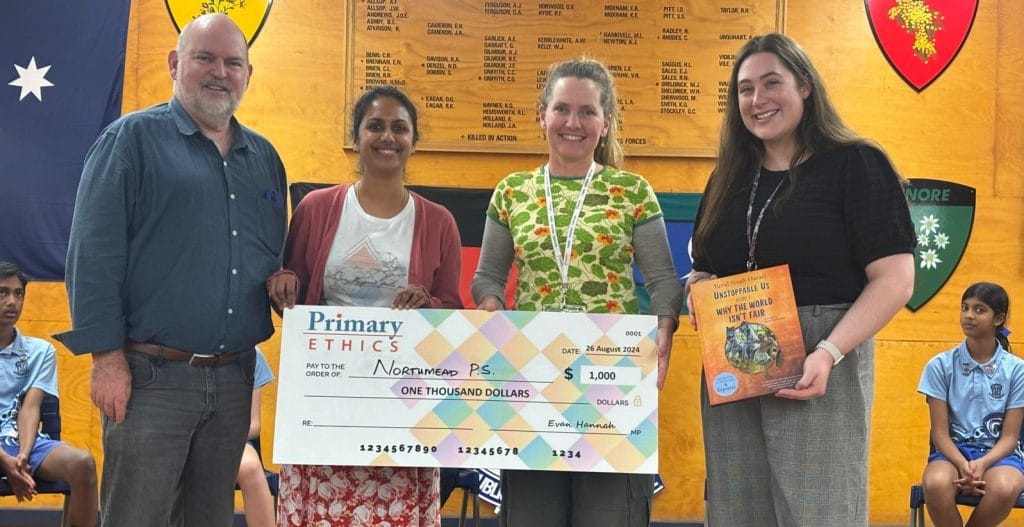
Northmead Public School ethics team were co-winners of the 2024 Kinghorn Volunteers of the Year award – in their school’s centenary year. At a recent school assembly they were presented with their $1000 winning cheque to go to their school library, as well as a hardback copy of Unstoppable Us by Yuval Noah Harari.

Evan Hannah, Primary Ethics, Mallika Ramaswamy, Veronica Roelink and the school librarian.

Northmead is a large, diverse school in western Sydney. The team have worked really hard at building a very strong, steady and committed presence to ensure that ethics is now offered across all years, having started with only two classes a decade ago. The reputation and popularity of the program has grown significantly and now almost one third of the school population is engaged in ethics lessons. The program is seen as an important part of school life and the team is well known and respected. With a diverse, committed and community-minded team, they’re not only teaching ethics — they’re building a lasting legacy. 

Our volunteers love the conversations and lessons we get to share with the kids and we especially love catching up each term to chat all things ethics and learning from each other's experiences. We all feel that we get as much from the experience of teaching ethics as we give to our students each week.

Former ethics coordinator Tania

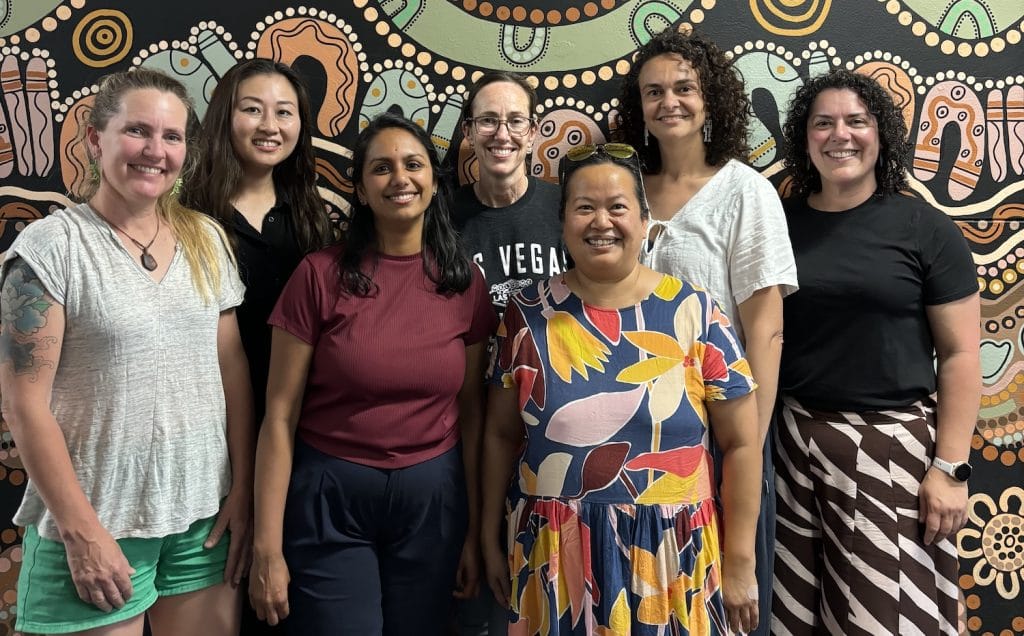
The 2024 Northmead ethics team, from left: Veronica, Christina, Mallika, Susannah, Myat, coordinator Tania, Elaine. Missing: Abha.

Volunteer Elaine

One of the team, Elaine Lee, told her story:

I have always wanted to volunteer in a program that has an impact for others. Taking a career break, I saw this opportunity  advertised at our school and jumped at the offer after reading up on the Primary Ethics program. My background is in Learning & Development and the program aligned with my values of instilling morale and critical reasoning, even more cause to volunteer with Primary Ethics.

What makes it great is that you don’t have to have facilitator experience! The training program is very well constructed, mine was led by Kelby Mason. 

 Knowing that I can make an impact for my child and the children of tomorrow makes it very rewarding and fulfilling. The curriculum is current with today’s scenarios and it’s such a pleasure to work with a cohort of like-minded volunteers who  want to make a difference. 

I encourage anyone who has the opportunity to participate in this program. I hope this becomes the norm as part of a child's learning in primary and high school. Thank you, Primary Ethics!

Elaine Lee. volunteer at Northmead Public School

Ethics teaching – a family affair

This year a third member of the Scott family has become an ethics volunteer. Peter Scott describes their journey to being an ethics family.

As ethics teachers, we often reflect on the benefits the Primary Ethics program has for our students. I have been an ethics teacher at Glenmore Rd Public Sschool in Paddington for 13 years now. Not only have I seen it benefit my many students over that time, but ethics volunteering has given my family a sense of common purpose and brought us closer together as we grow older.

In my second year I taught our younger son Lachlan, who was in Year 6. He was a little embarrassed to have his dad in front of his mates, although he got used to it as I brought my soccer coaching skills to bear. Our older son Alasdair had already left for high school when I started ethics teaching and felt a little left out of the conversations we were having at the family table.

Eight years later their mother Sarah became an ethics teacher too, partly to better inform her architectural work designing early childhood education facilities. She could see how much value I was getting from teaching the curriculum. Now she is part of our group of eight teachers at the school and absolutely loves it.

Sarah tells this story about witnessing the impact of ethics thinking skills in her class:

``One of my favourite ethics moments occurred with the lesson about the intent and structure of an ethics class. I followed the script, starting the class with random questions about unrelated topics which they could not possibly have answers for. They were all initially very puzzled and confused, but then one girl had a lightbulb moment and put her hand up with much animation. 'I know what this is!' she exclaimed excitedly, then in a conspiratorial voice she added, 'It’s an ethics class about ethics classes!' They all went 'Ahhhh'.``

Sarah Scott

After all these years the wheel has now turned full circle. Alasdair, who just missed out on being a student in the primary school ethics program, finally had some time to contribute after completing six years of university. We did the teacher training together in January 2025 – it was my second time and after 13 years it was completely different. Not only had the curriculum evolved, so had the teaching techniques.

So now Alasdair too has become part of our group of teachers and also loves it.

So we are an ethics teaching family! We sit down at the dinner table, speak one at a time, there are no putdowns and we build upon each other’s ideas … Okay, no, that doesn’t quite happen – we are a normal family and all talk at once. However, we  all recognise that the ethics program offers a really positive way of engaging with younger generations and listening to each other in order to build a future together.

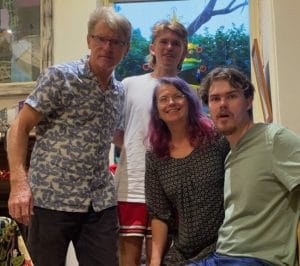
Peter, Lachlan, Sarah and Alasdair Scott
Jim Neely Q+A

We asked Jim Neely, who, alongside the Northmead Public School team, was Kinghorn Volunteer of the Year 2024, to do a Q+A for us.

Jim is embarking on his second decade of volunteering this year, having started in 2015! He has quite a spread of experience with ethics, from the school level down to the lesson level. He’s regional manager for ethics programs in seven schools in the broader Queanbeyan region in southern NSW – four in Queanbeyan as well as Bungendore, Jerrabomberra and Sutton. Between them they deliver lessons to thousands of students each week. Currently, he supports 12 ethics teachers and himself teaches five classes every week in four different schools.

When accepting the Kinghorn Award, Jim said: “As you all know, we are delivering a very worthwhile and important program and I get a lot of satisfaction out of my engagement with the students, as well as with the other volunteers – which is what keeps me motivated.

“I’d also like to acknowledge the wonderful support we receive from what I consider the ‘head office’ team: from the Help Desk, to the classroom support team, the trainers, area managers, communications team, the curriculum team…

“Your helpfulness, expertise and ongoing striving to improve the program and the volunteer experience contributes enormously to the satisfaction I get from my Primary Ethics volunteering.”

Jim Neely

Here’s Jim’s Q+A.

How did you hear about ethics and what drew you to volunteer?

Originally I read stories in the Sydney Morning Herald about the attempts to establish Primary Ethics in NSW public primary schools and thought, ‘What a great idea’! It was obviously such an important program for children. When I heard that the program was in place at Queanbeyan Public School, I volunteered.

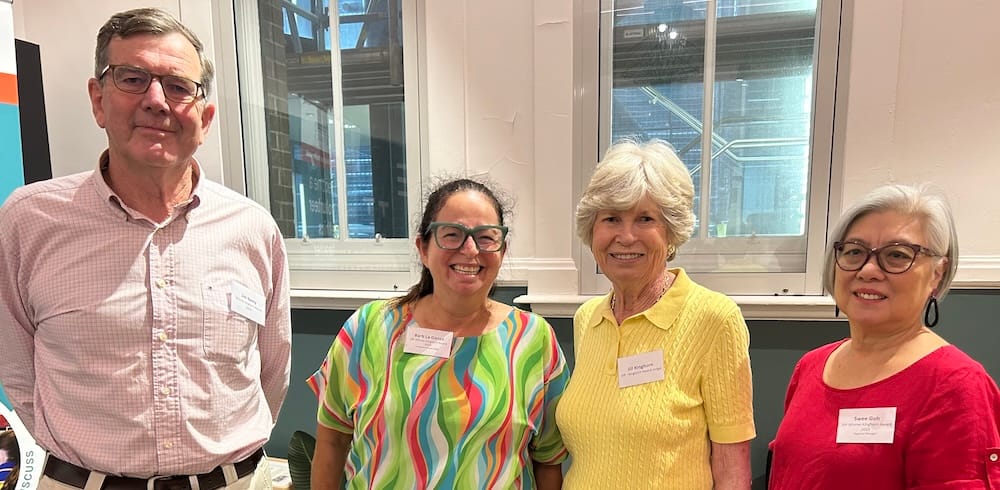
Jim with Barb LaGanza (Kinghorn 2023), Jill Kinghorn and Swee Goh (Kinghorn 2022).

What have you done over your 10 years as an ethics volunteer?

I’ve continued as an ethics teacher and coordinator across that decade, but after retiring I also took on the Regional Manager role and worked to establish the program in more schools in the Queanbeyan area, plus Goulburn, which I looked after for a couple of years.

It’s very satisfying to now see many more children in the area having the opportunity to attend ethics classes.

What do you see the kids get from ethics and what do you get from it for yourself?

It’s very rewarding to see the development in the students’ ability to engage with the topics – to listen to each other and give thoughtful responses to the questions.

When a child says, ‘building on what so-and-so said’, I give an internal fist-pump! Also, when a class is going well, I feel a real sense of community develop, a level of trust, which is reflected in how the students engage with the discussions.

I also very much value working with such an inspiring bunch of people from different walks of life, many of whom I know have full lives already, managing work and children, but who also manage to fit in this commitment because of the value they place on it. I also value the sense of community that has developed between the volunteers in the different schools and the willingness to help each other out.

What’s your favourite lesson topic?

A number come to mind. With the little kids, the topic involving meerkats. This is one I know they remember. With Stage 3, I like the way the topic on Authority develops over four lessons, from a girl who shows courage at school in standing up for a disabled student, to the story of Rosa Parks and the Civil Rights movement in the US.  This topic always engages the students.

Are there other rewards you weren’t expecting? 

As time has gone by, I’ve come to appreciate more the broader benefits the children get out of the classes, beyond the development of their critical thinking/ethical reasoning skills, such as increased self-confidence, empowerment… For example, I recall one girl in a class who was initially very reluctant to contribute but became more confident as the year went on. When I asked in the end-of-year lesson, ‘How did you feel when you were talking and everyone else was listening?’, she said ‘Respect’.

Another reward is hearing about our impact. One school invited me and other community volunteers to an end-of-year morning tea. In speaking to the assembled group, the school’s SRE/SEE coordinator specifically mentioned our program and commented that the conversations from ethics often continued afterwards in the regular classes. That was very gratifying to hear.

Thanks Jim!

Five lessons I’ve learnt from teaching ethics

Karina Morgan is a volunteer ethics teacher who’s learnt as much from her class of seven-to-nine year olds as they learn from the ethics curriculum. Here Karina describes her own five lessons learnt.

Each week, for 45 minutes, I sit down with a group of Year 2 students and discuss ethics. We’ll tackle an ethical concept or dilemma, typically in the form of a story, with questions designed to draw out deep discussion amongst the class.

The Ethics Centre established Primary Ethics as an independent not-for-profit in 2010, tasked with developing a curriculum and recruiting volunteers to run weekly ethics classes as an alternative in the scripture timeslot in public schools. They now deliver lessons to 45,000 children in 500 schools from kindergarten to year eight.

Classes are led by trained volunteers, who act as impartial facilitators. Our role is to model active listening and ask questions that build critical thinking skills and encourage collaborative learning.

For me, it feels like the most important gift I can give to the next generation. And if I’m honest, I find I am learning in each and every class right alongside them. Here are five lessons I’ve learned from teaching the Primary Ethics curriculum:

1. Curiosity is the gateway to critical thinking

Embracing curiosity is how we learn; it’s the driving force for growth, discovery and innovation. The innate curiosity in children is a vital foundation for developing skills like critical thinking, empathy and thoughtful decision-making.

You see, a curious mind doesn’t accept information at face value; it probes deeper, asking why, how and what if? It fuels the critical examination of ideas, helps us identify biases, to sort fact from fiction and consider situations from multiple perspectives.

I admire the unbridled curiosity of the students I teach. It’s contagious. As adults, we can get stuck in our routines and belief systems. We accept the status quo and stop exploring what’s possible.

2. There is power in saying ‘I don’t know’

One of the most powerful moments last year came when a student asked a question I couldn’t answer. I took a breath and said, “I don’t know – what do other students think?”

And just like that, the room lit up. I had given the students permission to be knowledge holders and had modelled the open-minded growth mindset we want to cultivate through ethics lessons. Since then I have witnessed so much more willingness from everyone in the room to have a go.

It turns out there’s a kind of magic in admitting you don’t have all the answers. Teaching ethics is not about being an authority; it’s about being a partner in figuring things out. Admitting you don’t know doesn’t make you weaker – it opens the door for connection and learning.

3. To disagree respectfully, we need to be open to learning from each other

Nine-year-olds are full of opinions. But what also stands out to me is how open they are to new points of view, to listen to each other, even when they disagree. Recently, a student in my class said she disagreed with the person sitting next to her. That student smiled, said, ‘that’s okay’ and leaned into hearing her peer explain why. Imagine if we could cultivate that across the political divide.

Kids don’t assume the worst in someone who thinks differently – they assume they are trying their best, just as they themselves are. Watching them address and debate differing points of view without engaging in personal attack or any attempt to discredit each other is a beautiful reminder that respectful disagreement starts with empathy, assuming good intentions and willingness to learn from each other.

4. Psychological safety empowers new ideas and even changes minds

There’s a sense of psychological safety built through collaborative inquiry, because everyone’s ideas and questions are valid here. The kids thrive in the freedom it offers to explore, build on each other’s ideas and even to change their minds.

When I started teaching this class two years ago, everyone was itching to have their turn and to get the answer ‘right’. Now they have begun to really listen to each other – not just to respond, but to understand each other’s opinions.

This year there have been instances where students have discussed feeling conflicted over a question, proposed merit across differing sides of a debate and even changed their mind after listening to other points of view.

It’s a powerful reminder of how active listening can transform conversations. Making someone feel heard deepens trust, fosters empathy and makes room for challenging conversations. It isn’t just a tool for learning; it’s a tool for connection.

5. Ethics in education can establish a resiliency for life

Resilience, I fear, is a word that’s lost some of its charm for a lot of adults. Through ethics lessons I’ve been reminded that resilience isn’t the nefarious push-through mentality or the ability to bounce back from a setback. It can also be staying engaged with challenging situations, even when the answers are messy or unclear. It’s regulating emotions, processing stress and being adaptable to change.

Ethics lessons are about grappling with tough questions, sometimes without any resolution. Nine-year-olds handle this better than you’d think, certainly better than a lot of adults. When there’s no clear answer, they meet the discomfort of uncertainty with curiosity and creative thinking.

My Journey as a Volunteer Ethics Teacher

COVID had an unexpected consequence for Lalita Kanetkar – it was the start of her journey to becoming an ethics teacher.

Lalita writes: During the COVID years, most parents had a very difficult and stressful time managing both their own jobs from home and the schoolwork of their children – particularly if the children were young. My younger daughter had a son in Year 1 and was dealing with her own job and home schooling. It got me wondering – could I be of any help with the home schooling?

When I put this to her, she was genuinely surprised … because, to be honest, I had never helped my girls with their schoolwork as they were growing up. Even so, my daughter accepted my offer. So the journey began, home schooling over Skype. I felt enormous relief and satisfaction when my grandson did really well that term, as evidenced by his school report. And so we continued with the home schooling and I had a sense of real success (in truth, the success belonged to my grandson!)

However, this success led to something quite unexpected. Around this time I started talking to a friend about Primary Ethics. She herself had been volunteering as an ethics teacher for a few years. My daughter’s encouragement and hearing about my friend’s experience got me really interested. I checked out the Primary Ethics website and registered my name. Following the interview, I undertook the training and so began my journey as a Primary Ethics teacher.

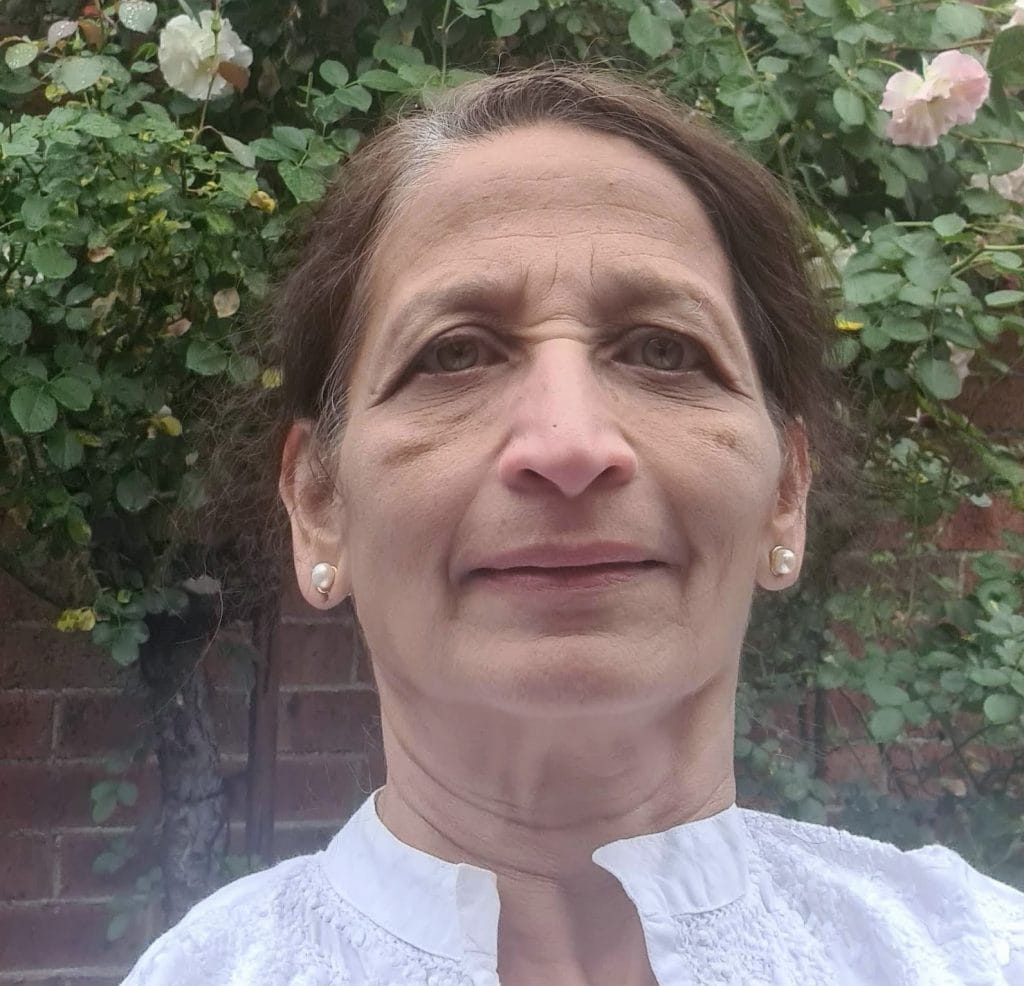
Lalita Kanetkar

The intention of ethics education is to teach children the skills they need for critical thinking from a very young age - recognising that it is so important in life to listen to different opinions, learn to question and develop the confidence to express one’s own point of view. After all, there are so many occasions in life when it not only important but also difficult to make choices and decisions. For example, how do we know if the choices we make are ‘right’ or ‘wrong’? Have we considered how they might affect others?

Lalita Kanetkar

These are the sorts of dilemmas the ethics curriculum aims to help children consider by introducing simple and relatable stories about choices and decisions they must make in their daily lives. By asking many questions, the lessons try to get children to think about why they agree or disagree with the opinions and decisions made by different characters in the stories.

For example, for younger children from Kindergarten to Year 2, we use simple stories on issues such as hurt feelings, teasing, telling the truth, showing empathy or accepting an apology. Children are able to relate to the characters and talk about whether they agree or disagree with them and whether they themselves would behave differently in the same situation. Slightly older children, from Year 3 and above, will have developed the capacity to think and question more critically. Again using stories, we consider topics of a more complex nature – be it keeping animals in zoos, bragging, etc.

To assist in critical thinking, the curriculum also introduces logic – recognising that the skills for logical thinking are an essential ingredient of critical thinking.

Since 2021 ethics has also been taught in Years 7 and 8 of public high schools.

Of course this means there is a great need for volunteers. In order to volunteer as a teacher, you need to obtain a Child Protection Certificate and a Police clearance. You also need to undertake a short training course. However, there is no requirement to have teaching experience.

Of course, being a volunteer means there is no financial remuneration. So you may well ask, what have I personally gained through my ethics teaching experience?

Well, my class goes for 30 minutes and I can assure you it is the most enjoyable half hour spent in the company of young, inquiring minds. I started teaching this group of children when they were in Kindergarten. They are now entering Year 3. It has been so exciting for me to see how their thinking has developed, how well they are now able to express themselves, set out their views and listen to each other. They understand that it is important to respect the opinions of their classmates though they themselves may disagree with those opinions.

And then of course, there are some heartwarming incidents. When for example, a child impulsively says, “I like you!” And once when I told my class I was going to be away for a couple of weeks, they cried out, “We’ll miss you!” I found that so touching.

And finally, teaching ethics is influencing me to think critically about my own day to day activities. The other day after a hard morning of housework, I finally sat down to watch a movie on Netflix. When it finished I was considering whether to watch another. And then the critically thinking voice inside me started questioning whether this would me a just reward for all my hard work in the morning or was I perhaps succumbing to laziness?

What do you think? If you were to join me in an ethics class I would love to hear your views. Better still, why don’t you consider starting your own journey as a volunteer ethics teacher!