Prominent British philosopher Professor AC Grayling is in Australia to talk about the future of democracy and the future of truth in the upcoming Sydney Writers Festival. Professor Grayling’s niece Catherine is an ethics teacher at her children’s school, Dulwich Hill Public School in inner-west Sydney. We were delighted when Catherine, in collaboration with the school and with Primary Ethics, invited her uncle to address an audience of parents, children and ethics volunteers and supporters at the school one afternoon last week. The subject was children and critical thinking. A huge thunderstorm punctuated the event but the audience was held by an amusing but serious and stimulating talk. But first, Professor Grayling was introduced by some young students who told us what they especially value about ethics.
Thoughts from a Year 5 student
Eli from Year 5 had this to say about ethics: “I think these classes give us some really important skills. Usually, Catherine our ethics teacher gives us a dilemma and draws out our different opinions. She asks us whether our views change with new information. She teaches us to listen to what other people have to say, even if we don’t agree with them – because that helps us make our ideas better or more nuanced. Sometimes it can be hard to listen to someone you don’t agree with or when you think they’re wrong. But when you do listen, sometimes you learn something you didn’t know or hadn’t thought of, or in working out why you don’t agree with them, it strengthens your own reasoning. … Understanding competing interests can be a very powerful tool, as can developing advocacy skills. Both are proving quite handy with my parents.”
Ethics and morality
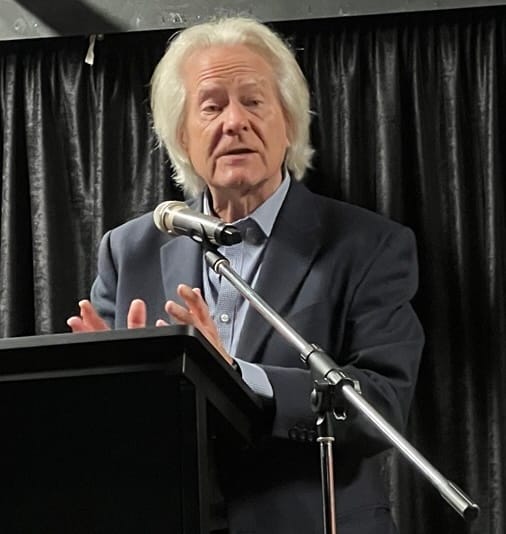
Then Professor Grayling spoke, first about the origins and meanings of two terms that are often used interchangeably, but benefit from a clear distinction. Ethics derives from the Greek word ethos, meaning character, disposition or way of being. He described it as relating to the philosophical inquiry into how one should live. Not in the sense of prescribing answers, but in examining and reasoning about them. In that sense, ethics is concerned with the process of forming character, of becoming a certain kind of person and thinker, with certain values.
Morality comes from the Latin mores, meaning customs, habits or social norms. Morality, therefore, refers to the rules, expectations or codes of behaviour that a society holds. It could be thought of as guidance [or in some stricter societies or religions, as a mandate] about what to do, how to behave.
Critical thinking
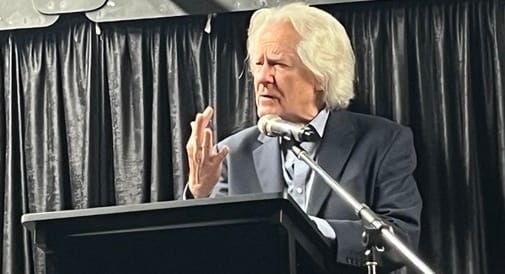
Professor Grayling used this distinction between ethics and morals as a segue into critical thinking. His point, in essence, was that developing one’s ethos, one’s character and way of thinking, is a process. And this process requires rigour in how we form, interrogate and review/revise our beliefs. Critical thinking, arguably, brings that rigour. It is not simply about having thoughts and opinions, but about testing them. He suggested things like asking whether the reasons support the conclusions, or testing assumptions. And he also spoke about the willingness to reconsider.

Audience reflections
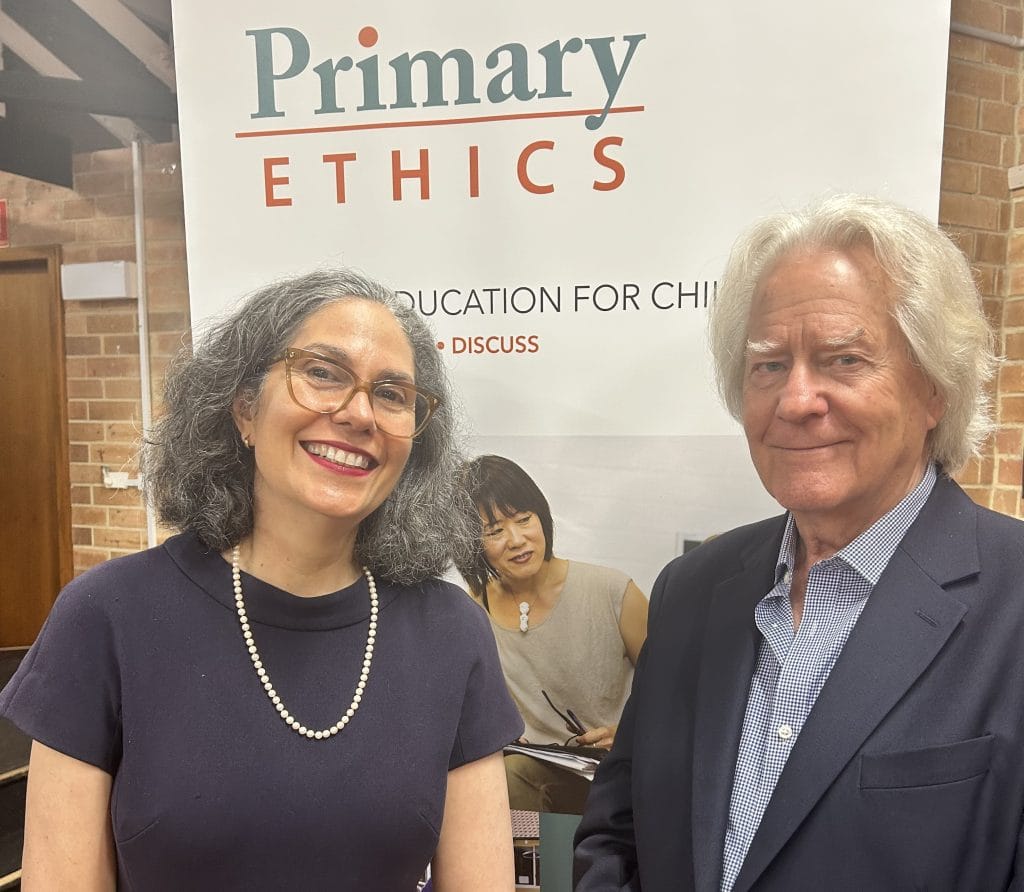
Catherine Grayling: I did really love hearing from the students and was so proud when my uncle acknowledged them and said that clearly the ethics program is working. Each week I am amazed at how thoughtful and engaged the children are and I agree with my uncle that the Primary Ethics materials are “marvellous”! It was fabulous to bring those things together on stage.
Gary: This was an extremely interesting deep dive into the history of ethical thinking and how it relates to education today. He highlighted the real need for critical thinking in an overly saturated age of information. I love that he asked us to always pose the question “Really?” when consuming ‘information’ online, essentially fact-checking as we sift through the noise.
Allan: Professor Grayling’s engaging and erudite talk had two themes: (1) what is ethics, why it is important and how it is significantly different to morality; and (2) what is critical thinking and how do we apply and cultivate it particularly in primary education practice. His clear and apt explanation of the Latin translation by the Roman orator Cicero (mid first century BC) of “moralis” for the Greek concept of “ethos” started to make a lot of sense to me. Morality concerns ‘proper’ behaviour or customs and is situated in a time and place, with Prof Grayling giving examples of the shifting moral expectations and standards from periods such as tight Victorian England, the roaring 1920s, the illiberal buttoned-down1950s and the swinging 1960s. Ethics is something more fundamental, more universal, more long-lasting. A phrase Prof Grayling used struck me as essential to understanding this. He said something like “ethics is predicated on sympathy for the human condition”. Yes! Whilst we don’t usually explicitly talk about the human condition in ethics, we do have our stories which illuminate and cultivate such sympathy, whether they are ancient fables (Aesop’s the farmer and the apple tree), myths (Daedalus and Icarus) or more modern examples, both fictional and real-world news stories.
It was an inspiring hour, with Zeus arguing with thunder outside to no effect. I am sure the audience understood and felt that the pursuit of ethics education at all ages is necessary and valuable.”
Bruce: AC Grayling was able to speak about some of the deepest ideas in the history of philosophy, and especially ethics, and to make those ideas so accessible for the audience – and that included my 10 year-old son! What the event showed me was how relevant, and even vital, ethical studies is for young people who are growing into themselves.”
Catherine: AC Grayling was both engaging and deeply insightful. He articulated ideas that many of us intuitively understand but struggle to put into words. His discussion on the importance of teaching ethics to children was especially compelling. He made a persuasive case that these skills are not only valuable, but increasingly essential in a digital age.
Rousseau: This talk was very nourishing for the mind! One of the things that stood out for me was his explanation of what ethics means. Ethics isn’t teaching students specific rules of behaviour (which is morality), but helping them to cultivate character. In our lessons, this is developed through students learning together how to articulate their thoughts about what constitutes ethical behaviour, actively listening and conducting a respectful dialogue. His comments highlight the urgency of ethical education in today’s world where there are many societal problems that can only be tackled on the level of ethics, including AI which was raised in the questions and then discussed at length.
Elizabeth: I was intrigued that Professor Grayling articulated what appears to be happening with global issues, eg. climate change, disease eradication, political self-determination. It came up in response to the question about use of AI and he called it Grayling’s Law: Anything that CAN be done WILL be done if it brings advantage or profit to those who can do it.
And the corollary to Grayling’s Law he mentioned, every bit as negative: What CAN be done will NOT be done if it brings costs, economic or otherwise, to those who could stop it.
Slightly depressing when set out like that, except that he was referencing that what’s needed to counter and break these laws (inter alia) is shared human experience – which is what we talk about in the scenarios in ethics.
Mike: Such an inspiring event, delivered with such warmth and humility. Well done for arranging the thunder and lightning at key moments to dramatise AC’s key points!
They correctly guessed:
- Hm (expressing curiosity or interest); and
- Ah (reflection or understanding)
Acknowledging AC, I have added the element Re (‘Really’! – critical thinking response to a dubious assertion, seeking evidence or counter perspective).
Glynn: This was a delightful and thoughtful evening. AC (as our family calls him) opened with what he’s famous for: ethics, why it’s different to morals and the huge benefits of mastering critical thinking early in life. But this time it was a little different for me. AC reached out to the children, including the four primary students who started the evening telling us all why they liked ethics classes so much. Professor Grayling reminded us that children are nicely positioned to ask themselves “Really?” (when they hear something that needs a little more thought) and to hum “hmm” (when a little thinking time is needed).
And a highlight for me: AC asked “Where does the hole in a donut go when you eat it?” The answer: ask a group of nine year olds, you’ll be surprised.
I’d also like to mention the pounding rain and thunder which wrapped up AC’s magical time with us!”
And the last word goes to Eli.
I really enjoy ethics classes. I hope they continue. And that AC Grayling might take up one of the volunteer positions here.