Archives

Googling the high school ethics curriculum

Kelby Mason, philosopher, ethics teacher and trainer, was lead author for our high school curriculum, before we launched the high school ethics program in 2021. Here’s his writing process.

Q: What do the following have in common: 

  • attractive people judged more trustworthy 
  •  what does nodding mean in Turkey
  • Roger Ebert idiot plot
  • shame culture guilt culture
  • apology displays in dogs
  • what is this thing you humans call friendship
  • influencers ruining nature
  • famous examples of not accepting an apology
  • indigenous Australians on importance of role models growing up
  • how far away is the heat death of the universe
  • what happened to Jeremy Bentham’s head [look it up yourself, it’s pretty interesting!]
  • famous female political prisoners
  • mismatched couples in ya fiction
  • average daily earnings Uber Eats
  • Trump tweet ‘we cannot let the cure be worse than the disease’
  • cross-cultural facial expressions
  • Paul Rozin glass of spit.

A: They’re all things we googled while writing the Stage 4 (years 7 and 8) high school ethics curriculum. 

Since 2011 Primary Ethics has been teaching ethics classes in primary schools across NSW, with (as of 2023) 2600 volunteers in 500 schools, reaching 43,000 students weekly, from Kindergarten to Year 6. It’s quite a challenge keeping that machinery running each week, but at least once Professor Sue Knight had written an entire curriculum of over 100 lessons to cover all the primary school stages, we could relax a little, knowing that would be all the ethical thinking school students would have to do. 

Yet it turns out that high schoolers face ethical problems too — who knew?! And, kidding aside, the ethical issues they confront are not the same as the ones facing primary kids. Plus, they can think bigger and deeper about the ethical issues we all face as individuals and as a society. 

So we googled a whole lot of weird stuff (which didn’t all make it into the curriculum) and made a curriculum for year 7 and 8 students. These classes give students who’ve done ethics in primary school a chance to develop their critical thinking and group discussion skills even further, while thinking about issues that matter to them as teenagers and to society. And for students who didn’t have the opportunity to do ethics in primary school, it introduces the fascinating, puzzling and stimulating world of ethical thinking and discussion. 

In high school ethics, students get to think and talk about a bunch of big important questions like:

  • Should we lower the voting age?
  • Is peer pressure always bad?
  • Who should decide how much time you spend playing video games?
  • If you could live forever, would you want to?
  • Is there anything wrong with leaving rubbish on the moon?
  • Can you put a price on human life? Are young people’s lives worth more than old people’s?
  • Does the environment have rights like humans do?
  • Does it matter if everyone disagrees with you?
  • And would you drink a glass of water with your own spit in it?

Yep, that spit one stayed in – believe it or not, the emotion of disgust is ethically interesting!

How is it ethically interesting? Well, you’ll have a take a high school ethics class to find out.

To find out more about our high school ethics program and express an interest, go here and click on the High School link top right.

Jane Hunter: Putting my values into practice as an ethics teacher

Jane Hunter is the Global Head of Digital Marketing for SFI Health – she’s also a volunteer ethics teacher. One of Jane’s workplace values is to progress human quality of life. She wrote this blog post describing how being an ethics volunteer chimes with that value.

Why is this core value important to you?
I think if we can improve the quality of people’s lives, bit by bit we can make the world a better place. There are so many ways we can do this, from donating blood to volunteering at a soup kitchen to helping kids to think and reason clearly. I think big picture, if people’s quality of life improves, humanity as a whole improves.

Building this value into our work culture is a smart move because it connects with so many.

What types of things do you do to progress human quality of life?
Outside of work, I volunteer with an organisation called Primary Ethics as a primary school ethics teacher for an hour a week and it’s one of the highlights of my week.

The lessons involve introducing complex ideas through storytelling around topics such as ‘Is lying wrong?’. We delve into sticky topics like this asking the kids to consider questions like ‘is it ever ok to tell a lie? Is withholding information the same as lying? Is it ok to tell a small lie to protect someone from feeling hurt?’ I guess it’s all about encouraging and developing skills in critical thinking.

I’m amazed at the capacity of eight and nine-year-olds to grab onto these very human conundrums and discuss them. I encourage the kids to think before answering, then to provide a reason for their point of view. I then open it up to others in the class who might have a differing view.

We also follow a set of rules for having healthy conversations, which I think are powerful skills to have all through life. These include building on each other’s ideas, showing respect for different ideas, tackling the ideas but not the individual, learning how to take turns at listening and contributing.

What type of impact do you think you’re having?
I hope I’m giving kids the opportunity to think about important issues, to build confidence in expressing themselves in a safe constructive environment and the skill to disagree respectfully.

It’s also a chance for the children to change gears and take a break from a world which can be very black and white.

The personal connections and circle we sit in encourage face-to-face conversations.

I think discussing these topics also gives the kids a chance to build interpersonal communication skills. I hope they learn it’s possible to be respectful when someone has a different point of view and that they model that kind of behaviour in the playground and later, online.

I was chuffed when an eight-year-old boy, who is normally quiet, walked with me as we left the class for a further conversation about the topic of ‘greed’. He was so engaged, he nearly missed his recess! It was a good feeling to see him thinking deeply about this and that the impact of the discussion might resonate beyond the classroom.

My daughter who is in the class keeps me well-grounded with lots of unsolicited feedback at home too.

Are the skills transferable to your workplace?
Absolutely. Teaching ethics and opening up the conversation to many viewpoints reminds me of the importance of keeping an open mind. This is critical in any global role because each day I interact with colleagues from different cultures, market conditions, life experience and personalities.

In the classroom, there is a good chance there are kids who are neurodiverse, just as there are sure to be neurodiverse people in any workplace. Improving human quality of life also extends to our colleagues through our considered interactions.

Teaching ethics has also honed my skills in facilitation and being agile. There’s no end to the tangents an ethics discussion with eight-year-olds can lead to or the general unpredictability of kids to keep you sharp! Having additional practice to think on your feet and find solutions on the go, even when things don’t go to plan, definitely has parallels to my work.

How does this relate to SFI Health’s culture and In Tune with You?
My first thought is that the business is in tune with me because teaching ethics is important to me.

I truly believe in the value of teaching ethics and knowing SFI Health was going to support me in doing this was really important to me. I think it’s impressive for a company to allow me time and space to do this, it makes a difference to me as an employee and how I feel about and engage with the company.

Focusing on this value I think demonstrates SFI Health is not only in tune with me, but with the greater good.

Empathy – an ethics class on Insight SBS-TV

What is empathy? Do we need to learn to be more empathetic? Can empathy be taught? The SBS program Insight dedicated an episode to this question, which aired on 16 May 2023.

Insight visited a public school in Sydney and filmed a wonderful Stage 2 ethics class on empathy taught by Primary Ethics volunteer Shing Ka, where students learn to consider other children’s feelings and motivations. It’s just a snippet of the whole 30-minute lesson but is a strong illustration of an ethics community of inquiry in action.

Ethics @Home bulletin for parents Term 2 2023

Our @Home bulletin for parents aims to let you know what your children are discussing in their ethics lessons this term. We hope they’re talking about it with you at home too!

Bear in mind that schools start their ethics programs at different times of the year, basically when they have enough volunteer teachers. The topics we show you below are based on classes which began at the beginning of the year. If your child’s class only commenced this term, you can also take a look at the Curriculum section of our website to see what they’ll be discussing.

Please contact us if you have any questions about your child and ethics.

Here’s a brief look at what your children could be exploring in their ethics lessons this term. 

Kindergarten: Doing harm without meaning to  
This kindergarten topic explores the ethics of accidentally hurting someone. Students think about and discuss: is it worse to do something bad on purpose or by accident? Should we be punished for harm we cause by accident? Does it matter if it was the result of carelessness or thoughtlessness?
Later in the year, students will consider questions about making things up and showing off.

Stage 1 – Years 1 & 2: When is it fair?  
This Stage 1 topic explores the concept of fairness. Students think about and discuss: How can we divide things fairly? Does being fair mean everyone gets an equal share? When you make something, should you still share it with someone who didn’t help?
Later in the year, students will consider how we should treat pet animals.

Stage 2 – Years 3 & 4: Persuading 

This Stage 2 topic explores the ethics of persuasion. Students think about and discuss: Is it okay to exaggerate or only share part of the truth when trying to persuade someone? And is it fair for advertisers to use tricks to persuade people to buy their products?
Later in the year, students will consider the ethics of getting even – does one bad turn deserve another?

Stage 3 – Years 5 & 6: Being vain 

This Stage 3 topic explores the ethics of wanting to be better than others. Students think about and discuss: is it okay to want to look good and to want to look better than other people? How can one person’s vanity impact on the wellbeing of others? And how do you draw the line between reasonable and excessive concern for how we appear to others?
Later in the year, students will consider how to balance the needs of people they know and strangers in need.

Stage 4 – Years 7 & 8: Giving and accepting apologies 

This Stage 4 topic explores the ethics of apologising. Students think about and discuss: What makes something a good apology? Do you have to accept a good apology? And is it ever important for a group (like a class of students) to collectively apologise for the actions of one of its members?
Later in the year, students will consider if being happy is all that matters in life.

‘I’m a Primary Ethics teacher’: Emily’s MamaMia story
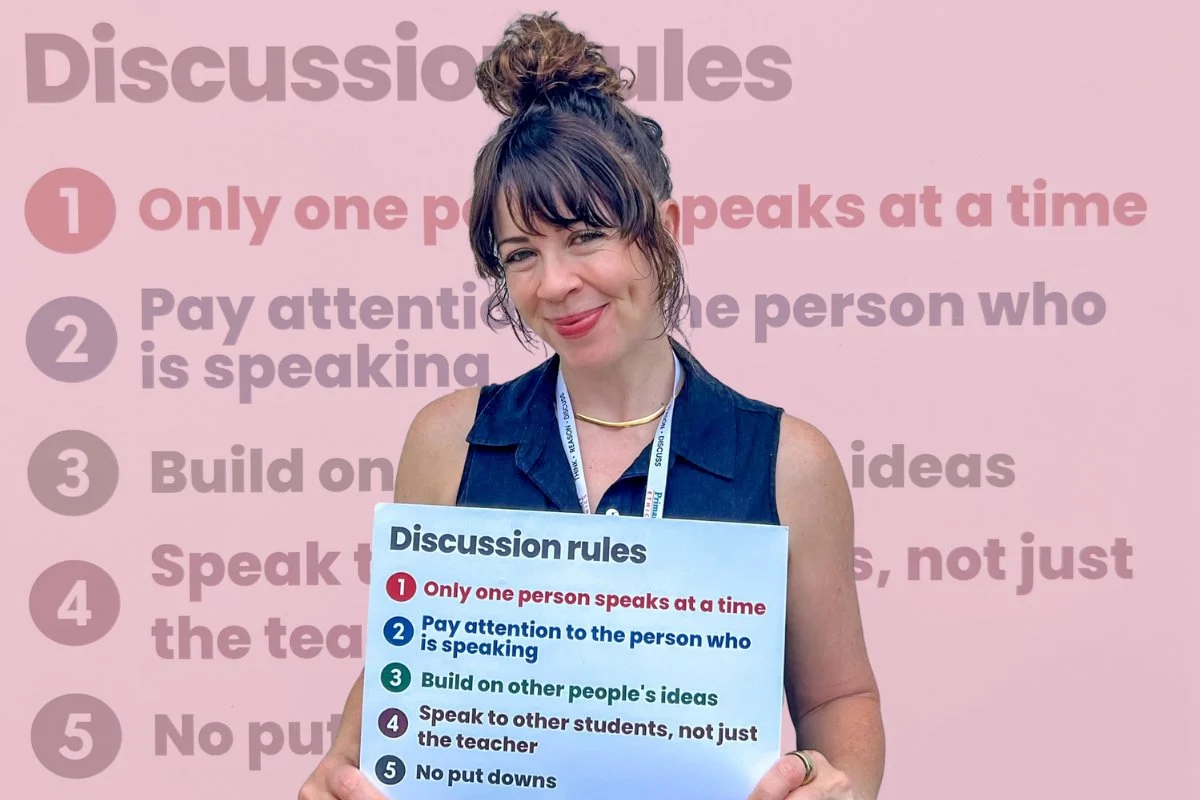
Emily McGrorey with the Primary Ethics discussion rules.

Newcastle ethics teacher Emily McGrorey has written about her journey to become an ethics teacher for the MamaMia website.

“[My daughter’s] teacher explained there weren’t any ethics classes running in her year level because they needed someone to volunteer to teach them. It was at that point that I thought, well, I’m someone.”

“To be honest though, I was quite nervous about the prospect of teaching. Until I had my own kids, I had very little experience with children and heading into a classroom to be the actual teacher all seemed a bit daunting. What if I couldn’t control the children and they revolted against me like some kind of chaotic scene from Matilda?”

Emily began teaching ethics during the lockdown year of 2021, so it was an on-again, off-again venture. She finally taught for a full year in 2022 – “and I’m pleased to report that the children haven’t staged a coup against me, yet.”

Read Emily’s full account, ‘I’m a primary ethics teacher. Here are the 5 biggest things it teaches kids.’

Swee Goh: Q+A with our award-winning ethics volunteer
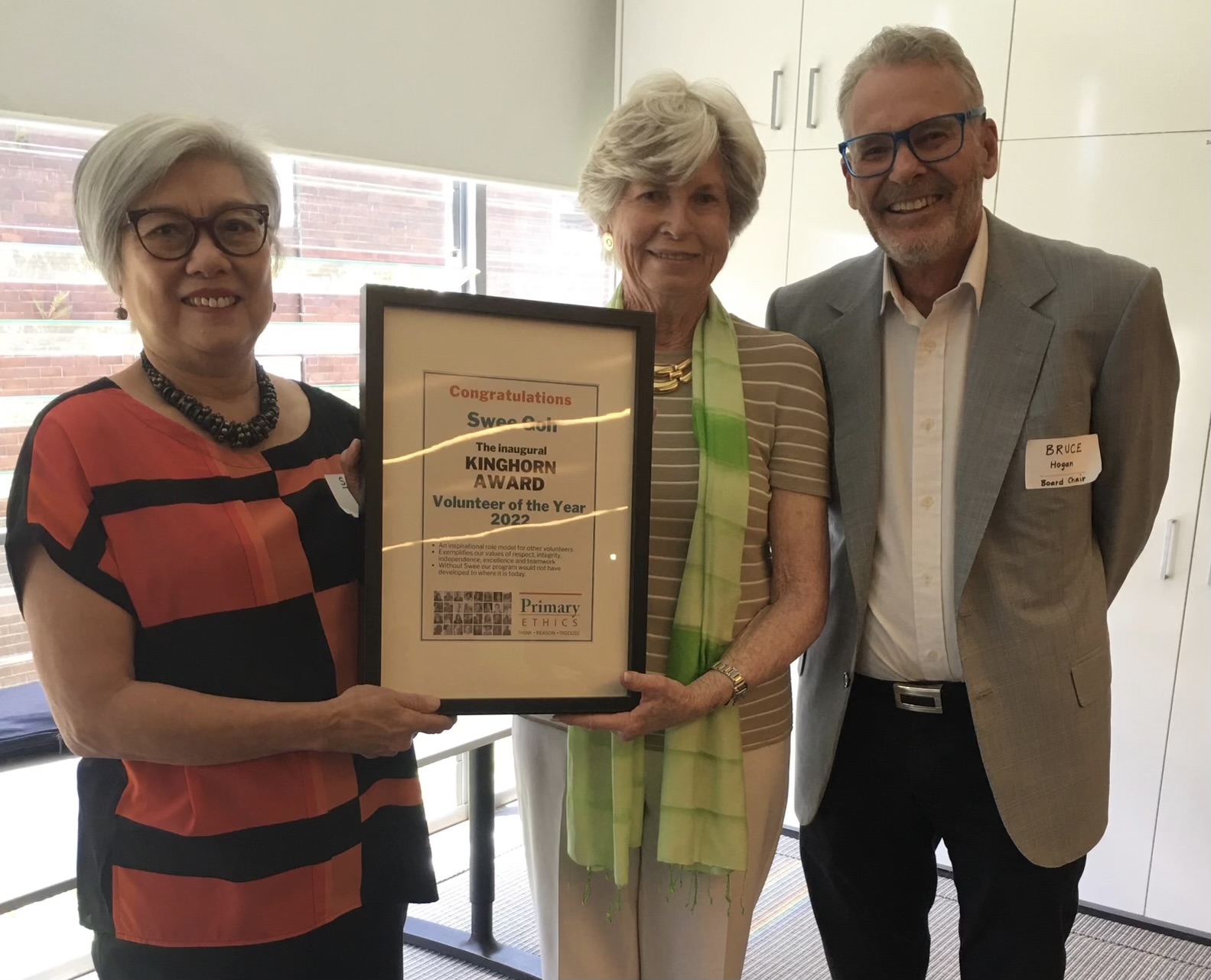
Swee Goh, Jill Kinghorn and Bruce Hogan.

Swee Goh is the inaugural winner of the Kinghorn Award for ethics volunteers. Swee is the manager for the ethics program Ryde region in inner northwest Sydney.

Swee was presented with her framed certificate in our office by Bruce Hogan, Chair of the Primary Ethics Board, and Jill Kinghorn, one of our chief supporters.

Swee also wins $4000 to direct to the schools of her choice. Some of that money is going to a very supportive school in her Ryde region, Smalls Road Public School (see page 5). She also wanted to give to a school that had been badly affected by floods – Mullumbimby Public School (see page 2) in the northern rivers.

This school was closed for several months while they waited for flood waters to recede and basic repairs to be made. Children were allocated to attend nearby schools. Obviously, there was no ethics program at all in 2022, though we are hoping it is able to restart in 2023.

Warm thanks go to Swee for nominating a school outside her region to receive prize money. We’re very impressed that she chose to assist students in a flood-affected area. Not just ethics students, but all students at the school will benefit. This is why Swee deserves to win the Kinghorn Award – to be recognised and valued for the wonderful work she does as an ethics volunteer and to acknowledge the amazing person she is!

“If I had to pick one person to start Primary Ethics from scratch tomorrow, Swee would be the first volunteer I would contact” – Primary Ethics staff member

Swee has built and maintained an outstanding ethics program in the Ryde region. She has recruited volunteers tirelessly to build the program to where it is today. Due primarily to her efforts, almost every parent in Ryde currently has the option of choosing ethics for their children. Swee is currently responsible for ethics programs in 12 schools. She regularly teaches at three schools and has taught at all others in the region. She manages 11 coordinators and 62 teachers supplying 64 classes, which approximates to more than 1000 students receiving ethics lessons on her watch each week. 

Swee Goh

Q+A with Swee

What motivates you to volunteer?

I find being an ethics volunteer extremely satisfying as I am working with fellow volunteers and a supportive and professional organisation. They all share the same interest, passion and commitment to bringing ethics education to children in primary schools. They are doing it because they want to!

Working as a relief ethics teacher in a number of schools in the Ryde region over the years has given me the opportunity to teach children from Kindergarten to Year 6. This has given me a deep appreciation for how they interact at different ages and how age-appropriate our ethics curriculum is. Across all primary ages, ethics classes provide a safe and friendly environment for students to express themselves, as there are no right or wrong answers. I very much enjoy teaching ethics because the children are encouraged to think freely and reason critically in expressing their opinions and ideas and to disagree respectfully, not just take what others say for granted. Engaging children this way in lively class discussions keeps me coming back for more!

What drew you to ethics volunteering?

I was looking for something to do after my retirement as a state operations manager in the Department of Education, where my responsibilities involved the regulatory compliance and assessment of early childhood education services in NSW. My earliest career role was an early childhood teacher, before I joined the NSW public service and diversified into areas of policy, child protection early intervention, funding and project management and regulatory compliance. Volunteering with Primary Ethics drew me back to my first role as a teacher and my experience as a manager. The big difference is working with people who want to do what they do and not because they are paid to do it!

What’s your response to winning the Kinghorn Award?

I am very humbled and honoured to receive this award as I know there are many other worthy nominees. I accept this award on behalf of all the Ryde region volunteers, especially the coordinators, as without their support and contribution I would not be able to do my job.

Thank you to the all Primary Ethics staff who are always there to help, support and guide me and answer my many questions, sometimes many times!

‘We need to do better for our children’s future’
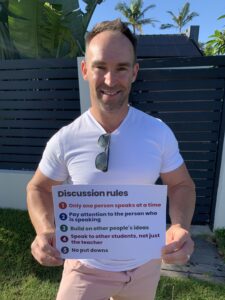
Shane Arthurson with the ethics discussion rules

My first class of ethics for the year takes place this week. Reading the rules before this first lesson reminded me of some thoughts I had last year when I was visiting Parliament in Canberra.

By Shane Arthurson

I’m a volunteer ethics teacher at a school on Sydney’s northern beaches. My daughter is in Year 1 and I teach her class.

I am very proud and very happy to teach ethics. It’s a beautiful program tackling ethical dilemmas and teaching the children to stay curious and respectful as we debate, reason and talk to others about complex issues. It is right that we teach our young children ethics and with discussion rules such as these.

As a sad observation though, I was in Canberra last year with my wife who was part of a group petitioning for increased parental leave. Inside the Parliament, I couldn’t help but notice that question time violated all our ethics rules in the first few seconds. It was a horrific display of heckling, put downs, talking over one another… There was no orderly debate and no intelligent discussion about the matter, nor any progress or resolve.

Furthermore, I looked up and saw school children observing the leaders of our country behaving in such a manner. It didn’t shock me but it did disappoint me.

The leaders of our country are role models for our children, amongst other things, we need them to do better and to demonstrate behaviour we would be proud to see in our children. If we want a better society we have to act better. These children are tomorrow’s leaders and decision makers.

This behaviour does not add to social progress and actually takes us backwards.

All the more motivation for me to keep teaching ethics!

Ethics @Home bulletin for parents Term 1 2023

Our @Home bulletin aims to let you know what your children are discussing in their ethics lessons this term. We hope they’re talking about it with you at home too!

Subscribe here to our @Home email bulletin.

Schools can take weeks to get organised and start their ethics programs for the year, so some won’t have commenced yet. However, we expect all schools which have enough volunteers to provide ethics to be underway by mid-March. Please contact us if you have any questions about your child and ethics.

Ethics Term 1 2023

Kindergarten: Questions and what is okay 

The first topic of the year introduces students to asking questions. They think about and discuss: Why do we ask questions? Why might someone feel reluctant to ask questions? Is it okay to say that someone’s answer is silly or bad?

Later in the year, kindy students will consider topics on sharing, including others and causing harm without meaning to.

Stage 1 – Years 1 & 2: Empathy
The first topic of the year invites students to consider the importance of empathy. Students think about and discuss: Is it important to reflect on how others are feeling? How do you work out how someone else might be feeling? And is it possible to imagine how someone else feels if you’ve never been in a similar situation?

Later in the year, Stage 1 students will consider whether being fair means giving everyone an equal share and whether it’s okay to treat people differently because they are your friends.

Stage 2 – Years 3 & 4: Being greedy 
The first topic of the year invites students to consider being greedy. Students think about and discuss: What does it mean to be greedy? Is there anything wrong with wanting more money or toys than you can use? Is it okay to want to be the richest person in the world?

Later in the year, Stage 2 students will consider whether lying is always wrong and whether it’s okay for advertisers to use tricks to persuade people to buy their products.

Stage 3 – Years 5 & 6: Voting 
The first topic of the year invites students to consider voting. Students think about and discuss: Is it okay to vote for someone just because they’re your friend? How should we balance self-interest and the needs of others when choosing who to vote for? For example, is it okay to vote for someone whose policies would benefit me but are not in the best interests of everyone? Should voting be compulsory or voluntary?

Later in the year, Stage 3 students will consider whether punishment is necessary to stop people from doing wrong and whether it’s okay to be vain.

Stage 4 – Years 7 & 8: You’re not the boss of me 
The first topic of the year invites students to consider how much control they should have over their own lives. Students think about and discuss: What right do parents, adults and governments have to limit teenagers’ freedoms? Why do we have age limits in Australia? And is it okay to stop people from doing things because they might get hurt?

Later in the year, Stage 4 students will consider whether hoarding food and medical supplies is wrong and what makes a good apology.

Primary Ethics discussion rules

This year, the six ethics class rules have been replaced by five discussion rules. In this short video, trainer, ethics teacher and curriculum author Kelby Mason talks us through those rules.

First some important context: these discussion rules are for stages 1, 2 and 3 (which is Years 1- 6). They aren’t for Kindy or secondary students (who have separate rules and guidelines).

Why have we updated the rules?

  1. We now call them discussion rules as they are primarily a roadmap for the type of discussion we want to see in all ethics lessons. This name will help students see how they’re different to the school rules and any classroom behaviour rules you might have.
  2. We’ve reduced them to five to help students focus on what’s most important.
  3. We’ve clarified the language to make it as meaningful as possible to today’s children.

The rules are displayed in every class and referred to regularly throughout the lesson.Why’s that?The rules are our important grounding tool and roadmap for helping create a genuine community of inquiry.

When teachers notice a student – or the entire class – veering off course, they can point their attention to the relevant rule and remind them to follow it. If necessary at any point, teachers can start a discussion about a particular rule and our reasons for following it.

What are the ethics discussion rules?

  1.  Only one person speaks at a time.
  2.  Pay attention to the person who is speaking.
  3.  Build on other people’s ideas.
  4.  Speak to other students, not just to the teacher.
  5.  No put downs.

Read more about how ethics classes work.