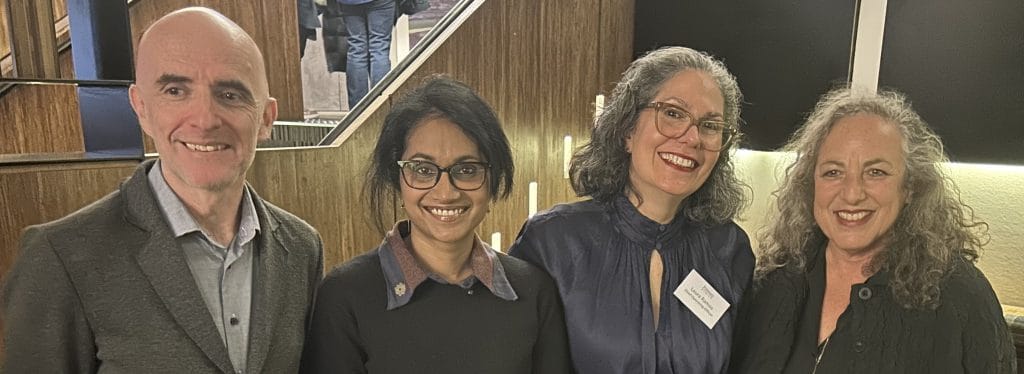
On Thursday 27 August, as part of the Festival of Dangerous Ideas, Primary Ethics held a special screening of the 1995 documentary, Hatred at the Dendy cinema in Newtown, followed by a panel discussion with the director Mitzi Goldman, author Shankari Chandran and Kelby Mason, our philosopher in residence.
We knew that some of the issues raised by the film could be challenging, but that they would give us a moment to reflect on the importance of maintaining respectful and constructive dialogue – especially when we come across ideas that we find difficult and where we’re likely to encounter disagreement. Those are the skills that Primary Ethics volunteers are building in over 2000 classes throughout the school year.
Our panel
Dr Mitzi Goldman, the director of Hatred, is now CEO of Documentary Australia. Shankari Chandran is a Miles-Franklin-Award-winning author, a lawyer and former ethics teacher. Kelby Mason, our philosopher in residence, is also a lead ethics curriculum writer and trainer.
The film
Hatred is an award-winning Australian documentary – a personal journey that asks big social questions about identity and prejudice in the modern world. What makes us who we are and how easy is it to hate? This is a question for us all as we are tested with personal identity, the right to free speech and the incitement to hate on the basis of skin colour, ethnicity, religion and ideology.
In a multicultural society, how do you discuss hatred in classrooms which may contain students who have fled ethnic violence or persecution for any number of reasons? How do you introduce the topic to students who may come from ethnic, cultural or religious groups with strongly opposed views? How do you deal with the self-hatred which comes from internalising the prejudice of others? Director Mitzi Goldman confronts hatred, exploring it in a range of places and then turns her questions to herself. We are all accountable for our own thoughts and behaviours.
The film documents various kinds of hatred and their consequences, beginning with the hatred that led to the filmmaker’s German-Jewish father fleeing the Nazi Holocaust. This led to exploring hatred in the lives of the poor and people of colour in New York and then to the complex clash of identity, religion, history and ideology between the Israelis and the Palestinians.
Some of the issues arising from the film:
- Is it ever okay to hate? It’s a word now used frequently, especially online; the relationship between hatred and violence; the philosophical context.
- Dialogue vs silence: learning to converse despite grief and rage; what’s the impact for future generations?
- Persisting with brave and difficult conversations: making space for speaking and listening after trauma; truth-seeking and justice; when is the right time to tell the truth?
- Identity, nationalism, belonging: connections between culture, community, nationalism and exclusion
- Race v gender-based violence: would the latter feature more if the film were made today?
- Hope and personal action: Is there shared responsibility to challenge hatred and continue these difficult conversations?
The discussion
The discussion kicked off with Kelby’s question about whether anything has changed in the 30 years since this film was made. Mitzi responded that hatred was not a topic that could be discussed openly 30 years ago. She remembers being told when she was young that she couldn’t use that word – instead told that she could ‘dislike intensely’. She also thought it might be impossible to do the documentary in the same way now.
Is it ever okay to hate? Shankari thought that if we encounter this in ourselves, we can’t deny or pretend it’s not happening. Hatred is part of the human experience. It’s what you do with it that is important, how you manage it. Shankari also reflected on Sri Lanka’s experience with civil war, brutality and hatred that remains to this day. She reiterated that it’s so important what we do with our experience and what we teach our children – which is why ethics education is invaluable.
Both panellists reflected on how online media has changed how we perceive hatred. “The landscape has changed. We are becoming passive recipients of information.” They lamented a lack of curiosity and critical thinking.
Kelby put in: “If only there were a program that could help young people with this!”
The panellists concurred that it’s so important to give young people permission to face difficult topics, to have space to think through things that challenge them and to remember to face into those difficult topics. And to listen.
Shankari and Mitzi both reflected on the importance of having the courage to engage with others with whom we disagree. Shankari added that we also need to:
- think about what it is others are saying
- consider why they might be saying this; and also
- connect that with how we might be feeling about this subject.
Mitzi chimed in: When we practice this, we can tap into a sense of compassion. Shankari agreed that listening critically and with curiosity and compassion can help us regulate our own emotions – something it’s very important for children to learn. Applying critical thinking also helps us to know and think strategically about when is the right time to speak up and when it’s better to listen.
As the panel drew to a close, Mitzi and Shankari commented on what gives them hope – and for Mitzi, having this film screened and discussed was in itself a point of hope.
Finally, Shankari raised the importance of ‘communication 101’ – let’s keep speaking, speaking up, listening and telling our stories.