Category: Parents

@Home bulletin Term 4 2023

Our @Home bulletin lets you know what your children are discussing in ethics. These topics are certainly relevant to us as adults too. We hope the students talk about ethics with you at home – ask them about it! We’d love to hear of any good discussions you have.

The topics we show you below are based on classes which began at the beginning of the year. Please bear in mind that the further we advance into the year, the less likely these topics will be accurate for your child’s class. Classes started at different times (depending on when there were enough volunteers), some lessons go much slower than others, some schools skip ethics for the first and last weeks of the term and so on.

If your child tells you they are discussing a topic you don’t see in this bulletin, you can also look at the Curriculum section of our website to find it.

Here’s a brief look at what your children could be exploring in their ethics lessons this term. 

Kindergarten: Owning up
In Term 4, kindy students will explore the ethics of owning up and telling the truth. They’ll talk about whether it’s okay to not speak up and admit when we’ve made a mistake and whether we miss opportunities to learn when we don’t own up.
Later in the term, they’ll reflect on two different ways we can work out if something’s true – by using our senses and by thinking.

Stage 1 – Years 1 & 2: Being kind
Our Stage 1 students will explore some big questions about kindness. They’ll consider whether helping someone because you hope to be rewarded or because you’ve been told to counts as being kind.

Stage 2 – Years 3 & 4: Cheating 
In Term 4, our Stage 2 students will delve into the ethics of cheating. They’ll discuss what counts as cheating and whether cheating is always wrong. As part of this, they’ll consider whether it’s possible to cheat in a one-player game and whether it’s okay to cheat if the other team is cheating.
Later in the term, they’ll explore questions about friendships.

Stage 3 – Years 5 & 6: Why should we trust science? 
Our Stage 3 students will explore some big questions about trust in science. They’ll talk about whether our beliefs matter and whether we have a responsibility to stay well-informed of the science when making big decisions.
Later in the term, students will consider what it means to treat someone fairly.

Stage 4 – Years 7 & 8: Yuck! The ethics of disgust 
In Term 4, our Stage 4 students will ponder how emotions can influence decision-making and whether disgust is a reliable indicator of something being morally bad. They’ll also talk about whether emotions get in the way of making good decisions – or whether they help us make good decisions.
Later in the term, they’ll discuss whether it’s ever okay to put a monetary value on human life.

@Home bulletin July 2023

Welcome to term 3 of ethics – we’re into the second half of the year already! And we still have new schools and new classes joining our ethics education program, so welcome to all the new parents.

Our @Home bulletin lets you know what your children are discussing in ethics. We hope they talk about it with you at home too – ask them about it!

Subscribe here to our @Home email bulletin.

The topics we show you below are based on classes which began at the beginning of the year. Please bear in mind that the further we advance into the year, the less likely these topics will be accurate for your child’s class. Classes started at different times (depending on when there were enough volunteers), some lessons go much slower than others, some schools skip ethics for the first and last weeks of the term and so on.

If your child tells you they are discussing a topic you don’t see in this bulletin, you can also look at the Curriculum section of our website to find it.

Ethics Term 3

Here’s a brief look at what your children could be exploring in their ethics lessons this term. 

Kindergarten: Disagreeing
In Term 3, students in kindergarten will explore the ethics of disagreeing with others. They’ll talk about whether it’s okay to tell someone they’re wrong (and when it’s important to speak up). They’ll also think about the best ways to express disagreement constructively and kindly.
Later in the year, they’ll tackle topics like owning up and being truthful.

Stage 1 – Years 1 & 2: Is it important to understand the rules?
In Term 3, our Stage 1 students will explore some big questions about following the rules. They’ll talk about why following rules can be tough and whether it helps to understand the reasons behind them. They’ll also think about whether people who set rules have a responsibility to explain them.
Later in the year, students will consider questions about stereotyping and being good friends.

Stage 2 – Years 3 & 4: Intentions
In Term 3, our Stage 2 students will delve into the importance of intentions. We’ll encourage them to ponder how much our intentions matter. For example, when someone tries to do good but accidentally causes harm, should we focus on their good intentions or the unintended consequences? Similarly, if someone accidentally does something good, should we praise them for it?
Later in the year, they’ll explore questions related to beauty.

Stage 3 – Years 5 & 6: Stealing
In Term 3, our Stage 3 students will explore the ethics of stealing. They will talk about what sorts of actions count as stealing. For example, is it stealing to watch a fireworks display from afar without paying? They’ll also think about what, if anything, makes stealing wrong.
Later in the year, students will consider what responsibility society and individuals have to do something about homelessness.

Stage 4 – Years 7 & 8: Does it matter if everyone disagrees with you?
In Term 3, our Stage 4 students will ponder the nature of disagreement. They’ll discuss whether our opinions on matters like taste in food or movies can be objectively wrong. They’ll also reflect on whether discovering that lots of people disagree with us should that make us less confident in our position.
Later in the year, they’ll delve into how emotions can influence our decision-making.

Jane Hunter: Putting my values into practice as an ethics teacher

Jane Hunter is the Global Head of Digital Marketing for SFI Health – she’s also a volunteer ethics teacher. One of Jane’s workplace values is to progress human quality of life. She wrote this blog post describing how being an ethics volunteer chimes with that value.

Why is this core value important to you?
I think if we can improve the quality of people’s lives, bit by bit we can make the world a better place. There are so many ways we can do this, from donating blood to volunteering at a soup kitchen to helping kids to think and reason clearly. I think big picture, if people’s quality of life improves, humanity as a whole improves.

Building this value into our work culture is a smart move because it connects with so many.

What types of things do you do to progress human quality of life?
Outside of work, I volunteer with an organisation called Primary Ethics as a primary school ethics teacher for an hour a week and it’s one of the highlights of my week.

The lessons involve introducing complex ideas through storytelling around topics such as ‘Is lying wrong?’. We delve into sticky topics like this asking the kids to consider questions like ‘is it ever ok to tell a lie? Is withholding information the same as lying? Is it ok to tell a small lie to protect someone from feeling hurt?’ I guess it’s all about encouraging and developing skills in critical thinking.

I’m amazed at the capacity of eight and nine-year-olds to grab onto these very human conundrums and discuss them. I encourage the kids to think before answering, then to provide a reason for their point of view. I then open it up to others in the class who might have a differing view.

We also follow a set of rules for having healthy conversations, which I think are powerful skills to have all through life. These include building on each other’s ideas, showing respect for different ideas, tackling the ideas but not the individual, learning how to take turns at listening and contributing.

What type of impact do you think you’re having?
I hope I’m giving kids the opportunity to think about important issues, to build confidence in expressing themselves in a safe constructive environment and the skill to disagree respectfully.

It’s also a chance for the children to change gears and take a break from a world which can be very black and white.

The personal connections and circle we sit in encourage face-to-face conversations.

I think discussing these topics also gives the kids a chance to build interpersonal communication skills. I hope they learn it’s possible to be respectful when someone has a different point of view and that they model that kind of behaviour in the playground and later, online.

I was chuffed when an eight-year-old boy, who is normally quiet, walked with me as we left the class for a further conversation about the topic of ‘greed’. He was so engaged, he nearly missed his recess! It was a good feeling to see him thinking deeply about this and that the impact of the discussion might resonate beyond the classroom.

My daughter who is in the class keeps me well-grounded with lots of unsolicited feedback at home too.

Are the skills transferable to your workplace?
Absolutely. Teaching ethics and opening up the conversation to many viewpoints reminds me of the importance of keeping an open mind. This is critical in any global role because each day I interact with colleagues from different cultures, market conditions, life experience and personalities.

In the classroom, there is a good chance there are kids who are neurodiverse, just as there are sure to be neurodiverse people in any workplace. Improving human quality of life also extends to our colleagues through our considered interactions.

Teaching ethics has also honed my skills in facilitation and being agile. There’s no end to the tangents an ethics discussion with eight-year-olds can lead to or the general unpredictability of kids to keep you sharp! Having additional practice to think on your feet and find solutions on the go, even when things don’t go to plan, definitely has parallels to my work.

How does this relate to SFI Health’s culture and In Tune with You?
My first thought is that the business is in tune with me because teaching ethics is important to me.

I truly believe in the value of teaching ethics and knowing SFI Health was going to support me in doing this was really important to me. I think it’s impressive for a company to allow me time and space to do this, it makes a difference to me as an employee and how I feel about and engage with the company.

Focusing on this value I think demonstrates SFI Health is not only in tune with me, but with the greater good.

Ethics @Home bulletin for parents Term 2 2023

Our @Home bulletin for parents aims to let you know what your children are discussing in their ethics lessons this term. We hope they’re talking about it with you at home too!

Bear in mind that schools start their ethics programs at different times of the year, basically when they have enough volunteer teachers. The topics we show you below are based on classes which began at the beginning of the year. If your child’s class only commenced this term, you can also take a look at the Curriculum section of our website to see what they’ll be discussing.

Please contact us if you have any questions about your child and ethics.

Here’s a brief look at what your children could be exploring in their ethics lessons this term. 

Kindergarten: Doing harm without meaning to  
This kindergarten topic explores the ethics of accidentally hurting someone. Students think about and discuss: is it worse to do something bad on purpose or by accident? Should we be punished for harm we cause by accident? Does it matter if it was the result of carelessness or thoughtlessness?
Later in the year, students will consider questions about making things up and showing off.

Stage 1 – Years 1 & 2: When is it fair?  
This Stage 1 topic explores the concept of fairness. Students think about and discuss: How can we divide things fairly? Does being fair mean everyone gets an equal share? When you make something, should you still share it with someone who didn’t help?
Later in the year, students will consider how we should treat pet animals.

Stage 2 – Years 3 & 4: Persuading 

This Stage 2 topic explores the ethics of persuasion. Students think about and discuss: Is it okay to exaggerate or only share part of the truth when trying to persuade someone? And is it fair for advertisers to use tricks to persuade people to buy their products?
Later in the year, students will consider the ethics of getting even – does one bad turn deserve another?

Stage 3 – Years 5 & 6: Being vain 

This Stage 3 topic explores the ethics of wanting to be better than others. Students think about and discuss: is it okay to want to look good and to want to look better than other people? How can one person’s vanity impact on the wellbeing of others? And how do you draw the line between reasonable and excessive concern for how we appear to others?
Later in the year, students will consider how to balance the needs of people they know and strangers in need.

Stage 4 – Years 7 & 8: Giving and accepting apologies 

This Stage 4 topic explores the ethics of apologising. Students think about and discuss: What makes something a good apology? Do you have to accept a good apology? And is it ever important for a group (like a class of students) to collectively apologise for the actions of one of its members?
Later in the year, students will consider if being happy is all that matters in life.

‘I’m a Primary Ethics teacher’: Emily’s MamaMia story
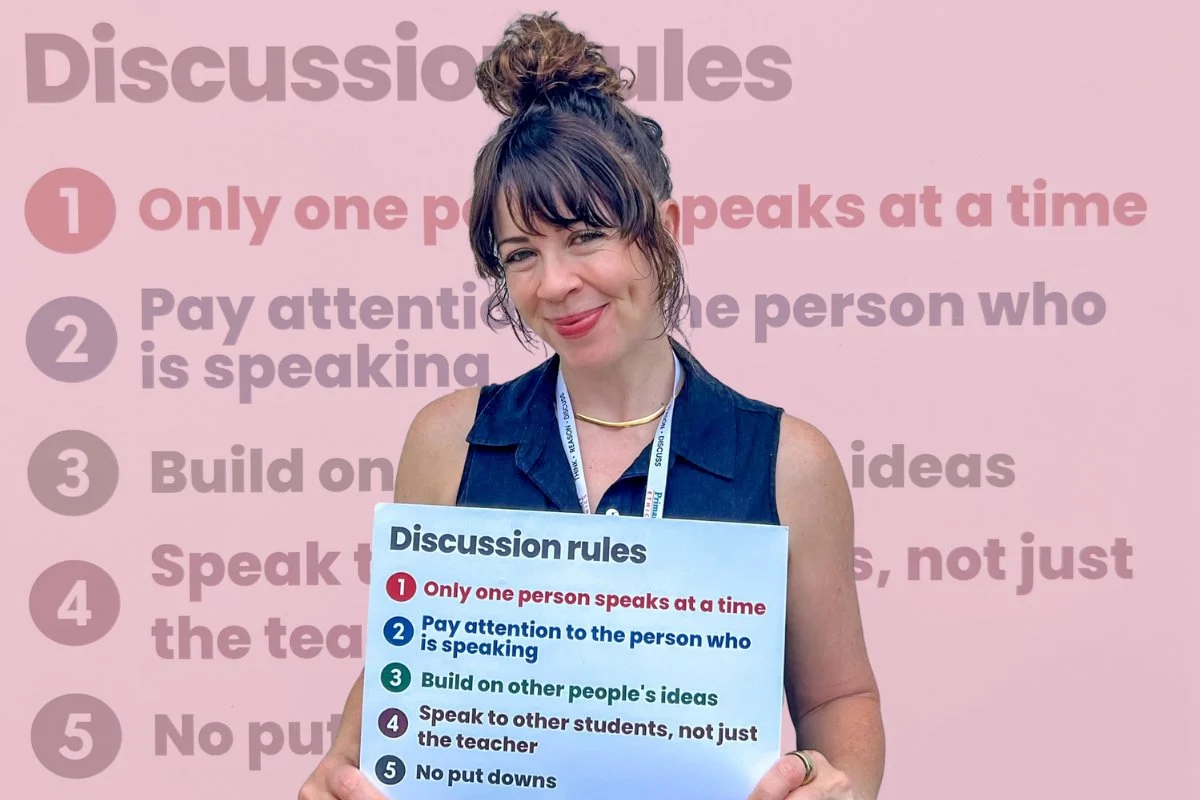
Emily McGrorey with the Primary Ethics discussion rules.

Newcastle ethics teacher Emily McGrorey has written about her journey to become an ethics teacher for the MamaMia website.

“[My daughter’s] teacher explained there weren’t any ethics classes running in her year level because they needed someone to volunteer to teach them. It was at that point that I thought, well, I’m someone.”

“To be honest though, I was quite nervous about the prospect of teaching. Until I had my own kids, I had very little experience with children and heading into a classroom to be the actual teacher all seemed a bit daunting. What if I couldn’t control the children and they revolted against me like some kind of chaotic scene from Matilda?”

Emily began teaching ethics during the lockdown year of 2021, so it was an on-again, off-again venture. She finally taught for a full year in 2022 – “and I’m pleased to report that the children haven’t staged a coup against me, yet.”

Read Emily’s full account, ‘I’m a primary ethics teacher. Here are the 5 biggest things it teaches kids.’

‘We need to do better for our children’s future’
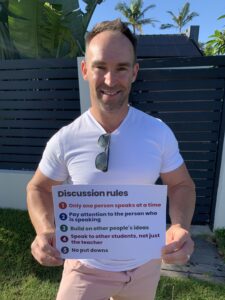
Shane Arthurson with the ethics discussion rules

My first class of ethics for the year takes place this week. Reading the rules before this first lesson reminded me of some thoughts I had last year when I was visiting Parliament in Canberra.

By Shane Arthurson

I’m a volunteer ethics teacher at a school on Sydney’s northern beaches. My daughter is in Year 1 and I teach her class.

I am very proud and very happy to teach ethics. It’s a beautiful program tackling ethical dilemmas and teaching the children to stay curious and respectful as we debate, reason and talk to others about complex issues. It is right that we teach our young children ethics and with discussion rules such as these.

As a sad observation though, I was in Canberra last year with my wife who was part of a group petitioning for increased parental leave. Inside the Parliament, I couldn’t help but notice that question time violated all our ethics rules in the first few seconds. It was a horrific display of heckling, put downs, talking over one another… There was no orderly debate and no intelligent discussion about the matter, nor any progress or resolve.

Furthermore, I looked up and saw school children observing the leaders of our country behaving in such a manner. It didn’t shock me but it did disappoint me.

The leaders of our country are role models for our children, amongst other things, we need them to do better and to demonstrate behaviour we would be proud to see in our children. If we want a better society we have to act better. These children are tomorrow’s leaders and decision makers.

This behaviour does not add to social progress and actually takes us backwards.

All the more motivation for me to keep teaching ethics!

Ethics @Home bulletin for parents Term 1 2023

Our @Home bulletin aims to let you know what your children are discussing in their ethics lessons this term. We hope they’re talking about it with you at home too!

Subscribe here to our @Home email bulletin.

Schools can take weeks to get organised and start their ethics programs for the year, so some won’t have commenced yet. However, we expect all schools which have enough volunteers to provide ethics to be underway by mid-March. Please contact us if you have any questions about your child and ethics.

Ethics Term 1 2023

Kindergarten: Questions and what is okay 

The first topic of the year introduces students to asking questions. They think about and discuss: Why do we ask questions? Why might someone feel reluctant to ask questions? Is it okay to say that someone’s answer is silly or bad?

Later in the year, kindy students will consider topics on sharing, including others and causing harm without meaning to.

Stage 1 – Years 1 & 2: Empathy
The first topic of the year invites students to consider the importance of empathy. Students think about and discuss: Is it important to reflect on how others are feeling? How do you work out how someone else might be feeling? And is it possible to imagine how someone else feels if you’ve never been in a similar situation?

Later in the year, Stage 1 students will consider whether being fair means giving everyone an equal share and whether it’s okay to treat people differently because they are your friends.

Stage 2 – Years 3 & 4: Being greedy 
The first topic of the year invites students to consider being greedy. Students think about and discuss: What does it mean to be greedy? Is there anything wrong with wanting more money or toys than you can use? Is it okay to want to be the richest person in the world?

Later in the year, Stage 2 students will consider whether lying is always wrong and whether it’s okay for advertisers to use tricks to persuade people to buy their products.

Stage 3 – Years 5 & 6: Voting 
The first topic of the year invites students to consider voting. Students think about and discuss: Is it okay to vote for someone just because they’re your friend? How should we balance self-interest and the needs of others when choosing who to vote for? For example, is it okay to vote for someone whose policies would benefit me but are not in the best interests of everyone? Should voting be compulsory or voluntary?

Later in the year, Stage 3 students will consider whether punishment is necessary to stop people from doing wrong and whether it’s okay to be vain.

Stage 4 – Years 7 & 8: You’re not the boss of me 
The first topic of the year invites students to consider how much control they should have over their own lives. Students think about and discuss: What right do parents, adults and governments have to limit teenagers’ freedoms? Why do we have age limits in Australia? And is it okay to stop people from doing things because they might get hurt?

Later in the year, Stage 4 students will consider whether hoarding food and medical supplies is wrong and what makes a good apology.

‘Bump’ does ethics

A number of Primary Ethics volunteers and staff noticed during the New Year break that Bump, a popular Australian series which began streaming its third season on Stan on Boxing Day 2022, has incorporated an ethics lesson into its storyline.

So I tuned in.

By Susan Ardill, Communications Manager

Bump is a satirical comedy about two young people from very different families who have a baby together. In season 3, the parents, mother Oly and dad Santi, have separated but continue to co-parent. Their daughter is now in kindy at school and Oly is unhappy to discover she is being sent to scripture under the influence of Santi’s family. So when she bumps into another mother who is about to teach ethics, Oly asks if she can sit in and watch.

The Bump ethics lesson is situated firmly in comedic territory and serves the purpose of the episode’s overarching storyline, to highlight the differences in parenting style and family culture between Oly and Santi. The ethics volunteer is immediately set up as a ditzy caricature, confessing to being badly hungover and then not knowing how to respond when the children raise some difficult questions. So Oly responds to them instead – and in doing so, Oly (who does indeed become an ethics volunteer in a later episode) comes to some of her own realisations.

The appeal of the series, which bills itself as a comedy-drama, is in the way it addresses contemporary social life in Sydney, but with tongue in cheek.

Oly, on right, is unsure about the ethics teacher's approach.

Indeed, this scene held my attention – and not just because I’m an ethics volunteer.

Yet I am an ethics volunteer (and Primary Ethics staff member), so I immediately noticed what was unrealistic about this scene, as did everyone who mentioned it to us.

Unreal!

  • The unreality begins with Oly inviting herself along to the lesson! Our volunteers are all fully screened, trained and authorised by Primary Ethics, which is the sole approved provider to the Department of Education to teach ethics in schools. No other parent can come along on the spur of the moment – and then contribute to the lesson!
  • In a real ethics lesson, the teacher isn’t at the front of the class and the children don’t sit in rows. Instead, the children and teacher sit in a circle and build a community of inquiry together. Everyone can see everyone else and this helps with paying attention to whoever is speaking.
  • Teachers don’t ad lib or give their own answers to questions, as both the parents do in this scene. Our lessons – not just the stories that are told, but the questions that are asked – are fully scripted. When children ask questions in a real ethics lesson, they aren’t answered by the teacher, who keeps their views to themselves. Instead, the students are guided with further questions to respond to each other, build on each other’s ideas and answer each other’s questions. Of course, Bump is a tv show, so when the flummoxed teacher turns to Oly and lets her respond to the children, it’s a plot hook, but it’s important to state that this would never happen in a real ethics class.
  • One of the Primary Ethics discussion rules is ‘no putdowns’. When one of the children in this scene says to another “You’re an idiot”, the hapless teacher weakly says “Respectful discussion” – and nothing more. Ethics teachers are trained to manage situations exactly like this and have robust class management strategies to help students discuss and disagree respectfully. We also have a Classroom Support Team to help our volunteers with managing just this kind of classroom retort.
Oly sits in on the ethics class

I like Bump and found this episode as a whole amusing. It’s good to see an Australian series which seems true to life for contemporary families – even though, as I’ve outlined, it’s not at all true to life when it comes to the Primary Ethics program in schools. I wouldn’t want parents – either those whose children already attend ethics or those who are contemplating choosing the ethics option – to come away from this episode with the impression that ethics lessons are really like this.

I hope it’s clear to the audience that in this scene, the emphasis is very much on entertainment.

To see a real ethics class in action, take a look here: https://primaryethics.com.au/about-ethics-classes/

By Susan Ardill, Primary Ethics Communications Manager

Kate’s story: Providing life skills to our children
Kate Sawtschuk
Kate Sawtschuk

Kate Sawtschuk writes: When I decided to volunteer to be an ethics teacher at our school almost four years ago, I received a serious and foreboding warning from my then eight-year-old daughter: “Teaching kids is tough.” Luckily, I was not discouraged!

Since then, I have taught ethics classes across all ages at Denistone East Public School and am now the ethics coordinator. I could never have imagined how much I would learn and how many rewarding moments it would bring.

Previously, when I had seen Ethics listed on our school Scripture form, I thought it sounded like a class that taught kids about what was right and wrong and what they should think. When a friend of mine became an ethics teacher and actually described it, I found out this could not be further from the truth!

Ethics classes give children a chance to practise skills like taking turns to speak, listening carefully to other students and forming and expressing their own ideas. Lessons are designed to enhance critical thinking and ethical reasoning skills, helping children make decisions based on logic and evidence rather than out of habit or due to peer pressure.

Upon first hearing this, I had two thoughts. The first: I want my own kids to be in ethics classes! The second: I wonder if I could become a volunteer ethics teacher and be involved in teaching them and other kids? I felt it would be the perfect way for me to contribute to the school community, given my limited availability, and would also allow me to become more engaged in the education my children are experiencing.

I enjoy teaching ethics because I find the topics fascinating; the lesson materials really make me think (as well as the children). Over the years, topics I’ve taught include empathy, fairness, being similar and different, good reasons, voting, punishment and vanity. It is incredible to be in a role where I can be around children and hear what they think. Their insights and thought processes can be impressive, surprising and often hilarious!

For example, this year my Stage 3 class began considering the concept of a fair society. They thought critically about discrimination, equality of opportunity and the moral responsibilities of society. There was a lot of lively discussion and many moments when their depth of understanding and innate compassion made me feel very reassured that the future is in their hands.

My Stage 1 class have looked at the concept of pride: what it means, when it is okay and if we can be too proud. They love providing examples to explore the topics and building upon the ideas of their classmates. We have moved on to talk about what makes a good reason and the concept of laziness.

It’s not always easy, as my daughter warned, but I also love the challenge of engaging the kids and encouraging them to think more deeply about certain topics.

The classes provide a safe and friendly environment in which kids can express themselves and question ideas they may just normally take for granted – to think about the reasons they hold certain views or opinions and to listen and build upon the often differing views of their classmates. It’s skills for life, really!

The ethics classes are quite a different experience for kids because there is no right or wrong answer. I think they really enjoy being heard and feeling that what they think is important.

I cannot recommend volunteering to be an ethics teacher highly enough! It’s a fantastic and practical way to not only to contribute to and support the school but to also develop your own skills in facilitation, communication and active listening – and as a bonus, in the process you get to witness the next generation mature in confidence and wisdom. What more could you ask for?

So I encourage those who can to seize the opportunity that is literally a life changing experience for all those involved – parents and kids alike. Kate Sawtschuk